Wednesday, 11 August 2021

The Brotherhood and Unity Highway - Friday 11th August

So, this was our last morning in Belgrade. By 11 am we had to leave, so we packed up in anticipation, but still left time for a bit of breakfast. Alexandar, our host, led us out of the apartment and down to the garage. John was in the driving seat for this initial leg of the journey. A shaft of light filled the dark and cool basement, and soon we were out and onto the cobbled street above. 

John retraced our entry into the city, but this time amongst noticeably more traffic as we passed the Parliament building and descended down towards the motorway. The one advantage the traffic provided was the time to scrutinise some of the old buildings along this governmental boulevard, and guessing their function.

With an unfamiliar road layout, and a version of the Birmingham ‘Spaghetti Junction’ coming up, together we exited the boulevard and veered right onto the downward slip road onto the main east-west motorway, seamlessly merging in. We glided over the Sava River, past the brutalist New Belgrade community, and were waved off by the Western City Gate, or Genex Tower as its also known. However, nerves began to bubble, as I knew that soon I would have to take over the driving.

Soon enough, we pulled into a service station to fill the tank and grab some road snacks. I was now in control of ‘Sandra the Suzuki’. I got my seat right, and mirrors sorted, and then set off back onto the somewhat quieter road. It took some getting used to, but on a straight and easy road I did not find it too challenging. However, the first stop on the way to Zagreb was going to take us off the ‘beaten track’ and north-east towards a quieter border point and beyond, to the town of Vukovar.

I turned off at the sign for Sid, and we now found ourselves travelling along a busy country road passing through small and narrow villages. Having gone north, as we arrived in Sid we turned left and towards the border about 1-mile further west. As we approached the small border post, a grave yard appeared to our right. Despite it being an ominous symbol of the reason why I wanted to visit Vukovar, I found it odd that a graveyard would sit on the border where no village appeared close by.

The Serbian side of the border was swift. When it was our turn to be checked by the border guard on the Croat side, a rather terse woman asked for papers, which I handed over. She barked ‘papers’ once more because, unbeknownst to us, we needed to give her the documents for the car. John shuffled in the glove box and pulled out a green booklet, which I handed over. A flick through aforementioned documents led to their return, and a barrier being raised. The road ahead was ours. 
I recalled that I had passed through this area before, and have the stamps to prove it, as I had crossed the border here some years ago when I travelled by train from Belgrade to Sarajevo. It’s always nice to have a new perspective on a journey when you are retracing your steps. Certainly, going through the border was quicker by car than by train!

The countryside had more contours now, with winding roads dipping up and down agricultural fields and low hills. We came close to the Danube again, swerving away from it once more until we would see it fully again at Vukovar. We were greeted on our arrival by the destroyed water tower in the east of the town. Meandering through some road works, we then found ourselves on a sort of bypass that went around the main high street, both of which were parallel to the river. We located a car park on the opposite side of the bypass to the market, through which we would have to walk to reach the river. We paid our fee and traipsed over. 


The odd person was spotted, doing their shopping or sat out staffing their stalls. It was a humid day, so perhaps people came out later in the day. We reached a sort of quay where a small river cut through the town to reach the Danube. We walked over the modern bridge which had helpful information on. The west part of the town was in geographical Slavonia - a name and place which has existed for many centuries. The east of the town was in the Srem/Srijem. This area stretches all the way to New Belgrade, bordered to the north by the Danube and to the south by the Sava. We crossed over into Srem/Srijem.


Situated here were older buildings, more turn of the century and rather more ornate. But also, the evidence was there that they were also recently refurbished. It’s difficult to imagine the horrors that took place here, little over two decades ago. One of the familiar clips of video, in my mind, is of a bus, window wipers miserably oscillating, driving through this very high street after forces on the Serbian side had ‘taken’ Vukovar. Rubble was strewn everywhere, and no people could be seen. It really captured the overwhelming destruction that took place at the start of the war, on a town that had only recently become a frontier town, as former internal borders overnight became international ones.

We walked briefly up and down the high street, during which John attempted to exchange denars at a shop (unsuccessfully I may add). The buildings were Austro-Hungarian in style, plastered and whitewashed, or pastel coloured, with minimal ornamentation gracing them, such as dark wooden beams. A notable feature were the arched colonnades you walked through in lieu of pavements, which provided much needed shade. We returned to Slavonia and sat in a café, near a fan with water misters, and had a coffee. We then returned to the boiling hot car, to continue our journey.


We needed to re-join the main highway, and did so in a south-westerly direction. The terrain was very much the same, but the roads passed by more villages than through them. The slower journey on these countryside roads allowed us to take in our surroundings. We circumnavigated the ring road around the only urban centre we would see until Zagreb. This was Vinkovci. Similar to any experience you have of circling a town - a junction, an industrial park, a retail park, some houses adjacent to the road, and topped off by my first roundabout!

At one point, we found ourselves descending into the Sava floodplain, but its backdrop, to the south and ahead of us, were the peaks of mountains in northern Bosnia, beyond the river. Their allure reminded me of our time there the previous year, and a hint of sadness crept in with the knowledge that we would not be there again on this trip. As we continued to the motorway, joining it after paying our toll, we were in the lull of the floodplain and our horizons were now fields or forests, the latter acting as barriers to settlements beyond.

Two hours out of Vukovar, and very much in the western part of Slavonia, we departed the motorway once more for a pre-planned stop. Having studied south-east Europe, and continuing to read an array of books on the region, the place we were going to visit had a sinister past, the traces of which were now long gone, and a memorial built in another era to commemorate that past.

It was a quiet country road that led to the outskirts of the village of Jasenovac, with the Sava, and Bosnia & Herzegovina, only a stone’s throw away. The name, notorious amongst a number of communities in the former Yugoslavia, represents the concentration camp that existed here during the time of the Nazi-puppet regime of the Ustasha. That regime took the destructive intent of the Nazis - murdering Jews, Gypsies and Roma, and political opponents - and added to those the local Serb population, who lived in the newly created, and expanded, Croatian state known as the Independent State of Croatia (NDH). The regimes’ intent was to ‘cleanse’ the territory of Serbs to make an ethnically pure Croatia. The Serbs comprised the largest group of detainees and victims.

The place was still as we arrived. Only a couple of cars were parked up, and the collective hum of crickets were the only background noise. We parked in front of a single storey building, a disconnected ‘L’ shape, the void of which had marble slabs with information on the site and the architecture of the nearby point of interest. The small museum was of interest, but only took 20 minutes to pass through. The photos of the camp were the only way for you to comprehend the space in which the horrors took place, in the vicinity of where we stood. 


We returned to the heat and proceeded to walk up a short embankment, which turned out to be a former railway line branch. An old steam train with animal wagons stood idly on the side, as a reminder of the disturbing role it played in the atrocities. The other reason why I wanted to visit here was to see my first, of what I hope to be many, Tito-era ‘Spomenik’.


The embankment kept the river at bay, but created an almost boggy island between it and the road on which we arrived. The only thing dominating this space was the quadruple winged ‘Flower Monument’. Wooden railway line sleepers formed the causeway to it, with two landscaped pools as sites for reflection, and small circle mounds symbolising where the former camp structures lay.


We had the space to ourselves, and it was peaceful to be here. The concrete structure, despite its beauty, encapsulated the brutal nature of the regime that did its evil work here. Bogdan Bogdanovic was the architect, and he went on to create a vast number of these monuments. One commentator noted that the abstract and non-explicit designs avoided explicit references to death, and instead moved into the sphere of how a monument can create feelings in the observer, feelings of the past, present, and future. Here, I think he captured that sentiment perfectly.


We returned to the car once more and made our way back to the motorway. Within 60 minutes we were at the city limits of Zagreb, and the urban sprawl began to suck us in. Despite my reluctance to drive in cities, I had ensured that the route to get to our accommodation was as simple as possible. It was a right fork off the motorway, now named ‘Slavonska Avenija’ and a left towards the Railway station. As we pulled off into a quiet set of low-rise central European style apartment blocks, hidden behind the Lisinski Concert Hall, I recalled the area as this was where I stayed in 2011. We were met by our host and shown around, given the house rules and what we needed to do before departure, then off they went. We gave ourselves some time to recharge our batteries and shower.

It was dark when we left the apartment, and the area behind the railway station was, as I recalled, a quiet and mildly threatening space you didn’t want to spend any time in. So, we aimed straight for the underpass, stopping for a quick snack from a newsagent, and then appeared out on King Tomislav Square. The series of three squares we were about to walk north through formed part of the late 1800s planned reconstruction of the city, and were the right line of a squared letter ‘U’ of green spaces arching through the city, and were surrounded by grand buildings with ornate facades popular at the time. At the third square, a classical music festival was taking place. We savoured it as we slowly passed, but hunger was very much controlling our movements.


We passed through the brightly lit Ban Jelacic Square, and wound around behind it up a bustling lane of cafes and restaurants, and then down a long and narrow street that had single level wooden framed shops, similar to those in the Bascarsija in Sarajevo. There was a lively atmosphere here, with people singing solo or in a duet every so often. John spotted a nice restaurant, where we could sit out and savour the music and warm evening.


Laterna na Dolcu was the name of the restaurant, and we examined the tasteful few options on the menu. We decided to get a bottle of wine too, after all our driving, and so asked the waiter to recommend one for the food we had chosen. He suggested a specific Croatian red, and we obliged. Only after he left did I see the price, and had a mild panic. It was going to be more than the food! John put me at ease, let’s say, and thankfully the wine was both nice and an had the effect of helping me forget its cost. The steak I had with a potato and spinach side was very nice, and we even had pudding. We left satisfied and meandered a little more about the centre of the city. 


A friend of mine from Zagreb recommended going to a small gay club that was near the central square, so John and I headed for there. A glazed door that looked more like the entrance to an office or travel agent was our discreet entrance into this club. We showed our ID and descended to the basement in the now familiar fog of cigarette smoke. It was quiet as we walked in, a couple of patrons on one side and a table of six around a low-level table and sofa. We had some beers and found a spot to perch. We chatted about the day, and often turned towards the door when someone new came in, as that’s how quiet it was. But all of a sudden it had become busy. 

Although we didn’t dance, nor stay too long after it had reached a party atmosphere, someone had spoken to us and, as we got chatting, mentioned that a lot Bosnian’s come here, given that it was the closest friendly city for them with a gay scene. I now noticed an ID card of someone who was getting served at the bar when I was, and this confirmed his observation. Soon after, we called it a night and returned via the green squares, and back to our apartment.

Saturday, 3 April 2021

Familiar Faces - 10th August 2017

We had no prior plans for today, so enjoyed a long lie in and savoured the coolness of the air con. But once up and washed, we agreed upon a walk to the main shopping street in search of brunch.

We returned to Boutique, as we knew the food would be nice despite the tourist mark up. I rather bizarrely complemented a fresh and light mozzarella and tomato dish with a hot and creamy Mocha; perhaps the heat was now seriously getting to me. I enjoyed the contrasted items nonetheless. While utilising the free WiFi, John located a nearby historical landmark to go and visit.

We paid and ducked down a side road from the bustle of the main street. We began a slow decline westward that soon became steeper on its way to the river side. This part of town must have been part of the historic district that grew up outside the walls of the Kalemegdan. Not only was the architecture reflective of that, with its opulence and hint of grandeur, but the roads became more narrow hinting at the old ‘mahala’ spacing of the former Ottoman town it once was. Set back from the street was the former Residence of Princess Ljubica. Built in the tumultuous period when Serbia became a principality, with the Ottoman Empire ceding control, this building resembled Ottoman architecture, but also had neo-Byzantine features, such as the towers or chimneys projecting out of its roof. The white wash walls and terracotta roof made it stand out from the neighbouring buildings especially in its current recessed state, with the sparse front gardens allowing you to absorb the entire building.


We then wondered the shaded side streets on our way to the Federal Parliament building. These political centres always end up as places of familiar retreat for me. Being the political and administrative centre of a country, their embodiment in architecture and location within the city, more often than not act as a draw and loci from which to explore other parts of the city. As we emerged from Makedonska, walking along Decanska and through the narrow buildings that act like city gates, the plaza area opened up before us. To our right was a long, reflective pool with spouting water features. A group of young teenagers were mischievously playing about, though no doubt to cool off than cause trouble.

The Parliament building seemed quiet, as it has done when I’ve visited before. But it also felt accessible with its lack of barriers and guards encircling it. Opposite was the Presidential Offices with a maintained garden bursting with colour, which we meandered around for a while. Intrigued, as we always are, to visit a national parliament building, we crossed over to circumnavigate it to see if there was a more ‘public’ looking entrance. As we went around the back there was a basement part to the building, not so apparent from the front, which was shaded by trees and nearby looming buildings. We couldn’t locate an entrance, and we weren’t keen to investigate, partly because there didn’t seem to be one single guard post to approach to ask and I didn’t want to be surprised lest we be accused of trespass. So instead, we went to admire the adjacent Post Office building again. I am always impressed by its brutal and imposing façade.


We then decided to venture into a part of town not explored up to now, and aimed for the Temple of St Sava, via Slavija Square. This route took us through an area with a familiar name, ‘London’, after a hotel dedicated to the UK capital many years ago. The road we walked along was one of the main boulevards that joined together at Slavija Square. It was a long and hot walk down, and it was bustling with shoppers and people going about their business. There was a myriad of buildings to observe and provoke thoughts on their history, particularly the ones that had inscriptions above their doorways or atop their fronts from their original construction, mainly from the turn of the century over 100 years ago.


Although anticipating a hive of activity at Slavija Square, we actually stumbled upon a vast construction site. Despite being one of the many popularised centre points of the city, we decided to pass through and escape to the last segment of road that led to the cathedral. I think I had tired John out with such a long walk, and the heat was continuing to beat down on us. I noticed a bar that had a parklet in the street, so we stopped for a couple of beers to refresh and recharge.

These went to my head a bit, so we left and visited the grounds of the cathedral briefly before my interest wore off, due mainly to the effort to get there. We were getting hungry now too, so were on the lookout for food as we meandered through a parallel return street that was lined with more villa style buildings, many of them being embassies. As we turned off this quiet street, and right on to a main thoroughfare, we noticed a fully sized takeaway shop of our favourite ‘hole in the wall’ pizza place, Bucko. A pizza each was ordered, again via a variety of short English words and pointing - more for our benefit than the server - and we plonked ourselves on two high chairs outside.


Nearby was the Tasmajdan Park, a sizeable green space deeper in the city, where we could take a break from the sun and casually stroll. Here, there was a more calming hum of traffic, and people were dotted about either under the shade of a tree, or on one of the benches lining the various pathways. We seemed to be perched atop of the city, when all of a sudden we were peering down into a stadium some 40 feet below us on the north side of the park. Keeping to this side, we turned right, away from a domineering church, and down some stairs.


It was here that we saw, looming defiantly, the shell of the bombed-out TV station. This ghost of the 1999 NATO bombing campaign was one of the few reminders in the city of that period. As we walked down the steps from the park to the rear of the building, I noticed a marble memorial. This marked the date of the bombing, likely listing the names of those killed too. We walked down and around the building and saw the TV station logo on top of the still functioning building. I also noted the street name looked somewhat familiar, Aberdareva, and pondered if there was a connection to the town in south Wales. We continued on back to the apartment.


During the day, two of the guys we met the previous year contacted John and said they were in town and suggested we meet up. After we got changed, we ventured over to the same area where we hired the bikes from. Here, in very hipster fashion, was a dilapidated warehouse that had been sparsely decked out inside, with an adjacent outdoor yard with benches and lit up bushes in place of a view of the river. Quirky lampshades hung from above and added to the illicit atmosphere of a bar wanting to be hidden. When we found our guys, one of them explained that this is a cultural centre with a bar, and that they host a variety of groups and events, including weekly drag shows following a showing of Ru Paul’s Drag Race. We had a good catch up with them, with the beers flowing almost at pace with the change in topics of discussion - whether it be Serbian politics or holidays. 


However, we noted that we hadn’t eaten since the pizza, and beer wasn’t a good replacement. It had been over three hours, and one of the pair said their goodbyes, leaving the three of us to a Norwegian couple who somehow joined our group 30 minutes previously. I wasn’t particularly entertained by the new joiners, so we also made our excuses to depart and made the 40-minute walk back to the apartment.

Saturday, 6 February 2021

Cycling to Ada - 9th August 2017

I left John in bed, and decided to get some food for breakfast and some bits for a planned trip to Ada Ciganlija. It was already a warm and still day as I walked from the apartment onto the main thoroughfare. I had noticed a couple of small convenience stores the day before, so I aimed towards those.

One store I happened upon had a series of customers coming and going, and a bit of a buzz about it, with the branding hinting it was part of a chain of stores. I thought I’d rely on the trust of strangers, them having chosen this store in significant, albeit briefly observed, numbers, to venture in myself. 

Easily enough, I gathered grocery items for John and I; Chocolate milk for the hangover, bread and Nutella for the power boost, and picnic items as a motivation that we should go on the planned trip. Upon my return to the apartment, I pulled together selections of cheese and Nutella on toast (though not combined), with coffee to fuel us for the next couple of hours. We sat out on the balcony to eat, which became more of an endurance test than a pleasure. After scoffing our food we returned indoors to the oasis of coolness, got ready then set off from the apartment. 
We followed the previous days route for a period, heading west into the city, passing crumbled facades of modernist architecture. We crossed over the main shopping street, down a pedestrian path to an adjoining main road connected to the Brankov Most, then downward towards the riverside. Here, a shop called iBike was based. Housed down a small alley between some of the few remaining small, two floor dockside buildings, it felt like we would be the last people to see it standing – what with the new Belgrade Waterfront development creeping ever closer. 


For a mere 2000 denars we had the bikes for 24 hours, but endeavoured to return them after our trip. My being nervous of riding a bike anyway, in addition to traffic being on the opposite side of the road and not knowing any Serbian Highway Code for cyclists, we pushed our bikes to a quiet nearby road that was a mere 100 meters from the waterfront cycle lane. We were very much on the periphery of the development building site stretching a good 2 kilometres upstream along the Sava riverside. The initial section was somewhat complete, but in that prior stage before residents occupied the buildings. The odd curious local or tourist, much like ourselves, ventured along the promenade for a closer inspection. Here, there was no shade to shield us of the sun, so all we had was the breeze to cool us.


Luckily, the cycle lane ran the whole length of the riverside to the Ada. We had to snake around a makeshift part of the route as land was being mechanically cleared away in anticipation of foundations for a new apartment block to be built. We then passed under the railway line that inclined from the railway station behind us to our left, and rose over to our right as it crossed the Sava to New Belgrade. Despite bridges overhead and traffic nearby, a slim wooded area dimmed the noise of the cars, no doubt to the delight of the quaint boat homes that were dotted along this part of the route.

Once past the towering and modern Ada Bridge, we had arrived at the tip of our island destination. This area was new to us, and the scene moved from boat houses on the river to functional quays filled with pleasure boats, where regattas could have easily been held. Passing these, we cycled alongside a sizeable throng of people with the same idea as us. We navigated familiar paths and cycle lanes now, but took a turn to head into the forest in the first instance - to get away from the heat for a while, if nothing more.


We zoomed down the gritty path along the spine of the island to its western end. Here, we turned back along the concrete walkway next to the lake, gradually slowing our pace as the number of beachwear clad pedestrians increased. About halfway along we stopped for a beer at a bar where the seating was nestled in the forest. Perhaps not a wise move, as I was harassed by an inquisitive wasp. We pushed our bikes along to another bar, this time on the lakeside. We decided to pitch up here, locking our bikes, and settled down over the course of a couple of beers alternating between reading and people watching. A light breeze brushed off the lake providing needed relief, as did the ice-cold beer. At one point, John sloped off for a dip in the cooling Ada. I refrained. 

I paid, so that we could both move away into the sun and sunbathe for a period. I happily snoozed for an hour or so, slightly sedated by the beers and the heat. John made a return trip to the waters of the lake. We then made our return, cycling the same route back, with people still flocking to the Ada to savour the cooler late afternoon sun. We returned our bikes, and went straight back to the apartment. I facetimed my family for a catch-up, and then John and I facetimed our friends Ant and Ash. We decided to eat somewhere on the Skardalija, so returned to the bottom of that street and walked up browsing the offerings of the numerous restaurants.
I opted for the steak with jacket potato, and John had beef layered on top of a ratatouille-like base. A litre of red wine was also ordered. As before, energetic and flamboyant bands started up along the street from one restaurant to the next. The warm evening night making the outdoor setting all the more enjoyable. From there, we returned to a bar we found last time, XL bar. Taking less time to locate than before, we strolled in to a quiet room. It still takes some getting used to, being British, that in Europe the social hour starts a lot later than at home. I continued on the red wine, while John opted for vodka coke.


We utilised the WIFI to search for a new place to visit. Over a second drink, a slow march towards inebriation, we had located a club via Facebook. As ever, the directions to get there were not altogether clear. They resembled more a treasure hunt than a simple geographical marker. Musk was our destination, and it was to be found nearby on Makedonska, a road name that pleased me somehow.

We walked the 5 minutes around the corner to Makedonska, and a few night time revellers and restaurant goers seemed to be heading home. We found the door number for the club, but this was a mere entryway into a pre-war, courtyard centred building. We walked in but no visible signs, nor sounds, of a club could be found. I noticed an open stairwell going up, and suggested that the club could be upstairs. We ventured up the first flight, but only noticed door signs for official businesses or trades. One even hinted at being a private dwelling. Uneasy about the prospect of being questioned by a resident, and having to explain that we were looking for a gay club, we soon sped back down the stairs. It was only at this point, with our eyes more used to the dimly light courtyard, did we see in the back the sign ‘Musk’. Indeed this was a basement club.

We descended the narrow stairs down to a door, and opened it freely. A wave of music and smoke brushed over us, as we tread down a couple more steps into the main bar area of the club. Two or three tall tables were between us and the bar, and the dimly light room was bordered by 3 or 4 small seating booths. Naturally, heads turned at us newcomers but not necessarily because we were unknown, perhaps merely because we had arrived. John ordered two beers as I navigated the warren of small seating areas, a few steps up here, a few steps down there, on my way to the toilet. I returned to find John had sat at one of the periphery seating areas. The music was loud but a conversation could still be had, with songs being played from a Serbian music TV station. Curious customers returned to their own conversations. Another beer followed in quick succession. A couple of people danced, and a new set of arrivals had engaged the bar staff in conversation.

But then something happened that struck alarm in both of us. A couple of uniformed police officers had entered. Yet, none of the other patrons batted an eyelid. In fact, once the officers had approached the bar, and the bar staff seemed to be on friendly terms with them. Rakija was poured, followed by another, and the officers simply looked around the room once or twice during their conversation. They then duly left. When the barman came with another round of beers, curiously we asked about the situation. He said that they routinely do that, and in fact their visits kept the place safe. He said they had a good relationship with them.

We enjoyed the rest of the evening, but kept ourselves to ourselves. By 2am we departed, but not before heading over the road to Bucko Pizza, our favourite from last year, for a snack for the walk home.


Sunday, 12 April 2020

Western City Gate - 8th August 2017

We anticipated a slovenly day, what with the heat and an afternoon of travel ahead. So we woke up well after the sun had risen into our room, at a modest 9:30am, and cobbled together the bits we took out of our rather large suitcase. Having repacked, we caught up on the day’s news whilst we had WI-FI.

We took the suitcase down to the car, before returning to the block to pay the hostess our fee. A deaf yet audible conversation of our English and her Serbian took place swiftly, with a lot of nodding heads and smiles. We wanted to explore the city a little more, so we left the car where it was and retraced our walk back to the centre of the old town via the riverside.

The high street was quieter than anticipated, so we easily found a table at café that served coffee and a variety of breakfast options. I had a craving for eggs, so ordered three fried. John is always partial to a ham and cheese toastie, so he ordered that. Although under a parasol, I could feel the heat rising around us. I was thankful for the water that so often comes with coffee as standard in the Balkans. Once fed, we walked back to the central square, where we noticed a tourist map in one of those free-standing advertising boards. On it was marked a synagogue, about a 10-minute walk away. I suggested we visit that, then loop around back to the riverside, and then back to the car.


So, we crossed over the main trunk road that ran through central Novi Sad, skirting the old town, before it went off towards the bridge over the Danube towards Petrovaradin. I lasted about 2 minutes in the heat, before I asked that we walk on the other side of the road under the shade of the trees and taller buildings.

The synagogue was on the shaded side of the street, behind metal fencing with the gates open. We wondered in to get a closer look. It was a large, sandy coloured brick building, with two ‘towers’ on each side of a recessed entrance. Flanked on either side were two similarly sized outbuildings. An information sign indicated that it was built in 1909. It amazed me that it had managed to remain here during the Second World War, given that the area was ceded to Hungary who had far right and then fascist leaders under thumb of the Nazis.


We continued on until we reached the main boulevard that begins at the railway station. There was a bit more life here, as shops lined the kerbside. After turning left, we had arrived at the entrance to a very brutal shopping centre plaza. We continued down another wide boulevard until we reached the riverside. Here, we had lovely views of the fortress across the way, and stopped to look at the memorial sculpture to the victims of fascism.


Having now called time on Novi Sad, John took to the driver’s seat, and we prepared to leave our concrete housing estate. Not before, though, I changed the language on the sat nav to English, so that we could safely make out way to Belgrade and beyond.

However, we had a little hiccup upon our departure with the sat nav. As the road network nearby was all temporary due to the bridge works, coupled with our lack of familiarity with Serbian road signs, we battled with the sat nav to understand where we needed to go. After pausing in the middle of the road debating whether to go left or right, and a little back and forth between John and I, we turned left. This way, we retraced our steps back through the suburbs and onto the motorway.

The journey to the outskirts of Belgrade should only have needed to take 30 minutes, but I was unsure what the traffic would be like in Belgrade itself. I was hesitant to drive, as I wouldn’t be confident driving in a city centre like Belgrade and on the opposite side of the road. John wasn’t bothered. The drive was still accompanied by flat, agricultural land, with the odd hill here and there. We slowly started to descend, soon after a road toll and surrounded by a forest, before approaching a bridge. This was suspended highly above the broad width of the Danube below. We coasted over into the region known as Srem or Syrmia. This piece of land, shared between Serbia and Croatia, is the wedge of land between the Danube and Sava rivers.

As we turned off the north-south motorway, we joined the main arterial east-west road between Belgrade and Zagreb. Once we drove past the airport, the traffic on the motorway became a lot busier, as we hurtled into the outer suburbs of the city. We were welcomed by the Western City Gate, standing in brutal dominance overlooking the motorway. To our right, we passed a Gazprom poster depicting the Serbian and Russian flags joining together highlighting their political and economic union.


As we began to slow into the rhythm of local and long-distance traffic negotiating more numerous junctions, we knew our turn off was the second of two immediate ones straight after we cross the Sava river. One thing to note is that the junction turnoffs are very short and sharp, which can make for dramatic driving. John navigated the mini spaghetti junction with ease, and we were now heading north on the road akin to Whitehall, with all its government and embassy buildings. We then ascended a hill to the main city centre, which flattened adjacent to the park in front of the Parliament building. You always get a different perspective of the landmarks as a road user than you do as a pedestrian. We bared right, and then began to descend. We had to navigate a one-way system around a park opposite our apartment, but finally turned right onto a cobbled street thinking we had reached our destination. We counted the property numbers, and it turned out we were on the upper part of the street, not the lower. John turned around and drove down.

I jumped out and called the proprietor. He came down to meet me, and directed John to the carpark accessed by a side entrance and a steep incline into the basement. He escorted us up to the top floor, and let us in. The one-bedroom apartment was decorated in a modern way but with local twists and additions. The air-con was already on, as he must have been boiling whilst waiting for us. He showed us around, and highlighted the balcony that came with a canopy shade. One he had left, and we had dumped our things, we departed for the city centre.

There was a traditional, Herzegovinian restaurant opposite our building, which acted as a key stone to a hemispherical park that led on to a secondary road into the centre. This was narrower than the wide boulevards and so more shaded, and it led us to a market space at the bottom of the hill where Skadarlija was located. Having visited twice before, it was rather serene in the daytime without the cacophony of diners and lively music. The sun was low in the sky, so it was ideal for some snaps.


We walked up to the now familiar Trg Republike, and down the main shopping street. For ease, we stopped for a beer in the same place we did the previous year. We then ventured around the Kalemegdan and returned to the shopping street, along with many others from the park, and walked to Hotel Moscow. Its white tiles radiated a soft pink as the sun had started to hide behind nearby buildings.


We were here because I noted that there was a gay bar or two in the vicinity. Armed only with a little bit of research I did before we left the flat, and no internet away from WIFI to use, we managed to locate one bar inside an arcade. A closed doorway sat between two windows, one being slightly pulled up. I walked in to the smallest bar I had ever been in. Aside from the barman, there were 4 other patrons. They all looked at us as they became silent. Along the width of each window was a bar shelf with 3 stools at each. The small bar was an ‘L’ shape, and to its right, there was a steep staircase that led on to a low mezzanine level. We ordered two beers, and sat down, which was when conversations were renewed. As the place was smoky, we opted for the stools opposite the open window.


We decided it would be rude if we only stayed for one, so ordered another round. The beers were relatively cheap, and the music in the background allowed us to converse without sparking up curiosity from the others. We drank up, then walked the 3 minutes to the next bar.

This was called XL, and to get to it you had to go into the entrance way of a shopping parade that was of the 1970s/80s style of marble and glass. Up the stairs to the first level and you had a choice. Café bar to the left that overlooked the main shopping street, or a frosted door leading to the back of the building. The latter was our bar. We went in and, despite the darkened lighting, everything was decked out in white. There was a small group and a female couple in already. It was early. I ordered a red, and we sat at a raised bench with a bar table that one could easily lean against when standing up.

We finished our night here after a few more drinks, and staggered back down Despot Stefan to our apartment, and then sleep.

Sunday, 15 March 2020

'The First Of Many' LGBTI Pride in Bosnia & Herzegovina 2019

In early September, last year, I participated in the most inspiring, courageous and progressive event I have ever been a part of during my whole activist life. This event was the first LGBTI Pride March in Bosnia & Herzegovina.

My presence in Sarajevo was only the second time I had marched for LGBTI rights in the Western Balkans. Before then it was in Podgorica, and subsequently in the inaugural Dyke March in Tirana. They were also the first pride marches for me where violence or attacks were a real possibility. I was out of my comfort zone.

Why, I hear you ask, would you want to go? Well, on the activist side, I am a member of Rainbow Rose, a social democrat LGBTI campaign and advocacy group, which seeks to further LGBTI rights across Europe. My task is to focus this work on the Western Balkans, working with our Party of European Socialist sister parties and LGBTI NGOs to achieve that. On a personal level, I am privileged to have come out and grown up in the UK during a time of fundamental social and political change concerning LGBTI rights. Activists before me, from the 1950s onwards, had put the case for change forward, and marched in their thousands so that people like me can be seen and counted. I wanted to support my LGBTI community in a country that pressures them into hiding their identity.

So, with Rainbow Rose, I organised a small delegation to support the organisers of the first pride. For four days I would be in Sarajevo, meeting with SDP BiH members and NGO activists, and participating in the march.

However, my initial apprehension about visiting Sarajevo and being explicitly ‘gay’ was first tested during my flight. I had taken a now familiar route whereby I had to transfer in Vienna. On this occasion, unlike earlier in the year, I had time to switch flights in less of a rush. I sat by the window next to a married couple in their 50s. I glanced over as they were both looking at the wife’s phone. It was a post on Facebook that they were looking at. It showed a mathematical equation containing screws and nuts. A screw and a screw equalled a big red cross. The same result was given for two nuts together. However, a big green tick was the result when a screw and a nut were added together. The couple chuckled at the message it promoted.

I do not know whether they laughed because they agreed with its message, or because of the absurdity of the picture and its meaning, but I felt very uncomfortable sat next to them for the next hour. I made sure not to play any film or programme on my laptop with an LGBTI theme, nor take out my paperwork for the visit. Neither did I challenge them. I didn’t want my cherished opinion of Sarajevo to be dinted by any anti-LGBTI sentiment or aggression.

So, it was with these emotions that I disembarked the plane and left the airport. A sweeping and crashing thunderstorm that roared overhead, a mere 15 minutes after landing, was somewhat ominous.

However, my perception and expectations ahead of the march began to take a turn for the better. That evening, I read up that we may have to call at a police station to register our stay. As we were heading out anyway, we found one local station and went in. A few police officers were heading out, and a couple were in a side room having a conversation, guns and batons clipped to their sides. I gesticulated that we needed attention, and an officer came out. I started speaking English, so he called over a colleague. I explained that were in an apartment for a few days, and that we had come to register our stay. He looked a little bemused and rhetorically asked that if we were wanting to the pay the city tax, then offered that we didn’t have to. Caught a little off guard, I continued that we were just here until Monday and that I read we needed to register. It was at this point, and out of nowhere, he said in a functional manner “Are you here for the march?”. I must have immediately blushed, but Joseph who I was with, with almost precise comedy timing and a hue of innocence, said “What?”. The officer, perhaps blushing himself for speaking out of turn, said “Let me see your passports” and rather quickly said we did not need to register, and hoped we had a pleasant trip. All I could do was scream in relief once we reached around the corner of the building.

Yet, despite my own fear of being ‘outed’ in a police station and presuming things may have taken a sour turn, this was a small acknowledgement that the march had indeed seeped in to the public consciousness; even if it was only because this officer would be patrolling the march. The next day, another small incident allowed me to move towards cautious optimism for the march.

Once my core delegation was complete, with Jose arriving the following day, we decided to take a trip up Trebević, the location of the 1984 Winter Olympic bobsled course. A steep walk to the base station, led to a very enjoyable ride on the newly re-opened cable car system with incredible views. There were a number of fellow tourists, but not overbearing. We walked along the old bobsled track, with its abundance of graffiti. As the four of us walked along, Jose and Joseph spoke in Spanish. It was during this conversation that one guy in a group of three interjected as he walked past. He was curious as to where my friends came from, and they had a brief conversation about Spain. The conclusion to this was that the passer-by asked if we would be attending the pride march tomorrow. My heart sank, accepting that in all of the places, we would have to be called out for being gay on a quiet mountain side. Jose almost flirtingly replied “Of course”, and with that came a positive acknowledgement from the guy that he would see us there. Amazing.


Another small, whispered comment was made to Jose once we left a restaurant the day before the march. During the dinner, Julie Ward, former Labour MEP for the North West of England, regaled to us her story of getting a taxi from Sarajevo airport to her hotel, where she candidly told the driver that she was here for the march. His reply was one of enthusiasm, and a discussion ensued of the benefits of the march. After eating, as we departed, one of the waiters caught Jose and said “Good luck for tomorrow”. At a bar later on, where we met other social democrats who had come to march, one of them overheard locals discussing the march tomorrow. I asked in what way were they discussing it, positively or negatively. He said more ‘matter of fact-ly’.

Evidently, this was a much talked about event and one that hadn’t rallied the mass opposition that some of their number had hoped. There was a rally a few days before the march, where the religious participants, rather foolishly, used balloons in the colour of the Trans flag to try and make a point about boys, girls and families being harmed by such a display of queerness. Another protest was planned on the day itself.

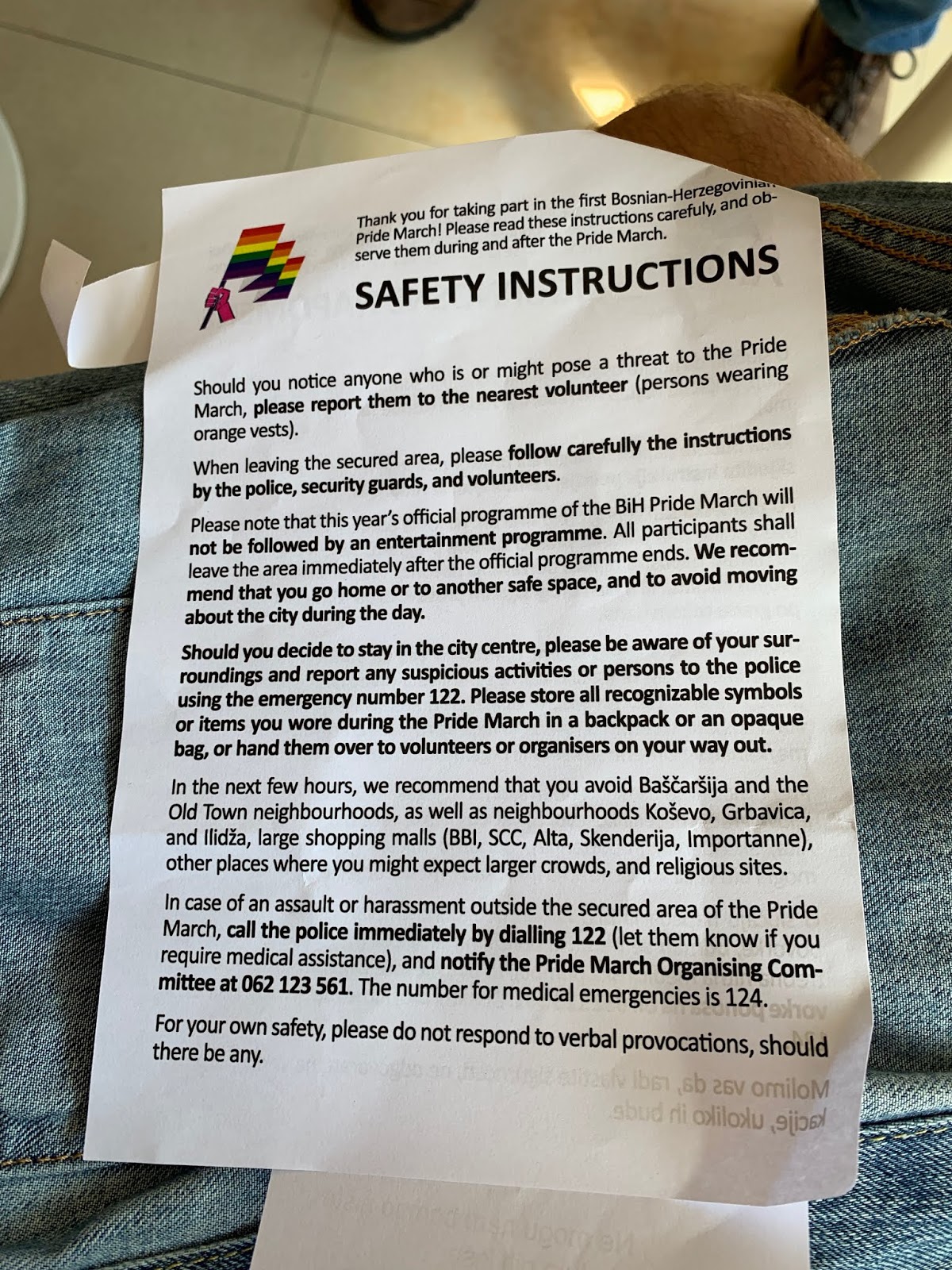
Sunday had arrived, and there was a sense of occasion about the main event. We followed the strict directions, as agreed by the pride organisers and police, as to where we needed to enter and what we were allowed to bring in. The police operation was firm but very professional – at the start and throughout. Those familiar with Sarajevo will know how one minute you are walking down tightknit roads and side streets, hidden by the towering 18th century buildings in this part of town; only to then be on an open plaza or river embankment in full view of the hillsides. We met our fuller delegation in the square in front of the Sarajevo Youth Theatre, to have a coffee and do formal photos of our attendance.

I watched as people funnelled through security, a few not heeding the warning to not wear LGBTI regalia until through security. Many were in groups, but others came as couples or by themselves. Many were evidently heterosexual, which was heartening to see. But once through security, the colours began to bloom. On flags and banners, on t-shirts, on people’s faces with paint or glitter. Where we were, we could hear the thud of drums not too far away, and the echo of a voice on a loudhailer. On the square where we were, the sound of whoops and squeals reverberated every time a planned rendezvous had been accomplished.


We then made our way to the main street, a minute’s walk away. The security cordon stretched between the Eternal Flame Memorial and the Central Bank, on the main westbound road from the Old Town called ‘Marshal Tito’. We turned the corner and saw a sizeable gathering that must have numbered over the expected turnout of a thousand already. We were 45 minutes away from the start. I managed to say a hello to a few activists I knew, before finding a spot to situate ourselves. Someone asked if I could say a piece to camera to say why I was here, and why it was important. I duly obliged.

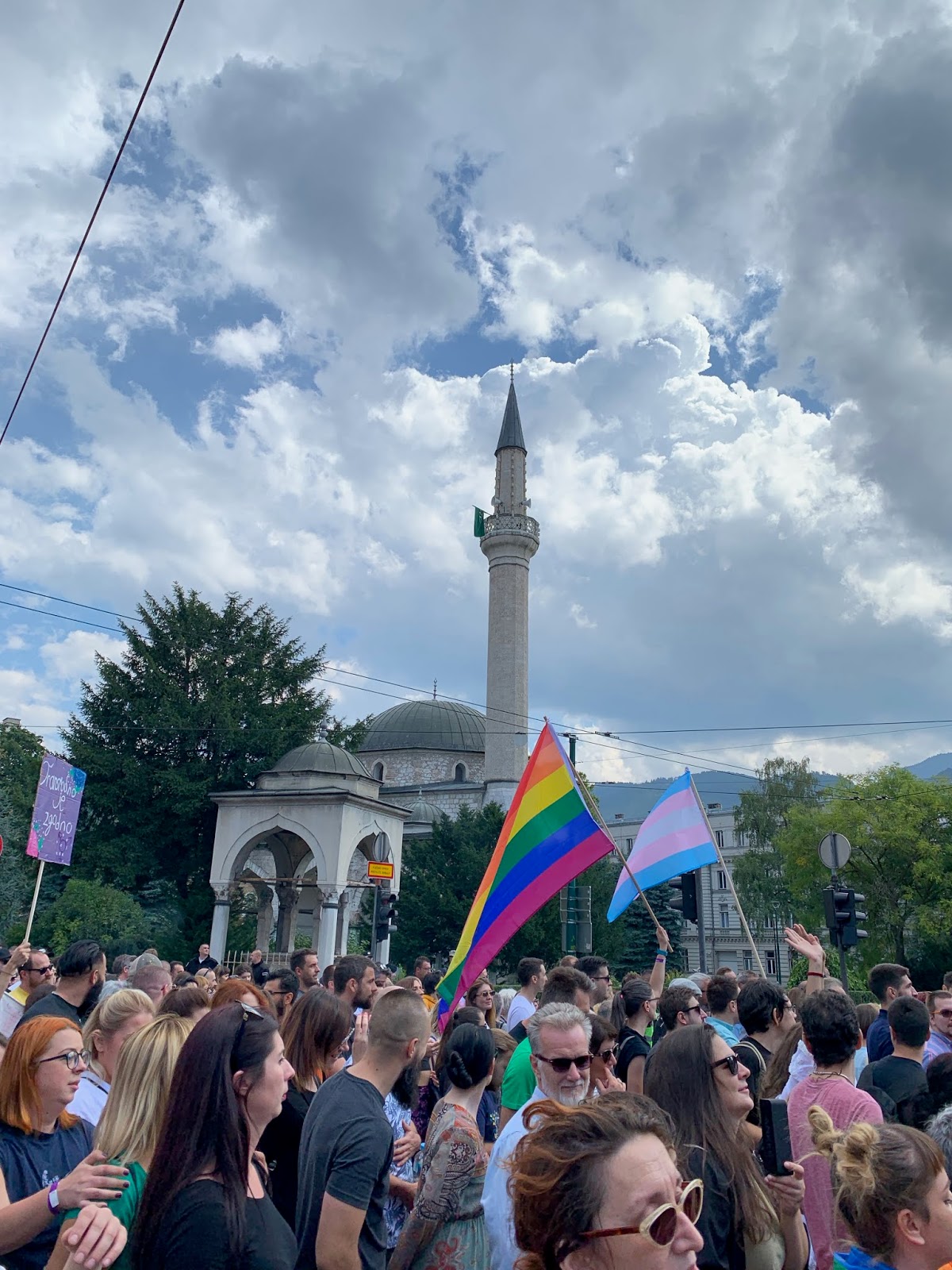
As more people began to fill our space, the atmosphere became electric. Drums were banging, whistles were blowing, and a wave of chanting flowed over the crowd. Rainbow flags were furiously brandished, and placards with an array of messages were jumping up and down overhead. The crowd was well over two thousand by now.

And then all of a sudden, with a cacophony of whoops and wails, we were off. And it couldn’t have been more peaceful, felt more liberating, nor garnered as much positive support than if you wished it. At first, there were no passers-by on the street along which we walked, but you could see faces in the windows of the apartments above. Only the odd face here and there, expressing curiosity. But then I noticed a young family, outside on the balcony, and they were waving. We then approached a modern mall, which had a roof terrace. It was packed with people watching. But that was it; neither cheering or heckling. Just observing. The crowd waived cheerily at them.

And as we went along, we kept seeing more faces in windows, and then people waving back. The scene that was often repeated, and which I got real emotion from, was seeing older women in their 60s and 70s, waving and clapping alone from their windows. What I took from that, and this is only a theoretical proposition with no anecdotal evidence, was they were expressing nostalgia for a time when everyone was equal, and understood having lives with and through hardship. I took their support to be one of compassion and understanding. It was just a feeling, but one that carried me all the way along the march.

We walked past aging mosques, the Presidential Office, many a war-torn building, but never any hatred. The only signs of dissent were the appearance of buses used to block the main roads into the city that crossed our route. And even then, you couldn’t see protestors. As we approached the Parliament area, a raucous cheer went up, as people in front of us turned 90 degrees to the right to look back at something. As I reached that point, I saw an elegantly dressed woman in her 70s or 80s, in a ground floor window. She had jet black hair, a black top and a large white beaded necklace. She was blowing kisses to us all. My heart lifted.


Meanwhile, as I was marching, I made a comment about someone’s t-shirt that had a sheep on it and mentioned Wales. Two women in their 50s next to me exclaimed “We’ve been to Wales!”. It turned out; they were from Sarajevo and had studied in Aberystwyth University for a number of years. We had a lovely chat about the film Pride.

The march then poured into an area where the two main roads merged, and opened out to a large expanse where the Parliament was situated. Those familiar with the siege of Sarajevo will recall many a photo or video footage of people hiding or running across this area, under the threat of sniper fire. I felt our presence now was also an act of reclaiming this space from the past. Opposite the parliament building on two sides were modern shopping malls. The terraces were again packed with observers.


The pride organisers stood upon some steps and made proclamatory speeches. My colleague, Dajana Bakic, started off proceedings. This was followed by a local artist singing two songs. One, I was told, was a Yugoslav anti-fascist song, which the crowd sung with gusto. The other was Bella Ciao, the Italian peasant song turned revolutionary anthem. Overall, the blend of LGBTI and anti-fascism proved a dynamic match, rousing a nostalgic call to arms akin to ‘Brotherhood and Unity’ but for modern times.

As proceedings ended, people sought friends who they missed during the march and caught up. Others were reeling from the high of the first LGBTI march in Bosnia & Herzegovina. Many were invited to a reception in the nearby Museum, our delegation included. This was set up to ensure a safe space following the march, should protestors try and attack people as they left. Buses were parked nearby for those to travel home, if they came from places like Banja Luka or Belgrade. At the museum, we met acquaintances old and new, and chatted with the Spanish and British Ambassadors, who were very pleasant indeed. A thunderstorm left as quickly as it arrived, but brought the reception to a natural end. Our delegation went its separate ways, but those staying for another day returned to the apartment. 


That evening, we reunited with our friend from the bobsled track on Trebević, as we were invited to a house party hosted by his friend. The evening was spent making new friends and drinking copious amounts of homemade rakija. The next day, we visited the grocery shop downstairs. In the magazine racks, I noticed one publication that had a rainbow flag on it. Inside was a 4-page article on LGBTI pride, with pictures taken of that summer’s Europride in Vienna. The magazine happened to be the most popular women’s weekly magazine in Bosnia & Herzegovina. No wonder public awareness was so high.

And so, that was my pride in Sarajevo. My departure was filled with a lot more optimism than when I arrived, and it taught me an important lesson. Don’t just count those who show opposition, and then let that skew your judgement and preconceptions of a place or people. Allow for the positive shows of support to boost your hopes for the event, and indeed the future. Also, don’t discount those who show indifference as being negative by default. The law of averages would indicate that they are neither agitated nor motivated – it’s just not a priority for them.

Until the next Bosnia & Herzegovina Pride!