Showing posts with label train. Show all posts

Friday, 27 April 2018

Around the Balkans in 20 Days – Part 10


The luxury of a twin room is that one does not disturb the other when it comes to tossing and turning, or when one gets up. I think John was happy of this fact as I turned out of bed at a not too late a time, in order to get breakfast.

I sat in the jazzy reception area where breakfast was put on, alongside a family with two toddlers and two straight couples. I grabbed some coffee, cheese and bread, sat myself down, and then oscillated between looking up news on my phone and awkwardly smiling in appreciation when one of the toddlers became rambunctious. After my second cup of coffee, and fully briefed on world news, I returned to the room to wake a sleepy John and get ready for the day out. It must have been around 10:30am.

It was a grey day, so John wore jeans and a jumper. I stopped after adding a jacket, wanting to keep my shorts on, as it was still warm. We visited the small bakery at the T-junction yards from our B&B, so John could grab a pastry to eat as we walked. As we began to retrace our route yesterday, it decided to rain. So we ducked into the Produce Market on Mula Mustafe Bašeskije, the site of the mortar attacks that killed scored of people during the siege. In-between walking around the food stalls in search for one that sold umbrellas; we stopped and read the mural to those killed that took up the whole space of the back wall. Once we looped round and walked back to the road, we managed to locate a stand that sold allsorts and purchased an umbrella for 10KM (about £5).

We then carried on towards our destination, the railway station. We passed the memorial from yesterday, and now noted that the road we were walking along and the pedestrian road yesterday becomes Maršala Tita – Marshall Tito. The rain was dying down as we passed the modern BBI shopping centre to our left, and arrived at a large junction with Ali Pasha’s Mosque commanding a dominant position. We crossed over the road and at a fork, took a right, splitting off from the main east west road taking us direct to the station. Away from the traffic, we looked up and around us. The street was quiet, with the odd café having seated patrons outside. The brown-grey Austrian-style blocks that started off the street still had bullet holes on them, alongside more recent graffiti. These then opened up to more familiar 1960s high-rise blocks before the train station plaza and tram stop welcomed us.


The train station was built in the modernist style, reflecting that of Templehof airport in Berlin. Almost light yellow in colour with a hint of marble effect; the curved building seemed to hug the plaza area in front. Only a handful of people seemed to inhabit the plaza and cafés nestled under a canopy at the station entrance. The modern, glass mini skyscraper loomed over us to our right as we approached the main ticket hall. There was as much life in here as there was outside, and we were soon to find out the reason why.

I approached one of the two open ticket desks and asked if there was a train to Mostar in a few days time. She shook her head politely, to which I responded with a “No!?”. She then explained in simple terms that there were no trains south. The train line is closed. This now made sense, as research I did before the trip seemed to imply that there were no trains. But learning from my previous trip, I thought things might have been different when here. We were then directed to the bus station located next door. We walked around past a couple of newspaper kiosks and entered the rather dated building plastered in an array of adverts for a multitude of bus companies and routes. We walked in to a small, dark-wooded ticket hall, and joined the queue. We didn’t need to get the tickets today, but I wanted to check how much they would be and how frequent the service was. After greeting the ticket seller with “Dobar dan” I soon conversed in English to ask my key questions. The price was similar if not a little cheaper than the train, and there were around 7 buses a day. He gave me the times of them so we could consult. Prior to the journey, I had already booked a bus ticket from Dubrovnik to Split to get the flight home. They were a Croatian company, but had services from Croatian parts of Bosnia. I noticed that they had services from Mostar. Later on, I would marry up the Sarajevo-Mostar route, plan for a short stop over, and then book a ticket for the Mostar-Dubrovnik route.

John wanted a soft drink, so we went to one of the kiosks outside. After purchasing, we had an idea to visit the Historical Museum of Bosnia and Herzegovina then the National Museum, which were located next to each other. So we walked south alongside the heavily fortified US Embassy, crossed the main road, and went in to the Historical Museum first. The building had still not been renovated since my last visit, and everything had a sort of ‘thrown together’ sort of feel to it. The display in the lobby area was different to before, with a wall of pictures juxtaposing photos of buildings in Sarajevo immediately after the siege with those recently.


We were directed to go downstairs with two other people for an English tour, led by a strapping young blonde lad in his 20s who was working in the archives. We descended a set of stairs in a small, glass-encased tower, and approached a doorway that had further steps beyond it and into a concrete bunker at the basement level. On our right, after the doorway, were two 1960s low-rise style black leather and silver framed chairs. The archivists’ opening speech focused on these with a story of the visit of the man himself, Tito. I felt that he was aching for us to be both amused and surprised to learn that Tito sat in one of these very chairs before us, so much so that he offered to take our picture in them. We politely declined. He seemed downbeat at our disinterest.

At the bottom of the stairs, and in the first of two sections in the bunker, was a display of Communist paraphernalia, which our guide talked us through with an air of having done this hundred of times. Batons, posters, badges, patches; you name it. We then wondered through a seriously thick metal security door. The room was encircled with militaristic metal shelving, which seemed to underscore a lot of what was on display in the damp and gloomy space. These items were from the Partisan struggle during WWII and contained many firearms and low-grade weapons. Some of the gorier items were clubs containing nails, or barbwire wrapped sticks. Again, there were other items from the period, which the guide talked us through.

When the tour ended 20 minutes later we ascended the glass staircase into the sunlight, continuing up to the second floor where the exhibition was. It came in three parts, the first part being new since my last visit. This was an examination of the material life of Yugoslav citizens since 1945, instantly drawing John and mine’s attention. A squared-off section of the main hall had within it a maze style layout that led us to move between themes. One theme looked at holidays and transportation, showcasing vintage posters of the national airline JAT and emphasizing the liberal migration policy Yugoslavia had in the form of ‘Gastarbeiters’, in deviation from other, Soviet dominated countries. Another theme looked at material life in the home. The 1970s chic outfit of a living room encouraged John to exclaim that it was an exact replica of ours back home. You couldn’t deny it. I fancied a couple of the pieces of furniture myself for the living room.


Once we made our way through this, we then went on to the second phase that looked at the siege. This was chronologically ordered and from a political angle, displaying items that the army or citizens used over the 5-year period. An example was a makeshift cooker that was used when the gas was turned off. I hurried around this part as I had seen it previously, but I still managed to give John the odd contextual explanation as he went around. The final section was post-Dayton looking at the settlement and subsequent governance of Bosnia-Herzegovina.

After this, and all the walking we had done up until now, we decided to go for a drink and a sit down. As we descended the stairs I noticed a cast iron life-sized statue of Tito in commanding pose out in an unkempt courtyard. This was a replica of the one in the grounds of the House of Flowers in Belgrade from a few days ago. I grabbed a snap and continued down the stairs. Tucked at basement level, at the back of the museum, was a café simply called “Caffe Tito”. If there was any evidence to suggest that Bosnians had a soft spot for Tito and Yugoslav nostalgia, then the last hour and half was proof enough. We slid past the patrons sat outside in the warmth, all young and student-like, and headed inside to cooler climes. Despite my aggravation from the heat, I ordered a hot coffee. Thinking ahead to the rest of the day, my third coffee before midday was a bit ambitious and could go either way. In between chatting and updating ourselves with social media banter, we admired the kitsch décor that had sparingly been placed on the walls in the dimly lit interior. The odd poster here and there from post WWII times, and a framed map of the now disintegrated country, was peppered amongst the Partisan and Pioneer memorabilia in the foreground of walls printed in bold patterns in the red, white and blue of the Socialist Yugoslav flag.


After finishing our drinks, we went to the neighbouring National Museum. This one featured archeological artifacts and a botanical garden in the courtyard. Having been before, I rushed around half re-reading signs on the displays. After a wonder around the gardens, we soon departed. We walked eastward to pass the dominant glass encrusted Parliament building on Trg Bosne I Hercegovine. The Holiday Inn loomed across the road as we walked on to a new shopping mall on this main axis of roads. We decided to eat here, visiting the food market section on the top floor, and chose to visit a restaurant that offered an array of food styles, mostly Western. I decided on a chicken, apple and hazelnut salad, which was delicious. Having rested our feet once again, we then walked back to the old town, taking in other side streets and buildings that we had not yet seen.  The most impressive was the Bezistan. This was the old, stone-built market hall in the centre of the old town. Now mostly full of shops selling rather tacky tourist stuff, the odd clothes shop or bag emporium stuck out. I imagined it to be mesmerizing when merchants sold textile or copper in the hall, the noises of production mixing with chatter and camaraderie, all for the shopper to see.


I knew the intense coffee intake earlier would now lead to a massive crash. In desperation, and with a renowned sweet tooth, we stopped at a café in the old town that had a vast selection of cakes on offer. I opted for a coffee and walnut cake that had layers of crushed meringue in it. It was divine! I also had a Bosnian coffee – why the hell not!


We decided to pay a visit to the Sarajevo Pivo Brewery, located on the south side of the river, not too far away. It had a museum too, so we decided it was worth our while. We crossed the river, admiring the town hall building once more, when I stumbled upon a street sign on a building that we were approaching. Below it was another sign with some explanatory text. The two newer signs were on the opposite side of a window to an older one. The newer street sign indicated the road to be called Ulica Obala Isa-Bega Ishakovica, named after the city’s founder. The older one was called Obala Pariske Komune, named to mark the 1871 revolutionary, socialist government in Paris. What the explanatory sign detailed was the history of name changing on this particular street. The Paris Commune connection is an obvious post WWII change. The newer name is a reflection of the Ottoman heritage that present day Bosniaks hold as part of their identity.


The whole issue of naming and re-naming is fascinating, and has been the site of common ideological and national struggles in South East Europe, particularly in the post-Communist era. The symbolic power that naming has, is a reflection of those who are in dominating positions at any one time. When you move beyond street names that come from geographic, topographical or commercial markers, such as Mostar Road, Mountain View, Copper Tin Alley for example; the act of naming then becomes political. This street in Ottoman times was named after two trades that existed on this side of the river when expansion of the city came along. When the Austro-Hungarians decided to regulate the river and create an embankment, they renamed it Careva Street, Careva being ‘Emperor’ in an obvious nod to their Monarch. In 1914, for 5 years, it was named after a sultan before returning to Careva Street then changing to Careva Obala, obala being ‘left bank’. It then changed to Francuska (French) Obala in 1927, then during a period of 4 years under the occupation of the Independent State of Croatia it held a different name before becoming Obala Pariske Komune. It changed to its current name in 1993. One can draw from this, that the last renaming was the attempt of Bosniak officials to lay down a marker that Sarajevo is a Muslim, Bosniak city, with a heritage that rests largely on its proud Ottoman history that will not be erased even when under siege.


We moved on and took a street that climbed up the hillside from the river. I noticed a number of Serbian registered cars here, so was unsure if this was a predominantly Serb area. We then reached the brewery. It was a dominant terracotta-bricked, gothic-styled building that seemed sort of out of place here and rather Bavarian. We passed the goods entrance and noticed a sign for the museum. We went in and noticed that it was literally a room that was 8 meters by 8 meters. The girl on reception said that we could pay something like £2 for the museum, or £3 for the museum and a free drink at the pub. We opted for the latter ticket. So we looked at the brewery themed objects on display and read a bit about the history. I noticed one piece that mentioned that this brewery had a connection with one in Petrovaradin Fortress in Novi Sad. What a coincidence.

We soon left and went to the pub. It was actually very impressive and very spacious. It almost had the style of a very well done Wetherspoons with added Germanic flair. Wood paneling dominated the décor; with a traditional bar almost spanning the whole left side of the pub. You also had a balconied area. We were only amongst a handful of patrons. Obviously too early for most, but I did notice that they had entertainment on at a more modest time of 8pm. We grabbed a seat and claimed our first pivo, fresh from the factory (or one would imagine). Having enjoyed the taste, we paid for another round before leaving.


We descended the hill back into the old town and ate somewhere non-descript. After that we attempted to find one of 3 places we believed to be LGBT friendly venues. After lurking around near the Orthodox Church and canton buildings, we gave up and returned to the B&B. Better that we didn’t drink any more, as we would be driving the next day.

Tuesday, 6 March 2018

Around the Balkans in 20 Days - Part 8

We left the apartment early in order to catch a mid-morning train to Novi Sad. I had wanted to visit the city because it was one of the centres of resistance to Milosevic’s hegemony in the 1999 and 2000. We walked up to Trg Republika, then back down the hill towards the train station, stopping at a kiosk for water and snacks on our way. The final part of our descent to the station led us along a steep, cobbled path where street sellers were in operation. They were either local people selling market type goods, or refugees selling their personal belongings. A very sad sight indeed.

As the train station came into view, we noticed a gathering of people in the park opposite us. As we crossed and walked through, we observed that officials wearing lanyards holding EU cards in them were speaking to the refugees. I assumed that they were migration officials overseeing the implementation of EU policy on the ground. My impression was that they were merely fact-finding to see how many were gathered, what their intentions were, and what their situation was.

We walked onwards to the main train station entrance. The ticket hall was quite dark as there were few windows, or perhaps because it was so sunny outside, but we located the ticket booths instantly. These resembled old-fashioned bank cashier hatches that were framed in dark brown wood, 10 or so in total but only 5 in operation.  The short queue soon disappeared and we asked for two return tickets to Novi Sad. After being handed our tickets I asked for the time of the next train. Again, I had already looked this up and knew what time the train was, but I wanted it corroborated and with the added information of what platform it would depart from. I began to think I had a problem.

We left the ticket hall and returned to the sunshine, which poured down on to the L-shaped plaza area that shadowed the shape of the station building. We had a bit of a wonder around and took a picture or two, as we noticed that the train was already in our platform. Cafes lined the outside of the station building and were alive with custom. Our train was of an older rolling stock, presumably one that played a role in the wars of the 1990s. I was a bit envious of the newer, air-conditioned train that was resting in the platform next to ours. We boarded the dilapidated train, and parked ourselves on seating that reminded me of those plastic and metal school chairs from my childhood. Not the most comfortable, but we bagged a window seat so we could enjoy the views Srijem had to offer. A loud, grinding noise of the engine firing up indicated our immanent departure. However the force of this noise was not matched with an equal emphasis on our acceleration out of the station. At a walkers pace, we slid out of the platform, navigating through the various points on the line. Once clear, the expected speeding up did not occur. This was because we had to incline and bear a sharp right to cross over possibly one of the oldest and creakiest bridges to span the Sava.


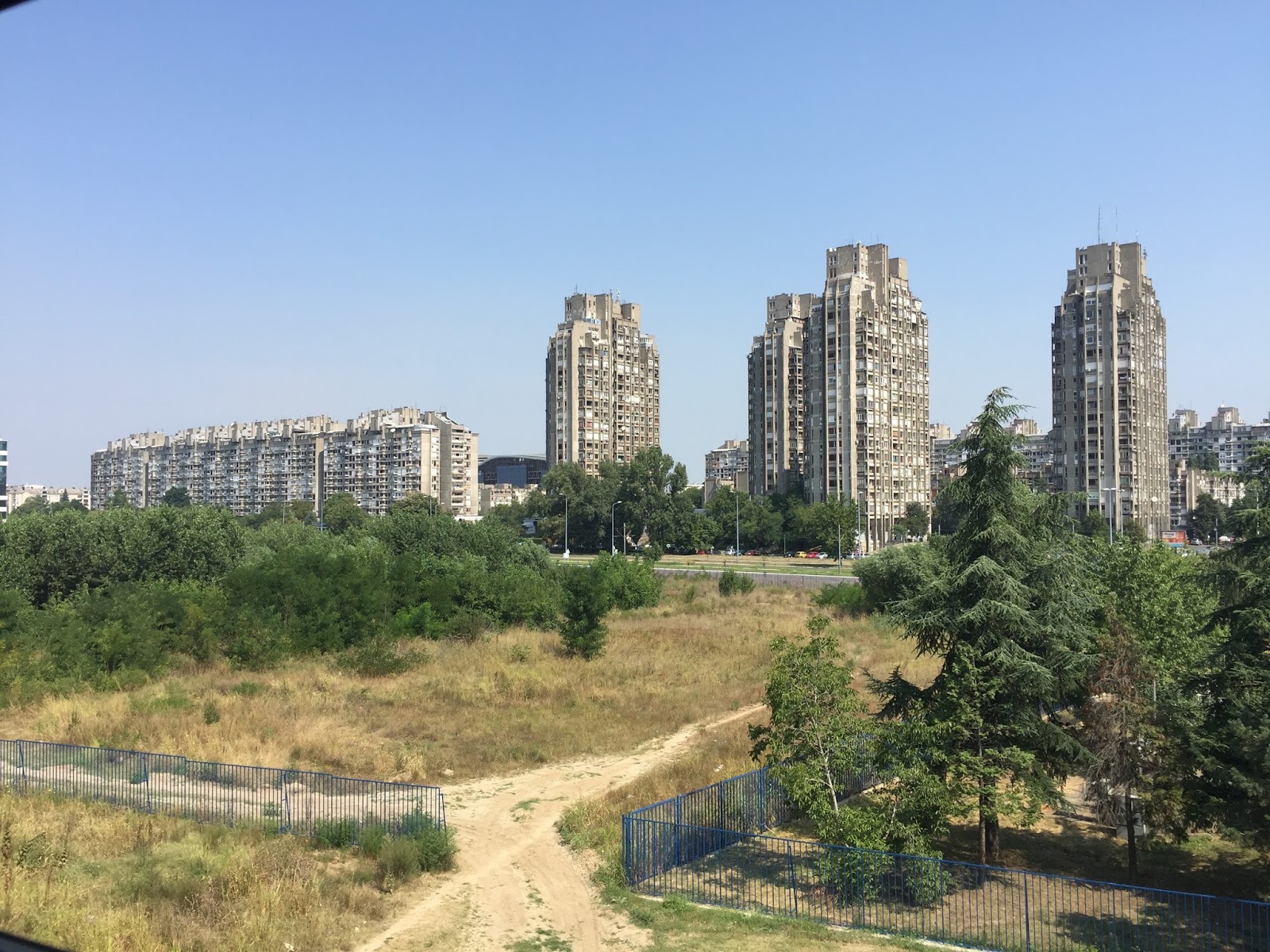
Once over, we immediately pulled into Novi Beograd station. The suburb is a Brutalist enthusiasts dream. Tower upon tower and block upon block of browny-grey concrete behemoths stood around us. We trundled on out of the suburbs of the city and entered the flat, agrarian plains. Most of the seats were filled on the train, with commuters sitting in contemplative silence and appreciating the breeze afforded by all the windows being open. Our initial interest soon passed into indifference due to the monotony of wheatfields, with the odd farmhouse every now and again. We anticipated one of the stops, Nova Pazova, as this was where our newfound friend Danilo was staying. The station there was typical of the rural, Balkan kind. A station building level with the tracks, over which you would have to climb to reach your train (no raised platforms or bridges). The station itself was painted sunshine yellow and came topped with a terracotta-tiled roof. No barriers or fencing surrounded the station or its grounds, so people and animals could wonder freely. One or two rail company officials were visible by their uniforms, and a handful of passengers boarded replacing those who left just before them.


The scenery remained unchanged until we started to approach the Danube. We couldn’t actually see the river, but the change in surroundings from flat, agricultural land to hilly forests certainly indicated that we ascended slightly on to land that would have historically housed inhabitants up and away from the floodplains from which we came.  In fact there was a train station nestled amongst the dense forestry, which we stopped at. A number of people got off here, armed with beach towels and picnics, pointing  perhaps to a secluded yet popular riverside spot for those in the know. We carried on to Novi Sad.

The train curved east around the hill town of Petrovaradin and opened up to the length of the Danube, which we were about to cross, and the city of Novi Sad behind it. To our immediate right was a gargantuan structure of two white arches with reinforcing metal ropes, one on each side of the river. A new bridge was under construction. We crept across our makeshift bridge, finally settling into the main railway station a kilometer away.

Again, faded beauty is how I would best describe this brutalist construct. The raised platforms were on the first floor, so we descended to the ground floor, passing under the platforms above and into a massive 1970s style arrivals and departures hall, then out to the plaza area outside. Unsure of what bus to take to the old town, we decided to get a taxi from the taxi rank to our left. A brief conversation led to our jumping in and hurtling off down the main boulevard that began opposite the station plaza. Again, this part of town must have been some part of a model new city, as the boulevard was three lanes wide on each side of a grassy central reservation, accompanied by parades of shops on either side occupying the ground floor level of rows of 12 storey tower blocks. We then bared left as we arched around the old town centre. We got dropped off and paid the near £12 fare, a bit of a rip off to be honest. But with only 4 hours in the city, I didn’t want to waste any time. We walked away from the now dual carriageway towards what I assumed to be the direction of the main square.


The buildings here reflected the architecture of the Austro-Hungarian period. The city would have been one of the last places in the empire before reaching the Ottoman border, whose furthest reaches would have been  the rivers shores opposite Belgrade. Over different periods it would have been Ottoman, Austro-Hungarian, then Yugoslavian. It now occupies the role as the capital of the Vojvodina region in Serbia. The Hungarian minority presence was felt not just by legacies invested in the buildings we were walking past, but by the street signs and other official signage being bilingual and in two scripts. You had Serbian in Latin and Cyrillic scripts, and Hungarian in Latin too.

The square was quite vast, with the expected grand 19th century municipal buildings and a church occupying its perimeter. We had a close look at a few to try and see what they were. This proved difficult when all the marble signs did not contain English. The odd word sprung out, like ‘banka’, so we did our best at deciphering them.  We walked down some side streets in a loop and ended up at the top end of a pedestrianized street that began at the square. It had café seating along it, so we decided that we should eat and grab drinks, as it was a scorching day. We settled at a table under a parasol and the waiter kindly brought over two English menus.


After lunch, I wanted to visit the Petrovaradin Fortress. This hosted Exit Festival each year, the initial gathering of which was the student protest in support of democracy at the turn of the millennium.  We walked towards the river, away from the old town, and merged again with the dual carriageway ring road. Just off it was a modernist looking building that housed the Socialist Party of Serbia, therefore it must have been the former headquarters for the League of Communists of Yugoslavia. After we walked across a junction and turned a corner we noticed a long modernist building that resembled a ship – complete with a Captains Bridge perched on top. It had nautical themes engraved on it, so it must have had something to do with the ship trade on the Danube. After 5 minutes, we reached the bridge that led over to Petrovaradin. The castle seemed to loom over the river, an imposing feature on the skyline. We crossed over and entered a rather rundown but quaint village. The houses seemed almost French, and were obviously the residences of those who had some connection to the fortress above. We walked up the main street, diverting right onto a cobbled side street to locate the path up the hill.


After a steep and sweat inducing climb, we reached the top and now saw the view of Novi Sad from up on high.  The river flowed directly below us, to our right we could see the two new bridge archways in the distance. Northwestern Vojvodina stretched out behind Novi Sad and was as flat as that which lay outside of Belgrade. We must have been on top of one of the few hills in the region, and one which was an obvious choice of location to build a fortress. There was a restaurant and a café located within the walls, so we decided that a couple of beers would be a nice reward for our efforts and with which to enjoy the view.


We were conscious of time, so departed after 45 minutes and made our way back down the slope, through the small village and over the bridge. We returned to where our taxi dropped us off and noticed a taxi rank. We set off back up the brutalist boulevard, and were placed outside the station for a cheaper fee than our outbound journey. I noticed an old locomotive outside the station, so decided to go over and inspect it. We then went inside and asked at one of the desks which train we could get. The staff member said that we could get the next one, which was deemed the ‘fast’ service (it shaved off 15 minutes off the 2 hour 10 minute journey to get here). It was due in 4 minutes, so we darted through the underpass and emerged at the platform at the same time as the train.

The train was your stereotypical trans-continental type, probably glamorous in the 1970s and 1980s but had grew tired over the years. We approached the 2nd class carriage and climbed on. The train had come from Budapest and was heading to Belgrade as its last stop. The décor was similar to that on the bus we took from Skopje – carpet-esque, moquette textile lined the walls (including the ceiling) - and the seats were a lot comfier than on the train ride here. I put on my headphones as the train pulled away, awake long enough to gaze back over the city as we crept back across the bridge to Petrovaradin, before succumbing to tiredness.

When we arrived in Belgrade, I thought we should walk a different route back, so that we could see a bit more of the side streets of the city. So we turned left out of the train station, and walked northwest along the main road that loops clockwise around the base of the Kalamegdan. We passed the Bristol Hotel and onwards to an art gallery and some ‘pop-up’ café bars that were housed in what seemed to be ex-dock buildings. We then approached a viaduct, and walked up some steps that saw us come level with the road it carried. We weaved along side roads, always uphill, so that we could reach the main shopping street. We came across a quiet square surrounded by restaurants and those high-end businesses housed in glass-fronted offices with sparse furniture and two or three employees.  We noted the restaurants for the evening.

Back at the apartment, we decided to do some basic packing ahead of our departure tomorrow and then agreed that we should head back to the fortress for the final evening. On our way over we bought some crisps and two 2-litre bottles of chilled Jelen beer. The park within the fortress walls was beginning to darken, the shadows beginning to creep further away from their source. We approached the outer wall and placed ourselves on top, as many others were doing and had done so around us.

And what a way to spend the last night in Belgrade! The blue sky above had already begun to turn pink-purple as it neared the orange-red sun on its approach to the horizon. Only a WWI plane flying overhead, an added touch of history at this poignant location, broke the quiet on this warm evening. A relaxed feeling came over me, quite possibly from the beer, but a note of surprise was that I was not planning in my head tomorrow’s journey. Being in the moment was all I felt. And the romance of sitting on this wall, with John by my side as the sun finally set over Zemun and the WWI plane playing a supporting role, was truly a memory to treasure.


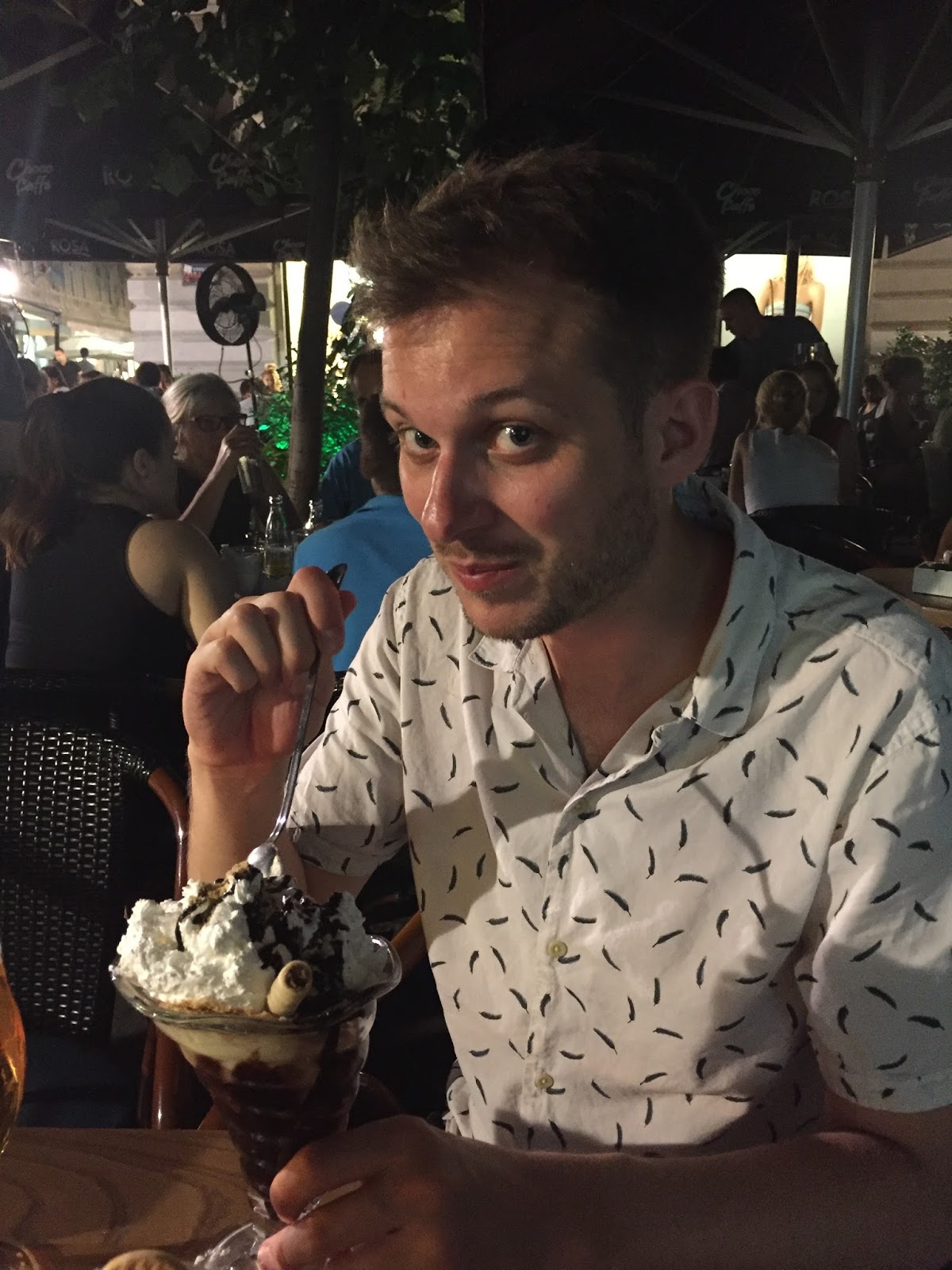
We sauntered back through the park and to a restaurant near the square from earlier. The meal was so-so, but we decided to go to another café on the shopping street for dessert. John outdid himself with a large ice cream sundae. We then went back and finished our packing ahead of our early start tomorrow.


Thursday, 28 May 2015

My Images of SEE – 16:24, Friday 26th August

I left the hotel refreshed, cooled, and spoken to my mum. It was still awkwardly hot and I had decided that I would go into town to eat, so I passed the train station, and series of squares, north at night. Surprisingly they were quite busy. The main square was also rammed with people. I turned west from there, buying a drink on the way, and arrived at the small square I visited this morning and afternoon. I found a table near to where I sat for lunch and ordered water and wine. I’m quite partial to a carbonated water now. I read whilst my order of chicken and bacon skewers was cooked. I ate, then read more in the bustling square, as it was at 21:00. I finished my wine and decided I’d had enough, so walked back to the hotel. The square in front of the train station was also busy. I had a lovely nights rest.

I woke up before my alarm, so I went for breakfast straight away whilst it was fresh. Fully fuelled, I went to bed and relaxed until 11:00. I then jumped in the shower, changed, and then packed. That thing gets heavier, but I managed to cram it all in. I departed the hotel, paying the 20kn ‘City Tax’ then made it to the train station for 11:55. I bought a sandwich at a kiosk at the underground shopping ‘mall’. The sweat was pouring off me. I went into Konzum and bought crisps, water and flavoured iced tea.

I then went to the tracks as the board still said that the train would arrive at 12:30. As I ate, a lad approached me to see if it was platform 1, and whether the train was going to Slovenia. I confirmed the two queries. He was South Korean, 21 and got chatting. He had started in Dubrovnik 2 weeks ago and went up the coast until Zagreb. He will finish in Budapest. He was studying Business Management. He sat by me and when the train arrived we boarded together he sat in front of me. It was like a decade old Pendolino with proper seats, air con and curtains. I learned through the journey that there were also refreshments on offer and clean toilets! Wow!

I bought the Guardian again, seizing the chance, and settled down to read that when three police officers came up and were checking passports. How efficient. After stamping mine, the ticket conductor waived me past once I flashed my Interrail pass. Within 40 minutes I was having my pass checked, and passport, by border crossing. I’m not used to the speeds the train was doing. I was now in Slovenia. However, this was the first time I saw someone getting chucked off. A woman of 30-odd was asked to leave. Don’t know why, but she was in tears as she departed.


Slovenia was more hilly than mountainous at first. Lovely green trees filled the small valleys surrounding the river running parallel to us. We arrived at Ljubljana at 15:00. So I got off, walked 10 mins to locate cash, then returned to eat at the train station. I then took a rip off taxi to the hostel charging me €15 for a 10 minute trip. I arrived, checked in, then had a quick rest.

Sunday, 22 March 2015

My Images of SEE – 08:32, Thursday 25th August

I dipped back in to the old town to eat. I went next door to where I ate last night and ordered steak. It was lovely. Not to outstay my welcome, I left as soon as I was finished (it was a small venue, so didn’t want to stop new customers) and went over to the City Pub. I had a couple of pints before going back to the hotel. Such was my last night in Sarajevo. At the hotel, I asked the lad on duty if my clothes were done, and they were! So I did 95% of my packing. I then drifted off to sleep.

I woke up around 08:15 and showered and changed first, then went for breakfast. The muscled guy was on duty this morning, so I helped myself to breakfast. I then dashed out, through the old town, to a sandwich shop I saw earlier in the week. So I got a cheese & tomato baton. I also collected some bananas from the ‘Konsum’ shop. I quickly packed my satchel then went downstairs. I thanked the lad, and asked him the protocol for getting the tram. So I walked to the stop that was in-between the hotel and the water spring, and bought the 1.5KM ticket from a kiosk. My tram No. 1 arrived 3 minutes later, and I got on then stamped my ticket. The latter point was important because 2 stops down, 4 inspectors got on. My ticket was fine, but a lad didn’t have one – tried to buy one, but got fined. One inspector, a stern looking woman, wrote down his details. I continued on to the train station. Once there, I lugged my bag inside then wrote out my ticket. I then went to Platform 1.

My train was 15 minutes late (not bad since it had to cross the border near Ploce). So I got on and into a cabin. Luckily these windows opened properly. A mother with son and daughter joined me as we set off, but she got off at the next stop. It was an extremely hot day, as we passed through familiar valleys, past Zenica, and up to Doboj. We then turned west on our journey, to Banja Luka. The train trundled along at 20 mph for about 15 miles. It was annoying. I just kept on reading, or falling in and out of sleep-induced consciousness.


The area became more plain-like, and agriculture still dominated. Still a smattering of mosques, but churches were more present here – definitely in Republika Srpska! However, not as many in density as the mosques. A lot of newly built or partially built homes were there too. The border was seamless enough, and then we picked up speed towards Zagreb. 20 minutes out, and you could see it sprawled out ahead, glowing in the distance, with a hill/mountain as a backdrop. The sun had gone now, but an orange glow still remained.


The station was modern enough, with a shopping centre below it, to a road that I needed to take. I walked over a main boulevard in to a residential area, quiet now – then found my hotel. The two girls were cheery enough, and wondering where I was. They called ahead to a restaurant for me, so I dropped my things and walked 200 meters to it. Lost in translation, I said to the English deprived waitress “salad” and “chicken”. The salad came sure enough, but followed by steak and chips – twice in 24 hours! Oh well, I was starving so tucked in hungrily. I had two ‘Pivo’s’ to help it go down too. I paid the 134K and then left for the comfort of my bed and slept.

Monday, 29 September 2014

My Images of SEE - 20:43, Friday 19th August

The young couple departed 2 stops later, in the suburbs of New Belgrade/Zemun I presume. We chugged along slowly to the next stop and 3 railway workers came into the cabin. I just read. I think they were getting a lift to near the border (which they indeed did, to Sid). I just read in the stifling heat that was produced with no really open windows and 4 men. The journey to the border, through the Vojvodina, was what can now be described as a normal journey – Stop-Start-Stop-Start. There must be a rule that train drivers shouldn’t trust car drivers at crossroads, as we always seemed to slow or stop and have a few blasts of the horn.

Anyway the scenery was what I came to expect of Serbia too – flat. Save for a parallel hill that seemed to follow us to the border; to the north, all there was were cornfields. One thing to note is that we didn’t pass another sizeable settlement until Bosnia. What there were copious amounts of were villages and hamlets. Some no bigger than 20 houses. The journey to the border was quicker than expected and the Serbian customs quicker than usual. We then crossed over. Now I was in recent history.

This was the border region of the early 90’s conflict between Croatia and Serbia (or Croats and Serbs I should say). Again the geography was similar to Serbia. The dwellings were the same too. But now there was the Latin alphabet. We passed through Vinkovci train station. It felt eerie to me, as I know that the town of Vukovar was only kilometers away, and was one day a bustling town. Then it was razed to the ground. Incredible.

The train continued west to Strizivojne Vrpolje, where we then turned south. 20 minutes we were at the border again. A swift check by the Croats let us then go forth over the Sava to Bosnia & Herzegovina – but technically “Republika Srpska”. We then went through another swift check and were free to continue. For a while the geography remained the same. Then it began to get hilly, then more so like the Conwy Valley, or Llangollen. They were covered in a ripe green expanse of forest. We meandered in-between hills and through valleys. Occasionally we went through the hills. Slowly we reached Doboj, still in Republika Srpska – just.

About 20 minutes from here I noticed two things that stuck out. One was that every village or small town we passed there were minarets and towers topped with the crescent and star. They were so numerous such as like passing Welsh village by Welsh village and coming across chapels and churches. Except these were new, and in use; not decrepit and in disrepair. It was an odd yet satisfying sight, as I now knew I was closer to Sarajevo and in the Croat/Muslim Federation of BiH.

The second was my first physical proof of the war. Pock-holed buildings were springing up. It caught me off guard actually, and made me look at my surroundings a lot more clearly and with context. If they didn’t have pockmarks, then they had filler plugged over them. But the scar was still underneath. Also to note was that there were a lot of houses being built, or had recently been built, from Croatia to Sarajevo in fact.

An old man came in, then left. Then a young lad came for the remainder of the journey. We then came up to Zenica, which is the largest town I’ve seen since Belgrade. An industrial city from appearances. But very much Muslim dominated. We continued on.

From here, a new road must be in construction as road works made the traffic build up as we scuttled past. At 18:00, and with the sun on its final descent to dusk, we arrived. Just a short 10 hours. 


I walked out of the station, towards a main road that would lead me directly to my hotel. Along the way I passed the ‘famous’ Holiday Inn hotel, I passed market that was mortared by the Serbs ending scores of lives, and skirted the Old Town. I also withdrew cash.


After 25/30 minutes of walking I reached the Pansion Stari Grad; a friendly guy welcomed me and explained about breakfast and wifi. I went up and showered, then had 20 minutes to myself. The old town is on the doorstep. So I had a little walk around, when a firework went off to mark the end of fasting.


I sat in a restaurant-cum-fast food place and sat next to a young lad. I had cevapci – the veal sausages with naan style open bread and onions. Lush. And only for 10km (£5) with a Coke. I then had an ice cream for 2km then walked to 60 seconds to the hotel where I relaxed, then slept. 

Tuesday, 16 September 2014

My Images of SEE – 08:17, Friday 19th August

Liam snoozed and I relaxed whilst waiting for my clothes to dry. I went down and the lady at reception had put them into a basket for me. So I went up, woke Liam, and we got ready to leave. We left the apartment, through the High Street, and down a little maze of side streets to the Brankov Most – the bridge to the ‘New Belgrade’ side of the Sava. The view north was amazing, just a horizon of forest.


We walked over the busy road bridge, which took us 20 minutes, to a park on the other side. Immediately in front of us was a shopping mall. So we hid from the evening heat inside and grabbed a snack. We then walked around the mall and up a blocked off road to a park. 


This was where the Beer Festival was being held. An adjacent road to it was crammed full of people going to it: teenagers, middle-aged men and women, families – the lot. We had a light padding down at the gate and walked down a security alley to the main arena. There were stalls of the different beers all around, the ground messy from a few days of partying. We grabbed a £1.50 beer each and went to the arena. The sun was creeping slowly behind the stage.


A nice folk band were on – 8 members I think and a man in his seventies on lead vocals. Songs lasted about 10 minutes long it seemed, and had an almost ‘Greek’ feel to them, although it was definitely a Serbian set up. 


We happily listened for 30 minutes, grabbing another beer, but then made our way back as dusk was approaching. More people were arriving as we exited. We walked back across the bridge at just the right time. The sun was leaving a glorious day, and we say the city light up on its banks. The fortress just glowed from the forest around it. 


St Sava’s Church the other side of town was a Christian beacon for the city. We walked to Republic Square, which was still busy, and had a couple of cocktails. We then went to the 24-hour convenience store next to our hostel and grabbed snacks for the morning. We watched some shows on my phone then slept.

We woke at 06:45. We showered and finally packed before living the hostel at 07:20. We walked the last time through the High Street, then down Balkanska to the train station. It was hot already. My train was at platform 4, and we confirmed Liam’s. We sat opposite the train for 10 minutes then said our goodbye’s. I was now on my own.


The train hardly filled up whilst I waited until the 08:15 departure. I had a young lad and girl for company as I departed Belgrade over the river Sava.