Showing posts with label war. Show all posts

Wednesday, 11 August 2021

The Brotherhood and Unity Highway - Friday 11th August

So, this was our last morning in Belgrade. By 11 am we had to leave, so we packed up in anticipation, but still left time for a bit of breakfast. Alexandar, our host, led us out of the apartment and down to the garage. John was in the driving seat for this initial leg of the journey. A shaft of light filled the dark and cool basement, and soon we were out and onto the cobbled street above. 

John retraced our entry into the city, but this time amongst noticeably more traffic as we passed the Parliament building and descended down towards the motorway. The one advantage the traffic provided was the time to scrutinise some of the old buildings along this governmental boulevard, and guessing their function.

With an unfamiliar road layout, and a version of the Birmingham ‘Spaghetti Junction’ coming up, together we exited the boulevard and veered right onto the downward slip road onto the main east-west motorway, seamlessly merging in. We glided over the Sava River, past the brutalist New Belgrade community, and were waved off by the Western City Gate, or Genex Tower as its also known. However, nerves began to bubble, as I knew that soon I would have to take over the driving.

Soon enough, we pulled into a service station to fill the tank and grab some road snacks. I was now in control of ‘Sandra the Suzuki’. I got my seat right, and mirrors sorted, and then set off back onto the somewhat quieter road. It took some getting used to, but on a straight and easy road I did not find it too challenging. However, the first stop on the way to Zagreb was going to take us off the ‘beaten track’ and north-east towards a quieter border point and beyond, to the town of Vukovar.

I turned off at the sign for Sid, and we now found ourselves travelling along a busy country road passing through small and narrow villages. Having gone north, as we arrived in Sid we turned left and towards the border about 1-mile further west. As we approached the small border post, a grave yard appeared to our right. Despite it being an ominous symbol of the reason why I wanted to visit Vukovar, I found it odd that a graveyard would sit on the border where no village appeared close by.

The Serbian side of the border was swift. When it was our turn to be checked by the border guard on the Croat side, a rather terse woman asked for papers, which I handed over. She barked ‘papers’ once more because, unbeknownst to us, we needed to give her the documents for the car. John shuffled in the glove box and pulled out a green booklet, which I handed over. A flick through aforementioned documents led to their return, and a barrier being raised. The road ahead was ours. 
I recalled that I had passed through this area before, and have the stamps to prove it, as I had crossed the border here some years ago when I travelled by train from Belgrade to Sarajevo. It’s always nice to have a new perspective on a journey when you are retracing your steps. Certainly, going through the border was quicker by car than by train!

The countryside had more contours now, with winding roads dipping up and down agricultural fields and low hills. We came close to the Danube again, swerving away from it once more until we would see it fully again at Vukovar. We were greeted on our arrival by the destroyed water tower in the east of the town. Meandering through some road works, we then found ourselves on a sort of bypass that went around the main high street, both of which were parallel to the river. We located a car park on the opposite side of the bypass to the market, through which we would have to walk to reach the river. We paid our fee and traipsed over. 


The odd person was spotted, doing their shopping or sat out staffing their stalls. It was a humid day, so perhaps people came out later in the day. We reached a sort of quay where a small river cut through the town to reach the Danube. We walked over the modern bridge which had helpful information on. The west part of the town was in geographical Slavonia - a name and place which has existed for many centuries. The east of the town was in the Srem/Srijem. This area stretches all the way to New Belgrade, bordered to the north by the Danube and to the south by the Sava. We crossed over into Srem/Srijem.


Situated here were older buildings, more turn of the century and rather more ornate. But also, the evidence was there that they were also recently refurbished. It’s difficult to imagine the horrors that took place here, little over two decades ago. One of the familiar clips of video, in my mind, is of a bus, window wipers miserably oscillating, driving through this very high street after forces on the Serbian side had ‘taken’ Vukovar. Rubble was strewn everywhere, and no people could be seen. It really captured the overwhelming destruction that took place at the start of the war, on a town that had only recently become a frontier town, as former internal borders overnight became international ones.

We walked briefly up and down the high street, during which John attempted to exchange denars at a shop (unsuccessfully I may add). The buildings were Austro-Hungarian in style, plastered and whitewashed, or pastel coloured, with minimal ornamentation gracing them, such as dark wooden beams. A notable feature were the arched colonnades you walked through in lieu of pavements, which provided much needed shade. We returned to Slavonia and sat in a café, near a fan with water misters, and had a coffee. We then returned to the boiling hot car, to continue our journey.


We needed to re-join the main highway, and did so in a south-westerly direction. The terrain was very much the same, but the roads passed by more villages than through them. The slower journey on these countryside roads allowed us to take in our surroundings. We circumnavigated the ring road around the only urban centre we would see until Zagreb. This was Vinkovci. Similar to any experience you have of circling a town - a junction, an industrial park, a retail park, some houses adjacent to the road, and topped off by my first roundabout!

At one point, we found ourselves descending into the Sava floodplain, but its backdrop, to the south and ahead of us, were the peaks of mountains in northern Bosnia, beyond the river. Their allure reminded me of our time there the previous year, and a hint of sadness crept in with the knowledge that we would not be there again on this trip. As we continued to the motorway, joining it after paying our toll, we were in the lull of the floodplain and our horizons were now fields or forests, the latter acting as barriers to settlements beyond.

Two hours out of Vukovar, and very much in the western part of Slavonia, we departed the motorway once more for a pre-planned stop. Having studied south-east Europe, and continuing to read an array of books on the region, the place we were going to visit had a sinister past, the traces of which were now long gone, and a memorial built in another era to commemorate that past.

It was a quiet country road that led to the outskirts of the village of Jasenovac, with the Sava, and Bosnia & Herzegovina, only a stone’s throw away. The name, notorious amongst a number of communities in the former Yugoslavia, represents the concentration camp that existed here during the time of the Nazi-puppet regime of the Ustasha. That regime took the destructive intent of the Nazis - murdering Jews, Gypsies and Roma, and political opponents - and added to those the local Serb population, who lived in the newly created, and expanded, Croatian state known as the Independent State of Croatia (NDH). The regimes’ intent was to ‘cleanse’ the territory of Serbs to make an ethnically pure Croatia. The Serbs comprised the largest group of detainees and victims.

The place was still as we arrived. Only a couple of cars were parked up, and the collective hum of crickets were the only background noise. We parked in front of a single storey building, a disconnected ‘L’ shape, the void of which had marble slabs with information on the site and the architecture of the nearby point of interest. The small museum was of interest, but only took 20 minutes to pass through. The photos of the camp were the only way for you to comprehend the space in which the horrors took place, in the vicinity of where we stood. 


We returned to the heat and proceeded to walk up a short embankment, which turned out to be a former railway line branch. An old steam train with animal wagons stood idly on the side, as a reminder of the disturbing role it played in the atrocities. The other reason why I wanted to visit here was to see my first, of what I hope to be many, Tito-era ‘Spomenik’.


The embankment kept the river at bay, but created an almost boggy island between it and the road on which we arrived. The only thing dominating this space was the quadruple winged ‘Flower Monument’. Wooden railway line sleepers formed the causeway to it, with two landscaped pools as sites for reflection, and small circle mounds symbolising where the former camp structures lay.


We had the space to ourselves, and it was peaceful to be here. The concrete structure, despite its beauty, encapsulated the brutal nature of the regime that did its evil work here. Bogdan Bogdanovic was the architect, and he went on to create a vast number of these monuments. One commentator noted that the abstract and non-explicit designs avoided explicit references to death, and instead moved into the sphere of how a monument can create feelings in the observer, feelings of the past, present, and future. Here, I think he captured that sentiment perfectly.


We returned to the car once more and made our way back to the motorway. Within 60 minutes we were at the city limits of Zagreb, and the urban sprawl began to suck us in. Despite my reluctance to drive in cities, I had ensured that the route to get to our accommodation was as simple as possible. It was a right fork off the motorway, now named ‘Slavonska Avenija’ and a left towards the Railway station. As we pulled off into a quiet set of low-rise central European style apartment blocks, hidden behind the Lisinski Concert Hall, I recalled the area as this was where I stayed in 2011. We were met by our host and shown around, given the house rules and what we needed to do before departure, then off they went. We gave ourselves some time to recharge our batteries and shower.

It was dark when we left the apartment, and the area behind the railway station was, as I recalled, a quiet and mildly threatening space you didn’t want to spend any time in. So, we aimed straight for the underpass, stopping for a quick snack from a newsagent, and then appeared out on King Tomislav Square. The series of three squares we were about to walk north through formed part of the late 1800s planned reconstruction of the city, and were the right line of a squared letter ‘U’ of green spaces arching through the city, and were surrounded by grand buildings with ornate facades popular at the time. At the third square, a classical music festival was taking place. We savoured it as we slowly passed, but hunger was very much controlling our movements.


We passed through the brightly lit Ban Jelacic Square, and wound around behind it up a bustling lane of cafes and restaurants, and then down a long and narrow street that had single level wooden framed shops, similar to those in the Bascarsija in Sarajevo. There was a lively atmosphere here, with people singing solo or in a duet every so often. John spotted a nice restaurant, where we could sit out and savour the music and warm evening.


Laterna na Dolcu was the name of the restaurant, and we examined the tasteful few options on the menu. We decided to get a bottle of wine too, after all our driving, and so asked the waiter to recommend one for the food we had chosen. He suggested a specific Croatian red, and we obliged. Only after he left did I see the price, and had a mild panic. It was going to be more than the food! John put me at ease, let’s say, and thankfully the wine was both nice and an had the effect of helping me forget its cost. The steak I had with a potato and spinach side was very nice, and we even had pudding. We left satisfied and meandered a little more about the centre of the city. 


A friend of mine from Zagreb recommended going to a small gay club that was near the central square, so John and I headed for there. A glazed door that looked more like the entrance to an office or travel agent was our discreet entrance into this club. We showed our ID and descended to the basement in the now familiar fog of cigarette smoke. It was quiet as we walked in, a couple of patrons on one side and a table of six around a low-level table and sofa. We had some beers and found a spot to perch. We chatted about the day, and often turned towards the door when someone new came in, as that’s how quiet it was. But all of a sudden it had become busy. 

Although we didn’t dance, nor stay too long after it had reached a party atmosphere, someone had spoken to us and, as we got chatting, mentioned that a lot Bosnian’s come here, given that it was the closest friendly city for them with a gay scene. I now noticed an ID card of someone who was getting served at the bar when I was, and this confirmed his observation. Soon after, we called it a night and returned via the green squares, and back to our apartment.

Thursday, 21 February 2019

Around the Balkans in 20 Days - Part 14


We decided on a cab to the bus station, as the walk would leave us exhausted and sweaty. After packing, eating breakfast, then checking out, we jumped in the hotel ordered taxi and arrived in good time for our bus. We searched for a few snack items from the nearby kiosk, and then unenthusiastically waited until our scheduled bus arrived. We decamped in front of ‘Peron 10’ – peron, I assumed, meaning platform – until a bus pulled into our bay. A little bit of commotion was caused by fellow travelers, presumably on our journey, with bags being dragged closer to the bus’ luggage storage. We waddled a little closer in order to hear what the official was saying to others. I cant explain why as we didn’t speak the language, but if I heard ‘Mostar’, I knew we would be onto a winner. As tickets were being checked and tokens for the luggage were handed out, we queued up and took our turn. 25 minutes before departure, we were in our seats. The bus was hot as the air con was not yet on, but it did seem to have modern conveniences that our previous coach to Belgrade lacked.


We unpacked things we needed immediately; water, headphones, books etc, and settled in for the journey. As scheduled, the driver climbed aboard, the doors were shut, and we were off. We drove west out of the city, but not taking the modern bypass southwest from the outset. Instead, we drove through Ilizda, crossing over the Bosna River, and then meandered through villages that ran alongside the main E73, before merging with it. At first, we essentially passed through similar terrain as Sarajevo; with tall green hills surrounding slim floodplains dotted with houses one could loosely call villages. Every now and then, we would see the railway line in an array of positions - running in and out of tunnels, vulnerably perched along high viaducts, or cross our path through a junction.

After 40 minutes or so, we then joined the main north-south road heading into the Herzegovina region, where the terrain began to turn mountainous. We must have continually been ascending since Sarajevo, because we now entered and hurtled down a long tunnel that brought us out into a steep, green valley. Villages perched on the side, containing terracotta topped houses and shiny white minarets poking out here and there. After an accelerated descent, we reached the first main town, Konjic, which was also our first drop-off/pick-up stop.


It ticked all the boxes for a market town at a crucial cross roads in central Bosnia, and was positioned near to the entrance of Lake Jablanica, spanning the Neretva River. We pulled up on the side of the road on the main Kolonija road, and dropped off a few people, as well as picking a couple up. We were soon off again and heading out of the town. Between here and Jablanica, we kept to the lakeside. It was blue-green in the sunshine, sparkling almost. Craggy hills descended into the lake, each valley between them filling the lake with its own tributary rivers. I was envious of the kayakers on the lake in their red boats and puffy life jackets. I made a mental note to stay in this region for a while on a future visit.

After travelling in a westerly direction, we began to turn south not far from the next stop of Jablanica. The sun was now out of my direct gaze, so it allowed me to squint less and observe the scenery more. We repeated the scenario; people off people on. Again, all in a matter of seconds, not minutes. As we left the tight streets of the central town, we drove past an open expanse to our left. The gigantic and stony Prenj Mountain stood dominant in the background, with what seemed like only slightly shorter hills closer to us. But nearby was a green plain, on the precipice of a gorge that contained the Neretva River. At the green’s edge was an old locomotive train, and on the opposite bank one could see a collapsed bridge with the railway track still fastened on. Later on, I soon learned that this was the site of the famous Battle of the Neretva. The bridge, though, was rebuilt and bombed twice for the filming of the movie of the same name.

We continued on, now snaking along the side of the river and within the same valley until we reached Mostar. A change in the environment was noticable about 45 minutes outside of Mostar, as the hills became parched, and the ground turned chalky-brown and more Mediterranean.  As we came into Mostar, you could see that beyond it, to the south, the valley opened up as the river went on towards the sea.


We disembarked at the quiet and dusty bus station. We had about 4 hours in Mostar, so we asked to put our luggage into storage for a few marks and confirmed our next bus. I read that we were on the Bosniak side of town, and one that we stayed in for our brief visit. We walked down a north-south side street that was parallel to the main thoroughfare we arrived on. It was quieter but, as we began to approach the Mostar Bridge, had more shops and cafes emerging around us. This is where we also noticed the outnumbering of tourists to locals as we approached the famous old bridge. We cut down a side street, to another parallel road to the one we were on, but this time adjacent to the river.


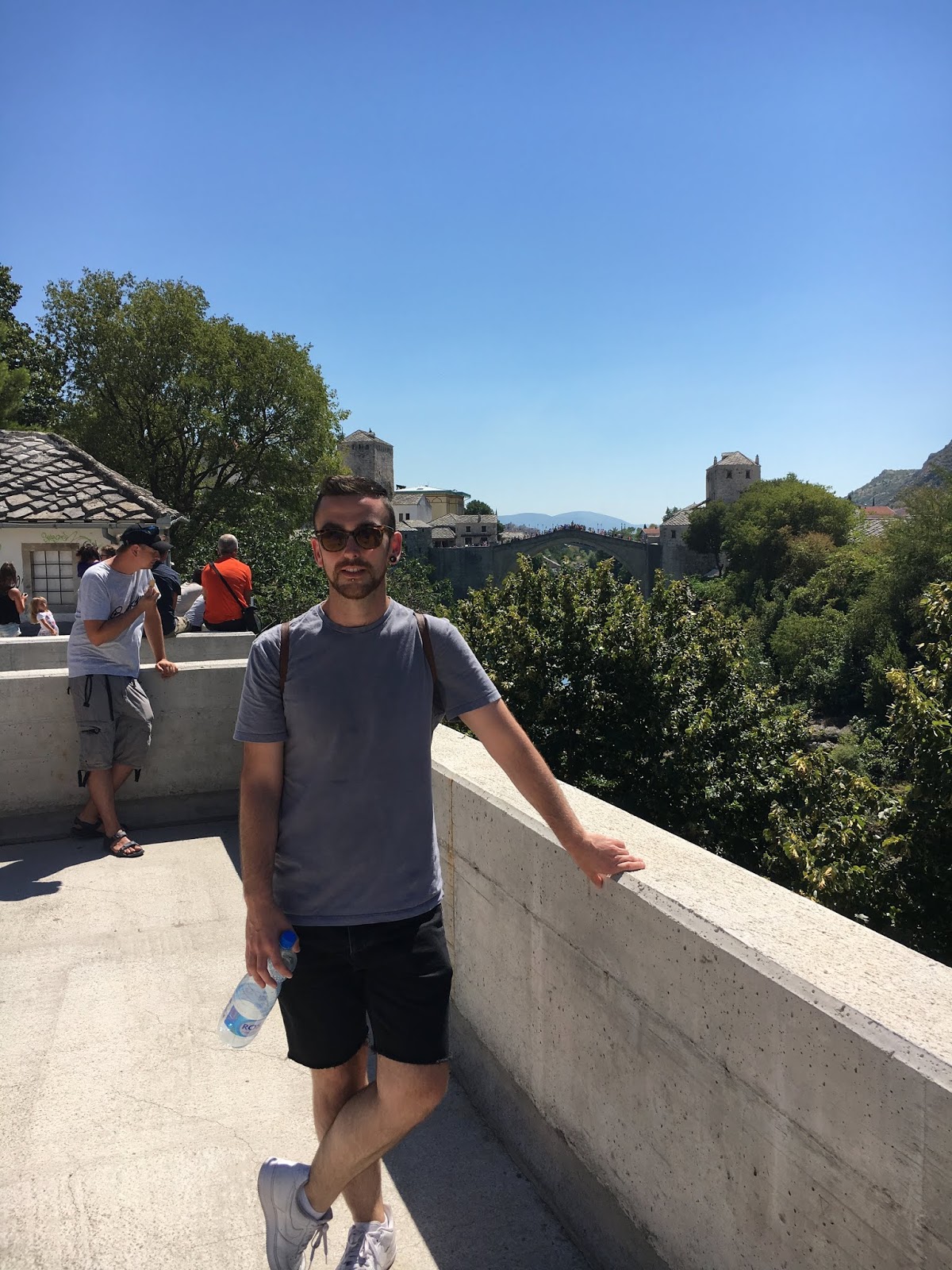
Above the tops of the trees that emerged out of the ravine below, you could see a wide ‘V’ of buildings come to centre either side of the top third of the bow of the Stari Most. You could already see a heaving gaggle of tourists on top. Suitable photo opportunity now, I thought. We paced downhill slightly along the cobbled street, where trinket shops lined the riverside. We were in direct sunlight, so began to bake slightly. We reached the bridge, and climbed steeply up its arched top. It was steeper than I anticipated, highlighted by the prominent row of bricks every 10 inches or so apart, acting almost like steps. It took 5 minutes to walk over, with no chance to stop, as people dawdled to look at the surroundings or posed for pictures.


As soon as we stepped off the bridge, we passed between a tower and a townhouse and into the tightly packed lane with more trinket shops. This had more of the feel of the Bascarcija in Sarajevo. We walked through, looking for a bar to have a drink and lunch. We continued in a straight line through the sand-coloured buildings, covered periodically by canopies between them, until we opened out into a street with generic 1980s apartments. Here, we saw a gelato shop ahead so anticipated further restaurants. However, we approached a rather wide main road, so turned back to try our luck back in the market area. This is where we also saw the first Church, so assumed we had entered the Croat side of town.

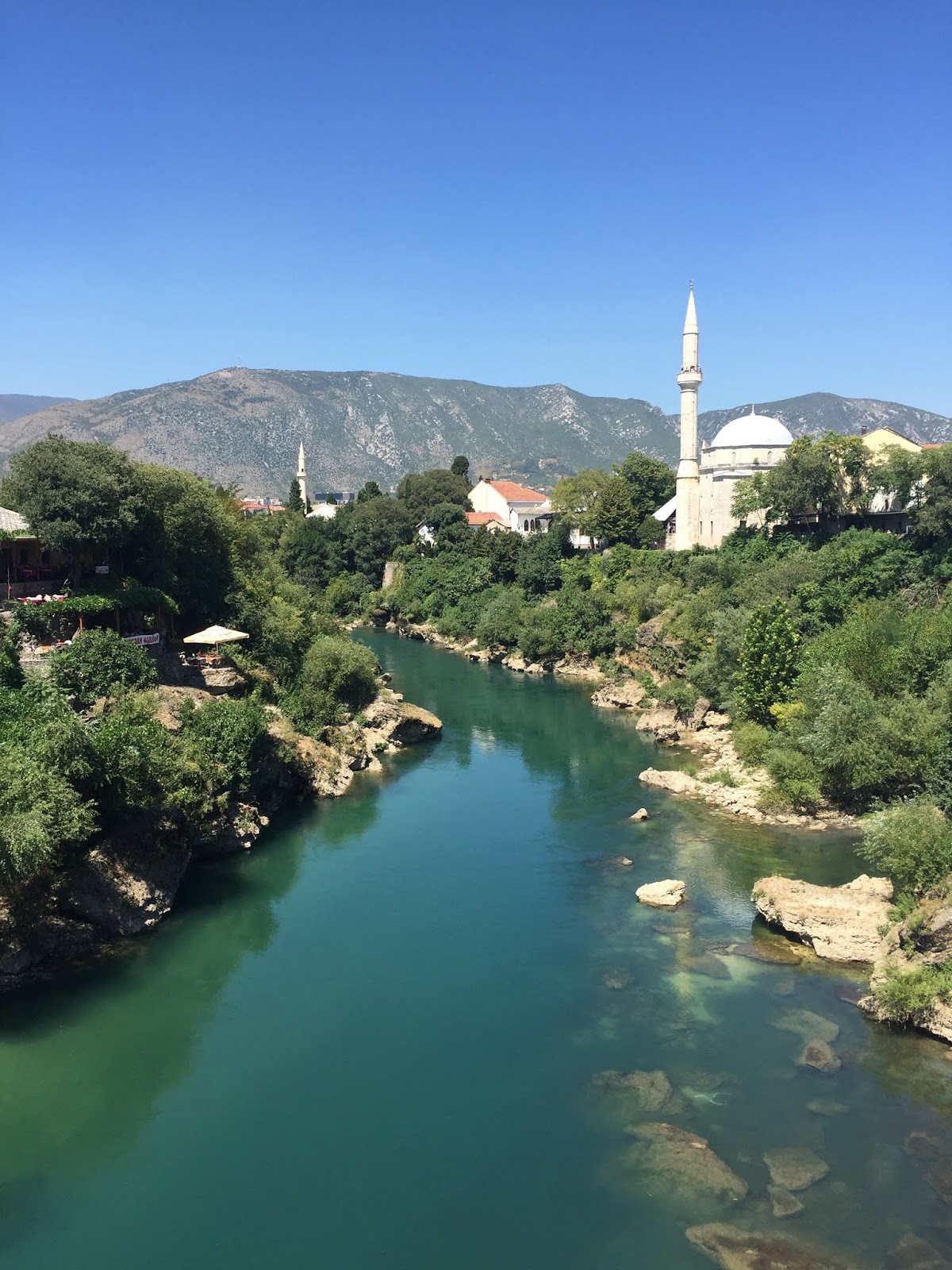
Near towards the bridge, John saw a sign for food ‘with a view’. We decided to give it a shot. We entered into a tekke-styled courtyard, and then off it into a restaurant entrance. We spoke to the waiter who led us through the dimly light restaurant, up some stairs, and then out of some French windows and onto a balcony. The ravine was below us, the sparkling green-blue water again, gushing together as it squashed through the bridge nearby. We were in the shade, but could take in the majesty of the bridge. I ordered cevapcici, as it may have been my last time on holiday, and ordered a glass of red. I may have ordered another, more in an attempt to hydrate, but this fanciful idea was quashed with my ordering water to accompany it. I just wanted to be woozy to pass the time.

After this, I wanted the money shot photo, so we headed on down to the riverside to look the bridge from below. It was very busy with children playing in the water, observed by family members on the rocks in the shade. The serene nature of the goings on were a far cry from the war that saw this historic bridge destroyed only 20-odd years before. Mostar resembled Sarajevo in that it was surrounded by domineering hills. It was from here that the Croat forces mortared the bridge. Its rebuilding and opening in 2004 was an attempt at reconciliation. However, as elsewhere, reconciliation between people proves a mightier challenge. Those of an older generation knew who their enemies were, on all sides, and those who have grown up since have done so with a petrified version of national identity and historic revisionism that continues the segregation.


The bridge still had lots of people on it, as the famous ‘divers’ were preparing to jump. For the 10 minutes we were down there, they still had not jumped. So we ventured back up. On top of the bridge, we managed to squeeze in a photo and see the divers tout for donations. We returned to the other side of the bridge and, with two hours still to kill, noticed a roof top bar with a canopy above. We walked off the main riverside path, to the back of this building, and climbed up to the bar. We grabbed a couple of chairs under the canopy, but with a lovely view of the bridge and hillside behind. The added bonus was the water spritzers.


We ordered a couple of rounds of beers to pass the time, whilst I took pictures on my instant camera. We paid up then walked back, still with plenty of time before departure. We got a few extra snacks on the way at a chain supermarket, stopping in the grounds of a mosque for a look, and then picked up our luggage at the bus station. The bus arrived not long after. Again, this coach was another step up in modernity and comfort.


We had our tickets checked, and then threw in our backpacks, before settling in for the next leg of the journey. We departed on time, and crossed a bridge next to the station to drive on through the west side of town. Was this because the bus company was Croatian and this was the Croat side of town, I pondered? Anyhow, as soon as we cleared the south of the city, the hills all receded, and we were now on sloping floodplains descending towards the sea. We made one stop at Capljina, before heading to a rural and quiet border patrol before heading towards Ploce. We then headed south-east in order to pass twice through a border – from Croatia back into Bosnia, then Bosnia back into Croatia – as we passed through Neum. We stopped here at a hotel so the driver could rest, and passengers could use the facilities. I bought John and I an ice cream, as we moved away from the coach and looked at the gorgeous Adriatic as it came in to this shielded port with the sun setting in the background. Perfection


It had been a long day so far, so we slipped in and out of snoozing as we travelled in the dark. We wound around villages and small towns, and in and out of bays. We did not arrive until around 9pm, our welcome being the cruise ships parked at the newer port in the north of the city. We got off, and walked over to a taxi that took us to our apartment. We were met buy the cleaner, who gave us our keys, took copies of our passport, and proceeded to point out where we could go for food nearby. So we quickly refreshed and headed out. We were in an area that was very much a suburb, Babin Kuk, but you could sense many of these homes were holiday places. We walked up a short hill, then down a much steeper one, until we reached a roundabout that had a bit of life off two roads that led to it. We went down one and hit upon a series of restaurants. It seemed a bit ‘Brits abroad’. We just picked one at random and ate an OK meal. As we were tired, we returned to the apartment in no time and hit the sack, exhausted.

Monday, 29 September 2014

My Images of SEE - 20:43, Friday 19th August

The young couple departed 2 stops later, in the suburbs of New Belgrade/Zemun I presume. We chugged along slowly to the next stop and 3 railway workers came into the cabin. I just read. I think they were getting a lift to near the border (which they indeed did, to Sid). I just read in the stifling heat that was produced with no really open windows and 4 men. The journey to the border, through the Vojvodina, was what can now be described as a normal journey – Stop-Start-Stop-Start. There must be a rule that train drivers shouldn’t trust car drivers at crossroads, as we always seemed to slow or stop and have a few blasts of the horn.

Anyway the scenery was what I came to expect of Serbia too – flat. Save for a parallel hill that seemed to follow us to the border; to the north, all there was were cornfields. One thing to note is that we didn’t pass another sizeable settlement until Bosnia. What there were copious amounts of were villages and hamlets. Some no bigger than 20 houses. The journey to the border was quicker than expected and the Serbian customs quicker than usual. We then crossed over. Now I was in recent history.

This was the border region of the early 90’s conflict between Croatia and Serbia (or Croats and Serbs I should say). Again the geography was similar to Serbia. The dwellings were the same too. But now there was the Latin alphabet. We passed through Vinkovci train station. It felt eerie to me, as I know that the town of Vukovar was only kilometers away, and was one day a bustling town. Then it was razed to the ground. Incredible.

The train continued west to Strizivojne Vrpolje, where we then turned south. 20 minutes we were at the border again. A swift check by the Croats let us then go forth over the Sava to Bosnia & Herzegovina – but technically “Republika Srpska”. We then went through another swift check and were free to continue. For a while the geography remained the same. Then it began to get hilly, then more so like the Conwy Valley, or Llangollen. They were covered in a ripe green expanse of forest. We meandered in-between hills and through valleys. Occasionally we went through the hills. Slowly we reached Doboj, still in Republika Srpska – just.

About 20 minutes from here I noticed two things that stuck out. One was that every village or small town we passed there were minarets and towers topped with the crescent and star. They were so numerous such as like passing Welsh village by Welsh village and coming across chapels and churches. Except these were new, and in use; not decrepit and in disrepair. It was an odd yet satisfying sight, as I now knew I was closer to Sarajevo and in the Croat/Muslim Federation of BiH.

The second was my first physical proof of the war. Pock-holed buildings were springing up. It caught me off guard actually, and made me look at my surroundings a lot more clearly and with context. If they didn’t have pockmarks, then they had filler plugged over them. But the scar was still underneath. Also to note was that there were a lot of houses being built, or had recently been built, from Croatia to Sarajevo in fact.

An old man came in, then left. Then a young lad came for the remainder of the journey. We then came up to Zenica, which is the largest town I’ve seen since Belgrade. An industrial city from appearances. But very much Muslim dominated. We continued on.

From here, a new road must be in construction as road works made the traffic build up as we scuttled past. At 18:00, and with the sun on its final descent to dusk, we arrived. Just a short 10 hours. 


I walked out of the station, towards a main road that would lead me directly to my hotel. Along the way I passed the ‘famous’ Holiday Inn hotel, I passed market that was mortared by the Serbs ending scores of lives, and skirted the Old Town. I also withdrew cash.


After 25/30 minutes of walking I reached the Pansion Stari Grad; a friendly guy welcomed me and explained about breakfast and wifi. I went up and showered, then had 20 minutes to myself. The old town is on the doorstep. So I had a little walk around, when a firework went off to mark the end of fasting.


I sat in a restaurant-cum-fast food place and sat next to a young lad. I had cevapci – the veal sausages with naan style open bread and onions. Lush. And only for 10km (£5) with a Coke. I then had an ice cream for 2km then walked to 60 seconds to the hotel where I relaxed, then slept.