Showing posts with label LGBTI rights. Show all posts

Sunday, 15 March 2020

'The First Of Many' LGBTI Pride in Bosnia & Herzegovina 2019

In early September, last year, I participated in the most inspiring, courageous and progressive event I have ever been a part of during my whole activist life. This event was the first LGBTI Pride March in Bosnia & Herzegovina.

My presence in Sarajevo was only the second time I had marched for LGBTI rights in the Western Balkans. Before then it was in Podgorica, and subsequently in the inaugural Dyke March in Tirana. They were also the first pride marches for me where violence or attacks were a real possibility. I was out of my comfort zone.

Why, I hear you ask, would you want to go? Well, on the activist side, I am a member of Rainbow Rose, a social democrat LGBTI campaign and advocacy group, which seeks to further LGBTI rights across Europe. My task is to focus this work on the Western Balkans, working with our Party of European Socialist sister parties and LGBTI NGOs to achieve that. On a personal level, I am privileged to have come out and grown up in the UK during a time of fundamental social and political change concerning LGBTI rights. Activists before me, from the 1950s onwards, had put the case for change forward, and marched in their thousands so that people like me can be seen and counted. I wanted to support my LGBTI community in a country that pressures them into hiding their identity.

So, with Rainbow Rose, I organised a small delegation to support the organisers of the first pride. For four days I would be in Sarajevo, meeting with SDP BiH members and NGO activists, and participating in the march.

However, my initial apprehension about visiting Sarajevo and being explicitly ‘gay’ was first tested during my flight. I had taken a now familiar route whereby I had to transfer in Vienna. On this occasion, unlike earlier in the year, I had time to switch flights in less of a rush. I sat by the window next to a married couple in their 50s. I glanced over as they were both looking at the wife’s phone. It was a post on Facebook that they were looking at. It showed a mathematical equation containing screws and nuts. A screw and a screw equalled a big red cross. The same result was given for two nuts together. However, a big green tick was the result when a screw and a nut were added together. The couple chuckled at the message it promoted.

I do not know whether they laughed because they agreed with its message, or because of the absurdity of the picture and its meaning, but I felt very uncomfortable sat next to them for the next hour. I made sure not to play any film or programme on my laptop with an LGBTI theme, nor take out my paperwork for the visit. Neither did I challenge them. I didn’t want my cherished opinion of Sarajevo to be dinted by any anti-LGBTI sentiment or aggression.

So, it was with these emotions that I disembarked the plane and left the airport. A sweeping and crashing thunderstorm that roared overhead, a mere 15 minutes after landing, was somewhat ominous.

However, my perception and expectations ahead of the march began to take a turn for the better. That evening, I read up that we may have to call at a police station to register our stay. As we were heading out anyway, we found one local station and went in. A few police officers were heading out, and a couple were in a side room having a conversation, guns and batons clipped to their sides. I gesticulated that we needed attention, and an officer came out. I started speaking English, so he called over a colleague. I explained that were in an apartment for a few days, and that we had come to register our stay. He looked a little bemused and rhetorically asked that if we were wanting to the pay the city tax, then offered that we didn’t have to. Caught a little off guard, I continued that we were just here until Monday and that I read we needed to register. It was at this point, and out of nowhere, he said in a functional manner “Are you here for the march?”. I must have immediately blushed, but Joseph who I was with, with almost precise comedy timing and a hue of innocence, said “What?”. The officer, perhaps blushing himself for speaking out of turn, said “Let me see your passports” and rather quickly said we did not need to register, and hoped we had a pleasant trip. All I could do was scream in relief once we reached around the corner of the building.

Yet, despite my own fear of being ‘outed’ in a police station and presuming things may have taken a sour turn, this was a small acknowledgement that the march had indeed seeped in to the public consciousness; even if it was only because this officer would be patrolling the march. The next day, another small incident allowed me to move towards cautious optimism for the march.

Once my core delegation was complete, with Jose arriving the following day, we decided to take a trip up Trebević, the location of the 1984 Winter Olympic bobsled course. A steep walk to the base station, led to a very enjoyable ride on the newly re-opened cable car system with incredible views. There were a number of fellow tourists, but not overbearing. We walked along the old bobsled track, with its abundance of graffiti. As the four of us walked along, Jose and Joseph spoke in Spanish. It was during this conversation that one guy in a group of three interjected as he walked past. He was curious as to where my friends came from, and they had a brief conversation about Spain. The conclusion to this was that the passer-by asked if we would be attending the pride march tomorrow. My heart sank, accepting that in all of the places, we would have to be called out for being gay on a quiet mountain side. Jose almost flirtingly replied “Of course”, and with that came a positive acknowledgement from the guy that he would see us there. Amazing.


Another small, whispered comment was made to Jose once we left a restaurant the day before the march. During the dinner, Julie Ward, former Labour MEP for the North West of England, regaled to us her story of getting a taxi from Sarajevo airport to her hotel, where she candidly told the driver that she was here for the march. His reply was one of enthusiasm, and a discussion ensued of the benefits of the march. After eating, as we departed, one of the waiters caught Jose and said “Good luck for tomorrow”. At a bar later on, where we met other social democrats who had come to march, one of them overheard locals discussing the march tomorrow. I asked in what way were they discussing it, positively or negatively. He said more ‘matter of fact-ly’.

Evidently, this was a much talked about event and one that hadn’t rallied the mass opposition that some of their number had hoped. There was a rally a few days before the march, where the religious participants, rather foolishly, used balloons in the colour of the Trans flag to try and make a point about boys, girls and families being harmed by such a display of queerness. Another protest was planned on the day itself.

Sunday had arrived, and there was a sense of occasion about the main event. We followed the strict directions, as agreed by the pride organisers and police, as to where we needed to enter and what we were allowed to bring in. The police operation was firm but very professional – at the start and throughout. Those familiar with Sarajevo will know how one minute you are walking down tightknit roads and side streets, hidden by the towering 18th century buildings in this part of town; only to then be on an open plaza or river embankment in full view of the hillsides. We met our fuller delegation in the square in front of the Sarajevo Youth Theatre, to have a coffee and do formal photos of our attendance.

I watched as people funnelled through security, a few not heeding the warning to not wear LGBTI regalia until through security. Many were in groups, but others came as couples or by themselves. Many were evidently heterosexual, which was heartening to see. But once through security, the colours began to bloom. On flags and banners, on t-shirts, on people’s faces with paint or glitter. Where we were, we could hear the thud of drums not too far away, and the echo of a voice on a loudhailer. On the square where we were, the sound of whoops and squeals reverberated every time a planned rendezvous had been accomplished.

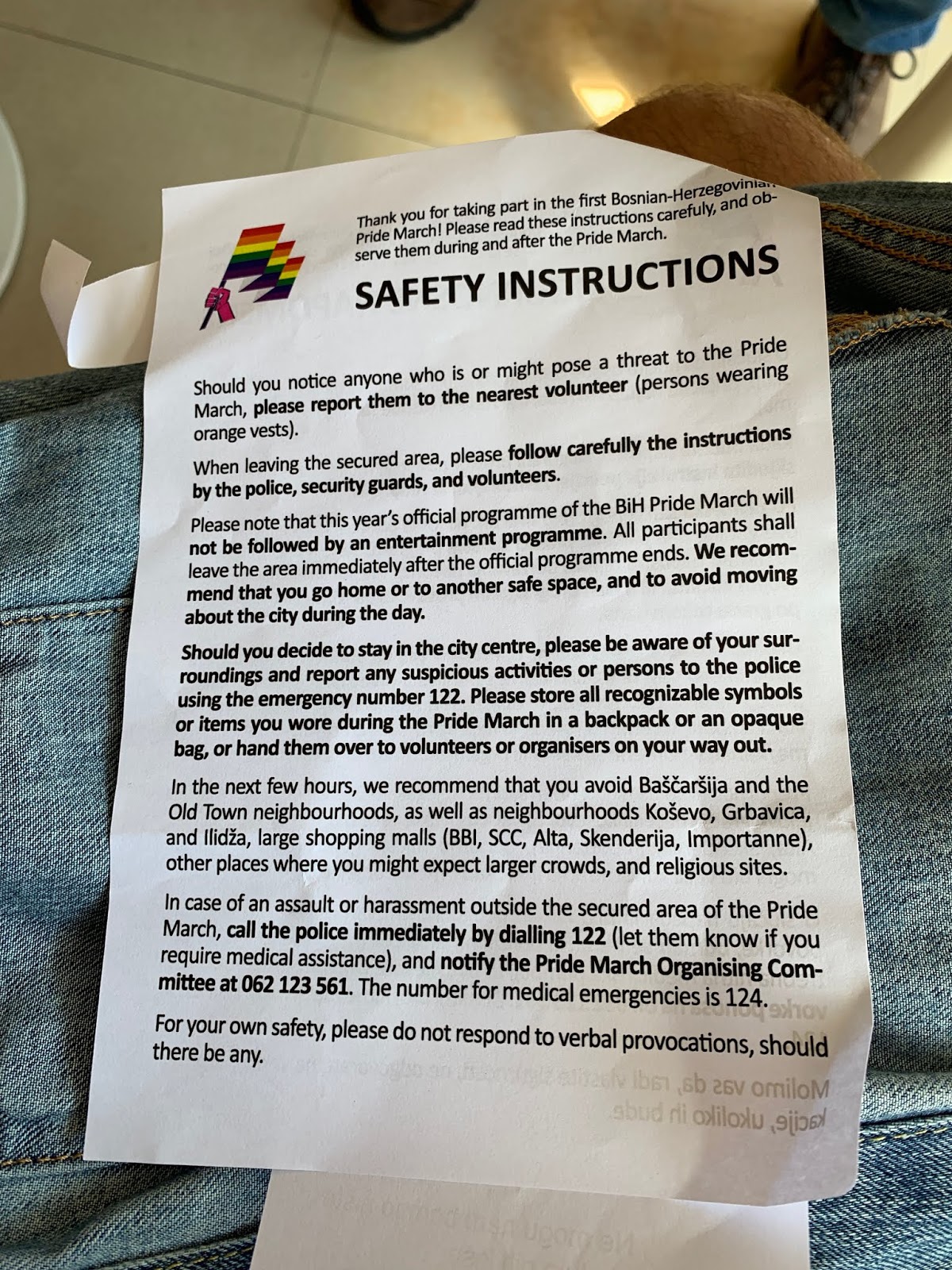
We then made our way to the main street, a minute’s walk away. The security cordon stretched between the Eternal Flame Memorial and the Central Bank, on the main westbound road from the Old Town called ‘Marshal Tito’. We turned the corner and saw a sizeable gathering that must have numbered over the expected turnout of a thousand already. We were 45 minutes away from the start. I managed to say a hello to a few activists I knew, before finding a spot to situate ourselves. Someone asked if I could say a piece to camera to say why I was here, and why it was important. I duly obliged.


As more people began to fill our space, the atmosphere became electric. Drums were banging, whistles were blowing, and a wave of chanting flowed over the crowd. Rainbow flags were furiously brandished, and placards with an array of messages were jumping up and down overhead. The crowd was well over two thousand by now.

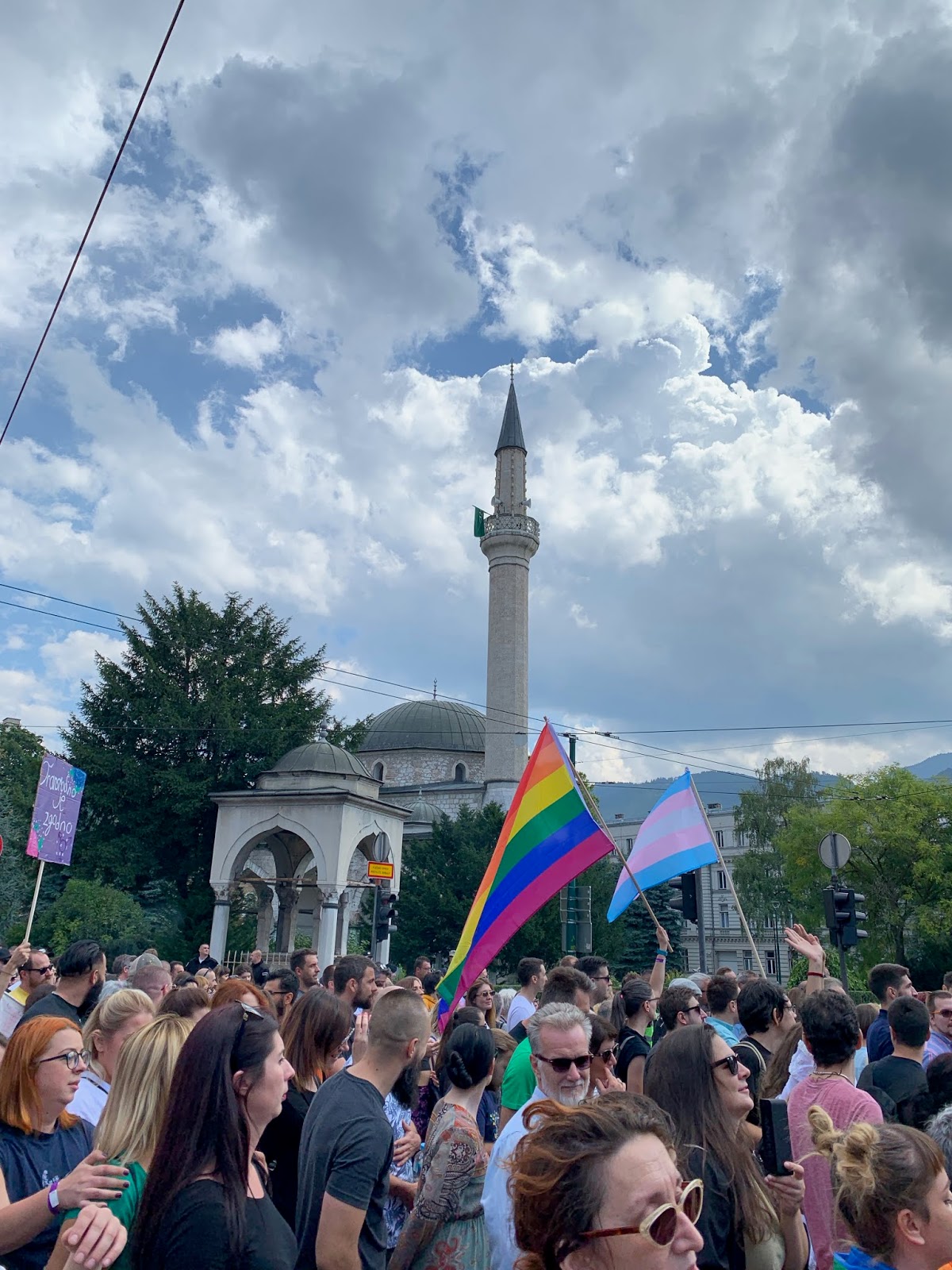
And then all of a sudden, with a cacophony of whoops and wails, we were off. And it couldn’t have been more peaceful, felt more liberating, nor garnered as much positive support than if you wished it. At first, there were no passers-by on the street along which we walked, but you could see faces in the windows of the apartments above. Only the odd face here and there, expressing curiosity. But then I noticed a young family, outside on the balcony, and they were waving. We then approached a modern mall, which had a roof terrace. It was packed with people watching. But that was it; neither cheering or heckling. Just observing. The crowd waived cheerily at them.

And as we went along, we kept seeing more faces in windows, and then people waving back. The scene that was often repeated, and which I got real emotion from, was seeing older women in their 60s and 70s, waving and clapping alone from their windows. What I took from that, and this is only a theoretical proposition with no anecdotal evidence, was they were expressing nostalgia for a time when everyone was equal, and understood having lives with and through hardship. I took their support to be one of compassion and understanding. It was just a feeling, but one that carried me all the way along the march.

We walked past aging mosques, the Presidential Office, many a war-torn building, but never any hatred. The only signs of dissent were the appearance of buses used to block the main roads into the city that crossed our route. And even then, you couldn’t see protestors. As we approached the Parliament area, a raucous cheer went up, as people in front of us turned 90 degrees to the right to look back at something. As I reached that point, I saw an elegantly dressed woman in her 70s or 80s, in a ground floor window. She had jet black hair, a black top and a large white beaded necklace. She was blowing kisses to us all. My heart lifted.

Meanwhile, as I was marching, I made a comment about someone’s t-shirt that had a sheep on it and mentioned Wales. Two women in their 50s next to me exclaimed “We’ve been to Wales!”. It turned out; they were from Sarajevo and had studied in Aberystwyth University for a number of years. We had a lovely chat about the film Pride.

The march then poured into an area where the two main roads merged, and opened out to a large expanse where the Parliament was situated. Those familiar with the siege of Sarajevo will recall many a photo or video footage of people hiding or running across this area, under the threat of sniper fire. I felt our presence now was also an act of reclaiming this space from the past. Opposite the parliament building on two sides were modern shopping malls. The terraces were again packed with observers.


The pride organisers stood upon some steps and made proclamatory speeches. My colleague, Dajana Bakic, started off proceedings. This was followed by a local artist singing two songs. One, I was told, was a Yugoslav anti-fascist song, which the crowd sung with gusto. The other was Bella Ciao, the Italian peasant song turned revolutionary anthem. Overall, the blend of LGBTI and anti-fascism proved a dynamic match, rousing a nostalgic call to arms akin to ‘Brotherhood and Unity’ but for modern times.

As proceedings ended, people sought friends who they missed during the march and caught up. Others were reeling from the high of the first LGBTI march in Bosnia & Herzegovina. Many were invited to a reception in the nearby Museum, our delegation included. This was set up to ensure a safe space following the march, should protestors try and attack people as they left. Buses were parked nearby for those to travel home, if they came from places like Banja Luka or Belgrade. At the museum, we met acquaintances old and new, and chatted with the Spanish and British Ambassadors, who were very pleasant indeed. A thunderstorm left as quickly as it arrived, but brought the reception to a natural end. Our delegation went its separate ways, but those staying for another day returned to the apartment. 


That evening, we reunited with our friend from the bobsled track on Trebević, as we were invited to a house party hosted by his friend. The evening was spent making new friends and drinking copious amounts of homemade rakija. The next day, we visited the grocery shop downstairs. In the magazine racks, I noticed one publication that had a rainbow flag on it. Inside was a 4-page article on LGBTI pride, with pictures taken of that summer’s Europride in Vienna. The magazine happened to be the most popular women’s weekly magazine in Bosnia & Herzegovina. No wonder public awareness was so high.

And so, that was my pride in Sarajevo. My departure was filled with a lot more optimism than when I arrived, and it taught me an important lesson. Don’t just count those who show opposition, and then let that skew your judgement and preconceptions of a place or people. Allow for the positive shows of support to boost your hopes for the event, and indeed the future. Also, don’t discount those who show indifference as being negative by default. The law of averages would indicate that they are neither agitated nor motivated – it’s just not a priority for them.

Until the next Bosnia & Herzegovina Pride!

Sunday, 28 October 2018

LGBTI Rights in the Western Balkans - ERA Conference 2018


In recent months I have taken on a new role on the board of an organisation known as Rainbow Rose. It is an umbrella organisation of all the LGBTI organisations associated to social democratic and labour parties across Europe. My appointment came on the back of my two and a half year co-chairpersonship of LGBT Labour. To those of you who have read my posts, my awareness of south-east Europe came to maturity thanks to my work with the Labour Party. The board want me to lead on a new working group on the Western Balkans; so it seems that the three interests of my life – Labour politics, LGBTI activism, and south-east Europe – have come together in a new and exciting challenge for me.

So the start of this work centred on my organising a delegation of activists to the Equal Rights Association (ERA) Conference for the Western Balkans and Turkey in Skopje, Macedonia. ERA emanates from civil society, so we were lending our support as social democrats in order to learn, share our knowledge and experiences, and to create networks for our new working group. Noting my affection for Macedonia, the week we visited happened to be when Macedonia had just held the referendum on its name change.

So I organised for a delegation of 11, 7 from the board, 3 activists, and one speaker. We arrived after a Ministerial meeting took place on the Thursday morning, and went straight to the plenary hall. I was with Jose, Secretary General of Rainbow Rose, who was introducing me to a few people in the room – an ILGA Europe representative, two representatives from the Commission, and Dragana from ERA. I also met Amarildo from ERA again, as I first met him three weeks previously in London, at a Western Balkans event in Lancaster House and then Speakers’ House. It was nice of him to stop and chat for 5 minutes, given he was organising the day and I’m sure had more things to be doing. The plenary then began.


We had a couple of opening speeches, one of who was by the SDUM Minister for Labor and Social Affairs, Mila Carovska. This was my first hint of the seriousness and commitment that the new SDUM-led Government had taken LGBTI rights, as well as neighbouring countries. Especially those from Macedonia, where you would have thought they could have used the excuse of the name referendum to withdraw from participating. Over the course of three panel events throughout the day, we heard from a mixture of Ministers, MPs, NGO activists, and individuals just living their lives in the countries of the region. The one particularly striking panel was on trans and non-binary rights, as it laid bare how uneven the legal rights of trans people were across the region, but also how much depended on the state having to recognise you in order to provide for you. Unknown to me that day was the SDUM MP Pavle Bogoevski, who sat on a panel on non-discrimination. Jose and I couldn’t grab him as he left, but I soon invited him to a dinner I had planned on Saturday night for the social democrats present at the conference. After our first day, we met more of the delegation who arrived in the evening, on the central square at Pelister restaurant.

On a side note, I was in my element having returned to Skopje after 2 years. On the Wednesday, I explored a little by myself as no one else had arrived. I walked through the eastern side of Karposh district, where the hotel was located, as I had not done so on previous visits. Once you turned into the residential area between two parallel east/west main boulevards, there was a hive of cafes and bars. One of them, Radiobar, was noted in the schedule of the conference as being a ‘liberal’ bar to drink at. I popped in for a beer on the way to food. On the Thursday night, I returned to the main square. It was a lot quieter that it was when I was here last, in the hot August nights of 2016. It was mid-week, I supposed. The hideous statues and building facades remained, but I noticed that the splattered paint had now gone. The traces of the Colourful Revolution may have gone, but their legacy was established within the political ones.

The Friday of the conference was the first of the two-day ‘Open Source Technology’ workshops. An innovative approach to decide what issues should be discussed, relying on what participants bring to the table and what they want to participate in. The speaker we brought over, Cllr Bev Craig from Manchester City Council and an old friend of mine, was going to pitch in to discuss how we can create LGBTI polices at the local government level. I was to present on how LGBTI people can organise within political parties, and Arturas from our delegation was to lead a discussion on whether pride is a celebration or a protest. As participants added their interest to the workshop board, I was proud that our sessions were going to be well attended.

Over the course of the two days, we had genuine interest and participation in our sessions. The one thing I wanted to avoid was a patronising tone to come from our contribution. I would be embarrassed if we were seen to have just turned up, delivered a speech on what was wrong and how our way was the best way to solve it, and then leave. Instead what we aimed to do was provide an overview of our journey, and then provide a few questions/statements in order for participants to share experiences and decide on the best action plans in each of their countries. Macedonian and Turkish participants eagerly attended Bev’s session, with many representatives of NGOs attending my own.


We on the board had to miss out on the Saturday proceedings, as we had to take the day to plan for our General Assembly that was taking place a few weeks later. The Friday evening saw us all congregate at RadioBar. This underlined the change in atmosphere that I felt whilst I was in Skopje. Although still very conservative, and LGBTI people could not be open, having a group of 100 odd LGBT people in a bar, out on the streets, felt liberating. Someone had even gone on well-known gay social networking apps to tell people that we were at this bar and to come and meet other LGBT people. A very novel and positive thing to do, I thought.

But before we arrived at the bar, 3 of the delegation were keen to see Skopje and I was more than happy to take them on a tour. Over the course of an hour and a half, I relayed my knowledge of the history of the country and the city, as I pointed out such buildings as the Government HQ, the old, brutalist Post Office and the Kale Fortress looming over the city, hidden behind those horrid buildings. We ventured into the old town, which was buzzing with a mainly younger crowd. This area has clearly seen investment as many of the shop fronts had been done up, and many of the bars and cafes had a hipster feel to it. It also seemed that this had not led to residents being pushed out, which is pleasant to see. We had a beer at one of the cafes, as I continued my history lesson. My only hope was that I didn’t bore my colleagues.

The Saturday night saw us host our social democrats dinner at La Terrazza, just off the main square. I arrived with a small number of our delegation, the rest following half an hour later. We had Julie Ward MEP, Pavle Bogoevski MP, Danijel Kalezic from Queer Montenegro, Antonio Mihajlov from Subversive Front, and Cllr Stamat Stamatovski from Skopje. Over the course of dinner, wine, and a few Rakija, we had a great discussion on the current state of politics in Macedonia, commitments to help our Montenegrin MPs set up an LGBTI working group in their parliament, as well as the great back story of Pavle.


He worked for the LGBTI Support Centre in Skopje, and it was this organisation that he said gave him a leg up in the world of work. It was his work for this organisation, too, that gave his cousin the courage to come out to his family. I was genuinely struck by how Pavle’s work and advocacy had helped his family member, and reminded me how small acts like this can help those closest to us. His activism then spread to become one of the leaders of the Colourful Revolution. I sort of knew this, having done a quick Google search of his name. But the stories he came out with were second to none. For example, in order to not be prosecuted by the authorities, instead of breaking windows by throwing objects, which was a criminal offence, they came up with using paint to merely mark the outside of buildings, as this was only a misdemeanour. This way they could make their point, without going to jail. But then the plans had to be expanded. As the police cordoned off buildings, they had farther to send their balloons of paint. So they made huge catapults in order to reach the buildings now a hundred or so yards away.  Despite getting elected to Parliament, and the paint being washed off the walls, he said that there is still a small patch of paint at the back of the Government building. When he takes guests on a tour, he proudly points out this reminder of recent political history of which he was a leading part.

That night, as we went to a bar where his cousin was actually leading a karaoke night, we rejoined the rest of the participants. The bar was packed, and Jose and I sang a rendition of Fuego. We met the Mayor of Skopje, and we thanked him for hosting the conference. I also let my guard down as, whilst I was in the queue to the toilet, I began chatting to a young woman, who asked why I was visiting Skopje. Perhaps the Rakija Pavle fed me made me lose my inhibitions, but I said I was here for an LGBTI conference. Her non-reaction to this news led on to a short conversation about why Macedonia needed to move forward on this issue. A sense of joy rose up within me.


The next day, I left Skopje full of hope. Pavle’s story and his continuing solidarity with us was a major factor in this. I look forward to his star rising. But the ERA conference really showed the power of collective action, with the participants sharing ideas and best practice, and then going away to accelerate the work they have already begun. From our perspective, it allowed for us to gain further knowledge of the situation in each of the countries and to develop our own strategy to support the LGBTI community in each country. The obvious channel is with those countries that have PES member parties in Government. But the role of our movement is not solely in getting the low hanging fruit, but to meet the challenges head on, especially when we are not in power.

Friday, 2 June 2017

Around the Balkans in 20 Days – Part 3

We decided to have breakfast in the apartment this morning, no doubt because of the effect our vodka and wine induced evening had on our reluctance to venture outside so early and in such searing heat. So coffee and (non fresh) chocolate croissants it was, before showering and packing for the day. Today the sky was pristine – not a cloud. Hence we packed sun cream, factor 50 naturally, and lots of water. We also packed ham and bread so that we could have a picnic later in the day. But first we had a task to complete.


We left the apartment, on to the main square, and then turned right aiming for the naff Arc de Triomphe replica. The only saving grace in my eyes were the remnants of the colourful revolution, etched on to the monument as a reminder of another triumph the citizens were seeking to achieve. Onwards from this the 11th October Street merged with a road from the right, its name a symbol of the start of the Partisan resistance in 1941 commemorated by the Communists. And as we walked on, symbolism from the current era was evident everywhere. To our left was a park, adjacent to the brutalist mall, which contained almost a graveyard of religious, cultural, and event-marking structures. The first to appear involved Greco-Roman men linked arm in arm, with the world being held behind them. The dates and list of names pointed towards this being a memorial to the Macedonian security services that were killed during a low level insurrection in 2001. Initially a localized skirmish, involving a transfer of land between Macedonia and what was then Serbia, escalated into an ethnic conflict. No Albanian names could be seen.

A peppering of statues that had no explicit symbolic reference led us to the end of the park. Here, a latterly installed statue heralded the first meeting of the Macedonian ASNOM in 1944 – the Anti-fascist council that was led by Tito prior to the war’s end. Kiro Gligorov, the first post independence President of Macedonia, sits prominently at the table whilst a comrade speaks from the lectern. The Government seemingly had to mix it up a bit with a statue from the Communist past. It was noticeable that there was still no Albanian statue this side of the Vardar. Opposite the park stood the Macedonian unicameral Parliament. Even it didn’t escape the ‘make-over’ of the city, with tacky domes forced onto its wings and cream paneling covering its original terracotta marble effect facade. For fear of under doing it, another man on a horse was placed outside.


After our little tour of ‘Disneyland’ we walked on. Even after only leaving the apartment 10 minutes earlier, the heat was overpowering.  We took a left at the junction and walked back towards the river, turning right at another small modern shopping mall. We picked up a fellow traveler on the way – a stray dog. What was a cute addition for a few minutes soon turned into an annoyance we couldn’t shift. The dog became aggressive towards certain passersby and fellow stray dogs. I felt both lucky to have the dog ‘on our side’ but impatient for it to lose interest in us and wonder off. However it was with us all the way to the dilapidated rail and bus station. Built following the earthquake, there was a hubbub of activity at its entrance, consisting mainly of taxi drivers and food vendors chatting amicably whilst eyeing up potential custom. We walked straight in, past the row of bus company desks to our left and a waiting area to our right, through to the other side of the station. We could not find the train station area. Outside now, we turned left towards the road, then under the bridge that supported the rail platforms. We found a secretive side entrance into the dark and unwelcoming train station hall. No one was about, and only one desk was staffed. In English, I asked if there was a day train to Belgrade. We were informed that there was not, only a night train. I was really disappointed, as I wanted to see the countryside slowly pass by as we took our first train journey. We left the desk and considered our options. We decided to ask at the bus desk for times of departures and cost. They had a couple of ‘express’ buses that only departed at nighttime and took 6 hours, and other buses departing during the day that took around 8 hours. We decided against night travel so opted for one of the day buses. It cost the same amount we budgeted for the train, so we weren’t dipping into reserves. We paid for our tickets, and I left reassured that our transport to Belgrade was now confirmed.

With our task complete, we walked back to the Ramstore, our canine friend nowhere to be seen. Whilst walking over we agreed that our next visit should be the cross on top of Mount Vodno. I was eager to go following my aborted attempt the last time I visited. So at the Ramstore, we jumped into a taxi and made our way up the windy road to the cable car. Our taxi driver was a woman in her mid-50s. She spoke good but broken English and was very chatty during our drive. She explained to us, somewhat nostalgically, that when she was in school, they had a choice of languages to learn and she chose English as it was one of the most common ones. She was interested to hear that we planned on visiting Matkasee, so much so that she gave us her number so that she could take us there tomorrow. We took her business card as we departed and waved her off.

We walked along a path with a shop in a wooden hut and picnic benches dotted within the ascending forest to our left. John was very impressed with the free wifi available in such a remote place. Very ‘back to nature’ I thought. We walked on to a ticket booth and the lower station of the cable car. We paid our £4 fee and boarded our private pod. We slowly slid up the side of the mountain, and as the trees departed we could see the city below us. At first, it was the entirety of our view, but as we climbed the whole valley came into range. Villages that emerged on the horizon soon came to be viewed from a Birdseye perspective.  As we neared the top you could see the crescent shaped valley from east to west, with the mountains to the north our only obstacle to peering into Kosovo. We arrived at the summit and departed our pod. The Millennium Cross stood stoically ahead of us, and to its right a run down restaurant that seemed closed for refurbishment. We visited the small kiosk in its base to buy snacks, and then decamped on to a table to eat our picnic whilst soaking up the views.


The 360-degree panoramic view was truly awesome. The clear day meant you could even see Serbia over to the east, towards the end of the mountain range. To the west emerged a motorway out of the city, partly taking form as a lengthy viaduct heading towards Tetovo, the predominantly Albanian town. After our picnic, we had a wonder along the mountain ridge. There were open circular wooden huts dotted across the mountaintop, only about 5 or 6. One was occupied with an amorous young straight couple. We walked along to the furthest hut, then back again, and on to a run down building that had a plaque marking a German Command Bunker – prime spot if any. We saw a workman in his 70’s emerge from a nearby building site and walk down the hill and into the thick forest just below. We took a few more pictures and then decided to make our way back down, waiting to avoid another group so we had a pod to ourselves again.


We reached the lower station, and walked over to the car park. There were no waiting taxis so we decided to use our phones (without 3G) to descend the mountain via the forest. We saw a large map on a billboard next to a large hotel-like building just off the roadside as we left the car park, but the colour coding was undecipherable. We could see from Google Maps a track through the forest, so decided to go for it. As we got off to a false start, we noticed the workman from earlier. He was obviously heading home on foot. We saw him dip into a slender gap in the forest on the side of the road, so we decided to follow him. He could have been anyone, but we decided to trust the stranger rather than our own technology and sense. Though as we descended, we saw coloured markings on trees every so often. It finally twigged, about half way down, that three different colors direct you in three different ways. I believe we took the easy route. After 45 minutes of walking on a dry dirt track, we came across man made works embedded in the forest – some form of water drainage system for the mountain – then re-entered civilization with a farm or two, then houses with grand gardens.


We passed a shop as we walked down hill in the up-market, hillside neighbourhood and grabbed a couple of iced teas and extra water, before heading to a café I researched before arriving. The downside of Macedonia is that it has a terrible record on LGBT rights. There is one LGBT resource centre that in the past has been attacked on a number of occasions; and the Dutch Embassy has done a lot to support civil society to make the LGBT community more visible, acting as a symbol of hope. However, I managed to research somewhere that was LGBT ‘friendly’. It was west of the main square 10 minutes on foot, tucked in a cul-de-sac just off one of the main boulevards. It had a bohemian pop-up vibe about it. There was an entrance gap between high walls either side, and in the middle of the courtyard stood a large tree, in a rather parched pond, with wooden seating constructed over and around it. We were the only patrons. Our thirst not even quenched by the iced tea and water, such a hot day that it was, we asked the waitress for a drink and was suggested a local specialty. I accepted and was offered basically an iced tea. Oh well. We sat in the shade for about half an hour whilst we regained energy and hydrated. The café leant against a 4 story high residential block, where we got our free wifi from, and was sheltered under the tree and a tarpaulin canopy. Upon leaving, we noticed a military truck parked nearby and a few officers. My suspicions were roused – was this place being watched? Was it really an LGBT friendly place or a trap to lure us in? More realistically, it was probably parked at the back of a barracks. We crept back out on the boulevard, lest we became associated with the ‘friendly’ venue.

The sun was starting to lower in the sky, so that the larger buildings were providing much appreciated shade from the heat every so often. After a long and busy day, we returned to the apartment for a snooze and refresh. By around 9pm, we woke up, got showered and changed again, then sat on the balcony drinking some red wine, recanting our day thus far and plans for tomorrow, whilst simultaneously observing the hubbub below. The screaming lady returned once more. After draining much of the bottle, we had to remind ourselves that we were intending to go out, so we locked up and went down to the Square. Tonight we decided to go to one of the restaurants along the riverside. The bridge looked amazing lit up in the night, with the byzantine museum and theatre looming grandiosely behind. Again, the square was busy with families and couples. We walked by the restaurants, checking out their menus, until we decided on a place that looked quite classy called ‘Carpe Diem’. We sat in the canopied section outside, eager again to observe Skopjians going about their evening. We had a full, three-course meal (John may have skipped the dessert), and two bottles of Tikves Alexandria white wine. The total bill, with tip, came to around £20. Half of that was the wine! We finished off the second bottle slowly, before setting off for the café we visited earlier in the day.


The cul-de-sac looked a lot more sinister in the darkness, but as we ventured in our eyes adjusted to the darkness that was only lightly dusted with moonlight from up above. We crept in to the courtyard, half expecting the atmosphere to be a bit livelier for an evening, so were disappointed to see only a handful of patrons. We sat towards the main building at the back - in a corner and opposite another couple 10 feet away. Our order for beer spoken in English piqued the curiosity of the other patrons, but that soon abated. Over the course of two beers, we either discussed plans for the rest of the holiday or fell into a relaxed silence, observing others in the vicinity. By 1am we grew tired again, so paid our bill and departed back to the apartment.


Wednesday, 21 December 2016

LGBTI Rights, Social Democracy and South East Europe


The coming together of three of my passions – The Labour Party, LGBTI rights, and the countries of South East Europe. This conference/workshop was a follow up from one held in Belgrade last year. Initiated by the European Forum for Democracy and Solidarity, and hosted by the Labour Party through the Westminster Foundation for Democracy; this session sought to provide practical aims and objectives for delegates, from the social democratic sister parties of the region, to pursue further LGBTI rights.

To put LGBTI rights in context of the countries of South East Europe, one only needs to look at ILGA Europe’s ‘Rainbow Europe Map’. The range amongst all the countries of the former Yugoslavia sees Croatia place 10th and Macedonia 39th out of the 49 countries of Europe. And this is solely on legislative terms. The attitude of society towards LGBTI people is overwhelmingly negative, and is hardening.

So the objectives for the conference delegates – representing Bosnia & Hercegovina, Croatia, Macedonia, Montenegro, Serbia, Slovenia and Vojvodina; as well as leads on LGBTI groups from Sweden and the Netherlands – were threefold.

First, the delegates had to contextualize the struggle for LGBTI rights. This came from speaking about their experience of furthering LGBTI rights both in society and within the party, the uneven passing of LGBTI legislation across the countries in the region and its relation to EU accession, and learning from the experiences of LGBTI social democratic groups in Sweden, the Netherlands and the UK.

Second, the delegates had to analyse and evaluate the successes and failures of integrating LGBTI rights into their social democratic parties. Here, breaking into three groups helped each group focus on one or two countries at a time, but allowing the entire delegation to pick out differences and similarities during the roundup at the end.

Third, the delegates had to then draw together an action plan for them to take practical steps to further LGBTI rights.

Throughout the conference, many shared observations were made. One of the agents of change in advancing LGBTI rights that was mentioned was the EU. Delegates commented that the EU guided the hand of Governments into passing legislation, even if only as a ‘box ticking’ exercise. Governments could easily ‘blame’ the EU on the need to pass these changes in order to achieve the overarching objective to join the EU. However, these changes have not yet acted as an agent of change in society.

Another observation was that the party leadership’s seemed to be positive towards the LGBTI community in most countries, but it was the middling and lower ranking membership of those parties that had a problem of accepting LGBTI rights. However, it was pointed out that future leaders and representatives of the parties were where delegates could exert pressure to further LGBTI rights, both in the culture of the party and future party policy. The youth sections were agreed as a starting point to entrench political education on LGBTI rights and increase activism.

And so it followed that many delegates agreed there seemed to be no comprehension amongst party members or some leaders as to how or why LGBTI rights were central to the values of social democracy. This turned into a debate on the meaning of social democracy, which the delegates would take back to their parties.

The lack of leaders, local and national, to either come out as LGBTI or be pro-LGBTI was a constant weakness most delegates raised, especially from Macedonia. Lack of visibility meant there was a lack of seriousness to accept the LGBTI agenda, as it is seen as an electoral negative rather than a potential electoral positive. Those contributors not from the region emphasised the parallel processes of greater visibility meaning greater social acceptance – and hence less electoral disadvantage.

The conference ended after delegates from each country agreed to small, achievable steps to take. These included arranging a meeting with the leader of their party, asking for a safe space in Headquarters for LGBTI members to meet, asking for an email to go out to all party members to make them aware of the existence of an LGBTI party group, setting up a Facebook group, and looking towards future local government elections to develop cost-free pro-LGBTI policies.


The success of this conference will be seen in the actions that these individual delegates take. As I said in my remarks at the start of one of the sessions, they are the founders of the LGBTI rights movements in their parties, and through those they will change laws and societies, and continue the march towards LGBTI equality. A heavy burden for them to shoulder, but one this conference motivated them to lead.