Showing posts with label VMRO-DPMNE. Show all posts

Friday, 2 June 2017

Around the Balkans in 20 Days – Part 3

We decided to have breakfast in the apartment this morning, no doubt because of the effect our vodka and wine induced evening had on our reluctance to venture outside so early and in such searing heat. So coffee and (non fresh) chocolate croissants it was, before showering and packing for the day. Today the sky was pristine – not a cloud. Hence we packed sun cream, factor 50 naturally, and lots of water. We also packed ham and bread so that we could have a picnic later in the day. But first we had a task to complete.


We left the apartment, on to the main square, and then turned right aiming for the naff Arc de Triomphe replica. The only saving grace in my eyes were the remnants of the colourful revolution, etched on to the monument as a reminder of another triumph the citizens were seeking to achieve. Onwards from this the 11th October Street merged with a road from the right, its name a symbol of the start of the Partisan resistance in 1941 commemorated by the Communists. And as we walked on, symbolism from the current era was evident everywhere. To our left was a park, adjacent to the brutalist mall, which contained almost a graveyard of religious, cultural, and event-marking structures. The first to appear involved Greco-Roman men linked arm in arm, with the world being held behind them. The dates and list of names pointed towards this being a memorial to the Macedonian security services that were killed during a low level insurrection in 2001. Initially a localized skirmish, involving a transfer of land between Macedonia and what was then Serbia, escalated into an ethnic conflict. No Albanian names could be seen.

A peppering of statues that had no explicit symbolic reference led us to the end of the park. Here, a latterly installed statue heralded the first meeting of the Macedonian ASNOM in 1944 – the Anti-fascist council that was led by Tito prior to the war’s end. Kiro Gligorov, the first post independence President of Macedonia, sits prominently at the table whilst a comrade speaks from the lectern. The Government seemingly had to mix it up a bit with a statue from the Communist past. It was noticeable that there was still no Albanian statue this side of the Vardar. Opposite the park stood the Macedonian unicameral Parliament. Even it didn’t escape the ‘make-over’ of the city, with tacky domes forced onto its wings and cream paneling covering its original terracotta marble effect facade. For fear of under doing it, another man on a horse was placed outside.


After our little tour of ‘Disneyland’ we walked on. Even after only leaving the apartment 10 minutes earlier, the heat was overpowering.  We took a left at the junction and walked back towards the river, turning right at another small modern shopping mall. We picked up a fellow traveler on the way – a stray dog. What was a cute addition for a few minutes soon turned into an annoyance we couldn’t shift. The dog became aggressive towards certain passersby and fellow stray dogs. I felt both lucky to have the dog ‘on our side’ but impatient for it to lose interest in us and wonder off. However it was with us all the way to the dilapidated rail and bus station. Built following the earthquake, there was a hubbub of activity at its entrance, consisting mainly of taxi drivers and food vendors chatting amicably whilst eyeing up potential custom. We walked straight in, past the row of bus company desks to our left and a waiting area to our right, through to the other side of the station. We could not find the train station area. Outside now, we turned left towards the road, then under the bridge that supported the rail platforms. We found a secretive side entrance into the dark and unwelcoming train station hall. No one was about, and only one desk was staffed. In English, I asked if there was a day train to Belgrade. We were informed that there was not, only a night train. I was really disappointed, as I wanted to see the countryside slowly pass by as we took our first train journey. We left the desk and considered our options. We decided to ask at the bus desk for times of departures and cost. They had a couple of ‘express’ buses that only departed at nighttime and took 6 hours, and other buses departing during the day that took around 8 hours. We decided against night travel so opted for one of the day buses. It cost the same amount we budgeted for the train, so we weren’t dipping into reserves. We paid for our tickets, and I left reassured that our transport to Belgrade was now confirmed.

With our task complete, we walked back to the Ramstore, our canine friend nowhere to be seen. Whilst walking over we agreed that our next visit should be the cross on top of Mount Vodno. I was eager to go following my aborted attempt the last time I visited. So at the Ramstore, we jumped into a taxi and made our way up the windy road to the cable car. Our taxi driver was a woman in her mid-50s. She spoke good but broken English and was very chatty during our drive. She explained to us, somewhat nostalgically, that when she was in school, they had a choice of languages to learn and she chose English as it was one of the most common ones. She was interested to hear that we planned on visiting Matkasee, so much so that she gave us her number so that she could take us there tomorrow. We took her business card as we departed and waved her off.

We walked along a path with a shop in a wooden hut and picnic benches dotted within the ascending forest to our left. John was very impressed with the free wifi available in such a remote place. Very ‘back to nature’ I thought. We walked on to a ticket booth and the lower station of the cable car. We paid our £4 fee and boarded our private pod. We slowly slid up the side of the mountain, and as the trees departed we could see the city below us. At first, it was the entirety of our view, but as we climbed the whole valley came into range. Villages that emerged on the horizon soon came to be viewed from a Birdseye perspective.  As we neared the top you could see the crescent shaped valley from east to west, with the mountains to the north our only obstacle to peering into Kosovo. We arrived at the summit and departed our pod. The Millennium Cross stood stoically ahead of us, and to its right a run down restaurant that seemed closed for refurbishment. We visited the small kiosk in its base to buy snacks, and then decamped on to a table to eat our picnic whilst soaking up the views.


The 360-degree panoramic view was truly awesome. The clear day meant you could even see Serbia over to the east, towards the end of the mountain range. To the west emerged a motorway out of the city, partly taking form as a lengthy viaduct heading towards Tetovo, the predominantly Albanian town. After our picnic, we had a wonder along the mountain ridge. There were open circular wooden huts dotted across the mountaintop, only about 5 or 6. One was occupied with an amorous young straight couple. We walked along to the furthest hut, then back again, and on to a run down building that had a plaque marking a German Command Bunker – prime spot if any. We saw a workman in his 70’s emerge from a nearby building site and walk down the hill and into the thick forest just below. We took a few more pictures and then decided to make our way back down, waiting to avoid another group so we had a pod to ourselves again.


We reached the lower station, and walked over to the car park. There were no waiting taxis so we decided to use our phones (without 3G) to descend the mountain via the forest. We saw a large map on a billboard next to a large hotel-like building just off the roadside as we left the car park, but the colour coding was undecipherable. We could see from Google Maps a track through the forest, so decided to go for it. As we got off to a false start, we noticed the workman from earlier. He was obviously heading home on foot. We saw him dip into a slender gap in the forest on the side of the road, so we decided to follow him. He could have been anyone, but we decided to trust the stranger rather than our own technology and sense. Though as we descended, we saw coloured markings on trees every so often. It finally twigged, about half way down, that three different colors direct you in three different ways. I believe we took the easy route. After 45 minutes of walking on a dry dirt track, we came across man made works embedded in the forest – some form of water drainage system for the mountain – then re-entered civilization with a farm or two, then houses with grand gardens.


We passed a shop as we walked down hill in the up-market, hillside neighbourhood and grabbed a couple of iced teas and extra water, before heading to a café I researched before arriving. The downside of Macedonia is that it has a terrible record on LGBT rights. There is one LGBT resource centre that in the past has been attacked on a number of occasions; and the Dutch Embassy has done a lot to support civil society to make the LGBT community more visible, acting as a symbol of hope. However, I managed to research somewhere that was LGBT ‘friendly’. It was west of the main square 10 minutes on foot, tucked in a cul-de-sac just off one of the main boulevards. It had a bohemian pop-up vibe about it. There was an entrance gap between high walls either side, and in the middle of the courtyard stood a large tree, in a rather parched pond, with wooden seating constructed over and around it. We were the only patrons. Our thirst not even quenched by the iced tea and water, such a hot day that it was, we asked the waitress for a drink and was suggested a local specialty. I accepted and was offered basically an iced tea. Oh well. We sat in the shade for about half an hour whilst we regained energy and hydrated. The café leant against a 4 story high residential block, where we got our free wifi from, and was sheltered under the tree and a tarpaulin canopy. Upon leaving, we noticed a military truck parked nearby and a few officers. My suspicions were roused – was this place being watched? Was it really an LGBT friendly place or a trap to lure us in? More realistically, it was probably parked at the back of a barracks. We crept back out on the boulevard, lest we became associated with the ‘friendly’ venue.

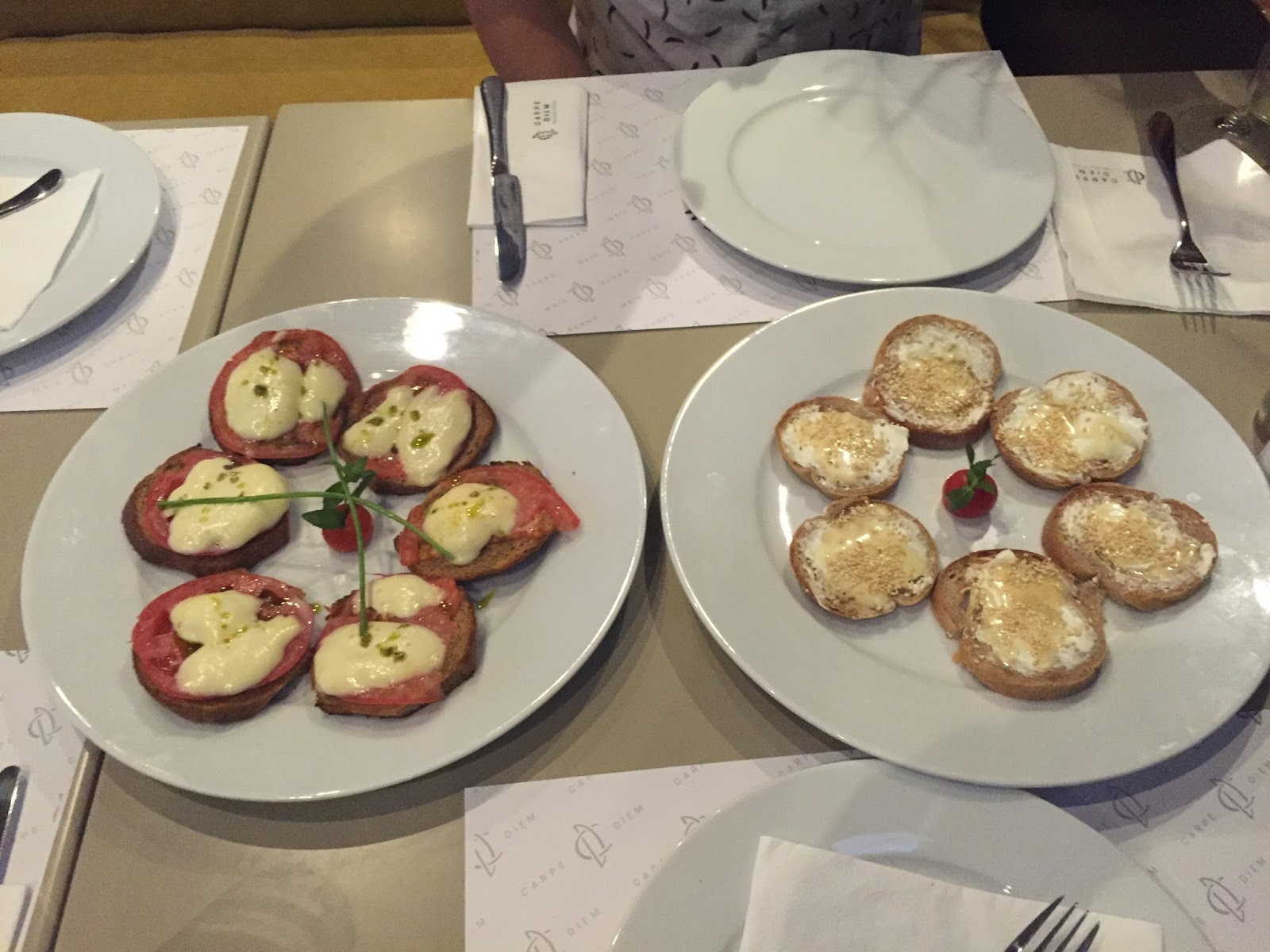
The sun was starting to lower in the sky, so that the larger buildings were providing much appreciated shade from the heat every so often. After a long and busy day, we returned to the apartment for a snooze and refresh. By around 9pm, we woke up, got showered and changed again, then sat on the balcony drinking some red wine, recanting our day thus far and plans for tomorrow, whilst simultaneously observing the hubbub below. The screaming lady returned once more. After draining much of the bottle, we had to remind ourselves that we were intending to go out, so we locked up and went down to the Square. Tonight we decided to go to one of the restaurants along the riverside. The bridge looked amazing lit up in the night, with the byzantine museum and theatre looming grandiosely behind. Again, the square was busy with families and couples. We walked by the restaurants, checking out their menus, until we decided on a place that looked quite classy called ‘Carpe Diem’. We sat in the canopied section outside, eager again to observe Skopjians going about their evening. We had a full, three-course meal (John may have skipped the dessert), and two bottles of Tikves Alexandria white wine. The total bill, with tip, came to around £20. Half of that was the wine! We finished off the second bottle slowly, before setting off for the café we visited earlier in the day.


The cul-de-sac looked a lot more sinister in the darkness, but as we ventured in our eyes adjusted to the darkness that was only lightly dusted with moonlight from up above. We crept in to the courtyard, half expecting the atmosphere to be a bit livelier for an evening, so were disappointed to see only a handful of patrons. We sat towards the main building at the back - in a corner and opposite another couple 10 feet away. Our order for beer spoken in English piqued the curiosity of the other patrons, but that soon abated. Over the course of two beers, we either discussed plans for the rest of the holiday or fell into a relaxed silence, observing others in the vicinity. By 1am we grew tired again, so paid our bill and departed back to the apartment.


Wednesday, 28 May 2014

‘Skopje 2014’ – National identities, historiography, and cross border relations

The development project known as ‘Skopje 2014’, is a multi-million Euro transformation of Macedonia Square and its area either side of the river Vardar. Unveiled in February 2010, it leans heavily on a ‘classical antiquity’ style and comprises of buildings, statues, an arch and obelisk, as well as a new footbridge. Given the turbulent political context of relations with Greece, along with a volatile ethnic situation domestically with the Albanians, my objective is to analyse the varying factors that surround the present VMRO-DPMNE government’s attempts to strengthen Macedonian national identity through Skopje’s urban landscape.

Laura Kolbe (‘Central and Eastern European capital cities’, in Planning Perspectives, 2007) conducted fascinating research into the presentation of Eastern European cities to the West via websites, and how capital cities in post-Socialism are seeking to portray themselves in a ‘European’ manner. I seek to invert this thesis and argue that ‘Skopje 2014’ is a project led by the current VMRO-DPMNE government’s nationalist discourse to ‘nationalise’ the city of Skopje for its ethnic Macedonian, domestic audience. Two problems arise from this and are intertwined. Firstly, the symbolism of the project affects relations with Greece; therefore I will seek to address the conflicting claims to Macedonian history and its impact on Macedonian national identity in view of the contemporary relations between these two states. Secondly, the location of the buildings and the perspective the individual takes alters depending on ethnicity and location within the city. As such, I will address recent ethnic Macedonian and Albanian tensions, which centre on the question of nationality, and link these to how ‘Skopje 2014’ could further entrench negative perceptions of the ‘Other’.

To deal with the first problem, I will use Benedict Anderson’s thesis (Imagined Communities, 2007) where he proposed the ‘following definition of the nation: it is an imagined political community – and imagined as both inherently limited and sovereign.’ In this sense, an analysis of Macedonian national identity needs to be understood in the context of the nation being a creation, albeit in constant construction, whose limits and sovereignties overlap on to other nations. And because, as Victor Roudometof (Collective Memory, National Identity, and Ethnic Conflict, 2007) says, at ‘the heart of the dispute lies the thesis that the Republic is the official homeland of the Macedonian nation.’, one needs to trace the emergence of Macedonia as a republic from the mid to late 19th century when national identities in the region began forming and interacting.

The geographical region known as Macedonia was mostly ruled over in its entirety, for over 400 years by the Ottoman Empire, up until the end of the Balkan Wars of 1912/13, albeit with a short spell in an autonomous Bulgaria in the 1870s. During this time, the communities that lived there identified more with their religious confession or language. However after the Treaty of Berlin in 1878 interest in the region grew, due to its strategic geographic position, from those national groups with coterminous state boundaries surrounding it, along with the Great Powers who dictated the terms of the Treaty. So, according to Jelavich and Jelavich (The Establishment of the Balkan National States, 1804-1920, 1977), Bulgaria, Greece and Serbia for ‘the last two decades of the nineteenth century […] entered into a regular battle for predominance. Their weapons were the competing churches, educational establishments and national societies.’ The resulting problem was a plethora of fluid national identities that included Bulgarian, Greek, Serbian, Ottoman and a nucleus of Macedonian in an area of conflicting claims over territory. After the two Balkan Wars in 1912/13, Macedonia as a region became split amongst 3 states. It was not until 1945 that the current territorial boundaries of the present day Republic of Macedonia came into being as a republic within Yugoslavia.

Victor Roudometof’s explanation of this period reads of ‘national narratives’ emerging prior to the Balkan Wars; yet for him the failure of inter-war Greek and Serb cultural homogenisation projects was the turning point for ‘Macedonian’ to be viewed as a ‘national’ identity instead of a regional one. In his view, the post-1945 period was the starting point for the articulation of a Macedonian ‘national narrative’, with the support of the institutions of the second Yugoslavia, geared towards nation building. So after 1945, people grew up and lived in a Macedonian national culture with a Macedonian national identity. In other words, a Macedonian nation only began to emerge after a territorial state was created to support the development of an exclusive ‘national narrative’. Ulf Braunnbauer points to historians and historiography as aiding the construction of this ‘national narrative’ because ‘Macedonian historiography had a nationalist perspective from the very beginning.’ This is because historiography was needed after 1945 to consolidate Macedonian national identity to counter perceived Bulgarian territorial expansion.

This constructivist observation of the development of Macedonian national identity leads to the current dispute between Greece and the Republic of Macedonia over the claim that the Republic is the home of the Macedonian nation. Evidently, ownership of Macedonian history is essential for one side to claim the nation (and thus identity) as their own, and this has been argued on both sides through claims to historical continuity. Loring Danforth (The Macedonian Conflict, 1995) believes ‘The view of history on which the argument for the Greekness of Macedonia is ultimately based is quintessential nationalist history that reifies both the Greek nation and Greek culture and seeks to demonstrate the unbroken continuity of the “Greek” race and “Hellenism” from the dawn of history to the present.’ Therefore Greece rejects the dual notion of a Macedonian nation within a Republic of Macedonia because they claim ownership of Macedonian history through continuity. Some Macedonians do try and counter this with their own version of continuity to antiquity, but most focus on the classic cultural reawakening of ‘Macedonian’ in the 19th century that underpins modern Macedonian nationalist thought. Ulf Braunnbauer ((Re)Writing History, 2004) sees this as a continuation of the ‘national history’ paradigm, in to the post-Socialist era. This is due to the lack of funds which deprive researchers access to external ideas, a government that still monopolises research; and researchers who feel obliged to focus on a specific era (19th and 20th centuries) for fear of becoming unemployed for speaking out against their elders. Therefore Macedonians are still only able to focus on researching their ‘own’ national history so that they can continue to legitimize their national identity by adding to the Macedonian ‘national narrative’. So what we have are two states who have different claims to some elements of the same history, whilst simultaneously trying to deny the other’s claim.

So how does the ‘Skopje 2014’ contribute to this reification of nationalist history? If the Macedonian ‘national narrative’ is an ongoing phenomenon even in post-Socialism, then ‘Skopje 2014’ attempts to further consolidate national identity symbolically in the city. ‘Conceptualised as an attempt to reshape the capital’s outlook by adorning the city centre with numerous monuments […] the project has been criticized as yet another dimension of the overall endeavour to redefine the public space, to bring about historical revisionism and to effect the invention of traditions.’ This is how Ljubica Spaskovska (In Search of a Demos, 2010) observes the project. Even before this project was announced other symbolic gestures were made in and around Skopje to complement the renewed attempt to solidify Macedonian national identity through a nationalist discourse of history: the renaming of the city airport to Alexander the Great, the naming of the city stadium after Philip II, the construction of a Christian Cross to commemorate 2000 years of Christianity, the use of the Vergina Sun symbol on the Republic’s flag, and so on. One could even question the intent of building the Mother Teresa memorial house as an attempt to claim her for Macedonia, even though she was born into the Ottoman Empire. Therefore the additions to the urban landscape continue in this reification process: The Alexander the Great statue in Macedonia Square, statues of leaders of the Ilinden Uprising of 1903 and religious figures, buildings in ‘classical antiquity’ style including a museum and so on.

But one can’t place this in the urban landscape alone in space and time. Cities are constructs too, and are representative of the varying political, economic and cultural discourses that the city has gone through. Just as one can’t create a homogenous community motionless in time, a city is a collage of all that came before leading to the present. Nuala Johnson, in her study on ‘monuments, geography, and nationalism’ (‘Set in Stone’, in Environment and Planning D: Society and Space, 1995), states that ‘geographers are just beginning to examine the relationships between memorialisation of the past and the spatialisation of public memory.’ These processes are being carried out with ‘Skopje 2014’. But problem the nationalist discourse has is that other histories are present that it has to compete with, such as the Socialist one and Ottoman one, in buildings that remain in the city. These include the Stone Bridge, Old Bazaar, Kale Fortress, Socialist apartment blocks, shopping centre – along side modern capitalist constructs such as the Rammstore. However the Macedonian Government still attempts to coerce its ethnic Macedonian citizens into collectively remembering their national history, by presenting the ongoing ‘national narrative’ of an imagined history through ‘Skopje 2014’. Furthermore this attempt is a deliberate provocation of Greece by trying to devalue their national identity through claiming ownership of a shared history.

In tandem with this reification and display of Macedonian national identity comes the distancing of Albanians from ethnic Macedonians within the confines of an independent Macedonian nation-state. I seek to narrow this to the two sides of the river Vardar where ‘Skopje 2014’ is placed, by looking at the demographics of the two municipalities that comprise it, Tsentar and Chair. The 2002 population census shows that in the Tsentar municipality of 45,412, 38,778 or 85% were Macedonian, and 1465 or 3% were Albanian. The 64,773 residents of Chair municipality comprised of 15,628 or 24% Macedonian and 36,921 or 57% Albanian. The rest of the population was made up of other minorities. Nationally the figure was 64% Macedonian and 25% Albanian. The conflict between these two groups was not based on a struggle over shared histories; instead theirs was a conflict over citizenship in the newly independent Macedonian state. Ljubica Spaskovska’s paper on citizenship and belonging presents a detailed narrative of how citizenship policy in Macedonia developed and contributed to the isolation of Albanians vis-à-vis their relations with Macedonians. The initial downgrading of their nationality in light of their position in the former Yugoslavia and inception of an ethno-national citizenship led to articulations of discontent and the desire for a new framework; in parallel to other factors accounting for Albanian discontent with the new state and its institutions. The Ohrid Framework Agreement in 2001 and the continued practice of consociational politics, just emphasise the differences between the two communities. So the relationship between nationality and citizenship can be expressed as the nationalisation of citizenship by the Macedonians, to the disadvantage of the Albanians. This feeds into insecurities that Albanians have regarding the rise of Macedonian cultural hegemony, and a lack of belonging to such a nationalized state.

Viewed in the post-socialist context of Skopje, one could see this as the pushing of minorities to the periphery or hiding them altogether. This is a mirror image of what Setha Low (‘The Anthropology of Cities’, in Annual Review of Anthropology, 1996) describes as a ‘Divided City’, the notion being that there are hidden barriers of race and class. The location of the buildings on the riverside is one example of how this idea can be linked to the spatial planning of ‘Skopje 2014’ in ethnic terms. If viewed from Macedonia Square, or read as a ‘Macedonian perspective’, then it blocks out the view of the Old Bazaar, and the Kale Fortress. Conversely, if one stands on the Albanian side of the Stone Bridge, the Albanian perspective is that of Alexander the Great on horseback striding towards the Albanians with the cross of Christ up upon the hillside behind. The former can be read as a wish to block out certain elements of non-nationalist history. This can also evident in the recent disputes over the renaming of city streets. The latter can be taken as an attempt to remind the Albanians of Macedonian cultural hegemony conjuring up an image of an historical leader ‘leading’ Macedonians across the river, as an attempt to rewrite history and to collectively ‘forget’ the presence of Albanians.

In conclusion, ‘Skopje 2014’ can be viewed as a continuation of 6 decades of Macedonian nation-building, in the form of urban planning and spatial development. On the one hand, it is an attempt by Macedonians to claim single ownership over Macedonian history against Greek attempts to do the same. This is present in the numerous symbolic processes undertaken and ongoing in the city of Skopje, in an almost ‘Andersonian’ attempt to (re)create an imagined Macedonian community. On the other, this attempt at developing a national narrative through ‘Skopje 2014’ is excluding the sizeable Albanian minority, already fearful of their place in the nation-state due to citizenship issue, compounded by their lack of presence in the present constructions of Skopje. This may be a matter of perspectives on the construction through the location of the individual in the city. So going back to Laura Kolbe, the Macedonian government is not looking externally to present the city to the world, but is looking internally to its domestic, Macedonian audience.

Addendum

Since writing this in early 2012, more constructs have occurred, and some political changes. The VMRO-DPMNE have recently won their third term in office, yet in the previous municipal elections they lost the Mayoralty for the area where the regeneration is occurring. This led to questions being raised about the hefty cost and  the possibility of halting the construction.

Further updates to the vista of constructions include galleons on the river, the ‘updating’ of commercial buildings on the square, and the transformation of the National Assembly building. All maintain the ‘national narrative’ of the ruling party. Yet, succour was paid to opponents both political and ethnic. Further statues were added recognizing socialist or communist ‘national’ heroes. Yet this just underpins the nationalist zeal with which the ruling party is imposing its version of history. It’s only of those it deems worthy of appearing in its nationalised public space.

In the Albanian area, a statue of Skanderbeg was allowed. But this reifies ethnic division on two levels. It allows Albanians to have ‘their’ own statue, but it is geographically placed outside of the arena where the other projects are occurring, thus symbolically isolating the Albanian community in the present. Yet it also isolates the Albanians historically as the choice of idol doesn’t fit in with the Macedonian ‘national narrative’, thus creating a separate (and deliberate) bridge between past and present for the Albanians. So the project has continued to pursue the path of division in the name of ‘a’ perspective of what being ‘Macedonian’ is meant to be.