Thursday, 6 March 2014

The former Yugoslavia and the descent into ethnic conflict


Many are familiar with the outcomes of the conflicts that consumed the republics of the former Yugoslavia in the early 1990’s. Many thousands were killed, hundreds of thousands were displaced or made refugees, and homes, businesses and even entire towns were destroyed in the process. Yet attempting to establish a clear view of the origins of the conflicts from the present draws attention to the multitude of forces and factors that have been presented in an attempt to account for such origins. I will delve into some of the many theoretical perspectives that have been developed to understand how ethnic violence was capable in the now defunct state that took pride in its multiethnic character. One must first understand the nature of nationalism, as this is the touchstone idea that all theoretical perspectives on ethnic violence emanate from. I aim to avoid a chronology of the events, and instead I seek to provide a series of thematic debates around some of the contested views regarding the forces that contributed to ethnic violence. I will look to forces of a political, historical, social/psychological, and cultural nature and critically analyse their validity. I shall then pull together the views on certain fundamentals, such as whether the conflict was inevitable or premeditated and if it was elite or mass led, or a combination of both.

Ernest Gellner (Nations and Nationalism, 2006) defines nationalism as ‘primarily a political principle, which holds that the political and the national unit should be congruent.’ He goes on to say that sentiment is the feeling that is aroused when this principle is either achieved or violated, and that a nationalist movement is the sum of physical acts derived from such sentiments. Taken at face value, Socialist Yugoslavia could not be described as the realized goal of a nationalist given that numerous peoples, nationalities and ethnic groups lived within its borders. Nationalism as an all-pervasive ideology has been blamed for conflict, however, what is of more interest is how an ideology manifested itself and how it had to fit on to a culture for it to be adopted by its people, as Erwin Staub suggests (The Roots of Evil, 1989). Nationalism was not new to the region prior to the 1990’s, but neither was it as ferocious as what was later witnessed. The redefining of state boundaries in the early 1990’s along with the geographic placement of ethnic groups within them are viewed as the watershed moment for the conflict to have begun, and I will now turn to the first of several theoretical viewpoints that lead towards this point and the violence being ethnic in nature.

Rogers Brubaker (in Daedalus, Vol. 124, No. 2, Spring, 1995) provides a theory centred on the political dynamics surrounding the collapse of the Yugoslav state. His triadic nexus of national minorities, nationalizing states and external national homelands portrays a relational perspective to the Yugoslav break up between these three. Because of the ‘nationalization of political space’, since the bigger political space has now evaporated, those constituent nations now dwell in pockets in new states where another dominant nation now governs. Citizenship in one state is balanced with ethno-national affinity with another. So an individual is at the centre of the triadic relationship going on, and of two nationalisms being played out; one in the state they reside in, and one in the ‘home’ state. Conflicts arise because of new reconfigurations of the triadic nexus. Nationalizing states partake in the elite-led promotion of a homogenous nation in a heterogeneous society, where there is a large national minority who is organised yet politically alienated. This group makes demands based on real or perceived threats to their wellbeing, and are closely watched by elites in their ‘homeland’ who protest on their behalf for their rights. The conflict in the former Yugoslavia should be seen in this triadic form. Three overlapping processes consisted of nationalizing Croats both before and after independence, disaffection and nationalist mobilisation of Croatian Serbs in the borderlands, and the development of a belligerent homeland stance in the Serbian state leaning on a Serbian dominated JNA to create a Greater Serbia out of the federation. So the Croat secession wasn’t simply a response to Serb assertiveness within Yugoslavia, but a nationalizing process by Croats. The interplay between these three processes acted as catalysts for people to become involved because of their perception of and reaction to events in one of the other two processes. These were founded on representations that had to be developed from monitoring situations in the other fields, and packaged in a way for people to be mobilized. So although he believes the processes to be elite-led, they had to have support from the masses. He takes the view that after an event occurred; new perceptions or responses were triggered. So he looks at the contexts of an event in relation to what went before it that acted as a trigger. This created the conditions for an escalation of events, the catalyst being the political leaders. However he looks at the process of the break up in isolation from the processes that led to the break up.

Jack Snyder (From Voting to Violence, 2000) believes democratisation played a role in this. He believes that nationalism is weak prior to democratization, and that this process actually produces nations and nationalisms. When political leaders wish to garner support, yet not to relinquish too much power to the citizen, they provide for partial democracy using nationalism to gain it. The timing and context of democratization varies the nationalism that results. Exclusionary nationalism occurs if the country is poor, the citizens lack skills to participate in democracy, and when politicians, the media and institutions are weak during the beginning of the process. This is what occurred in Serbia and Croatia. In pre-conflict Yugoslavia democratization and political decentralization led to communist elites fearing for their position, giving them an incentive for leading popular nationalist movements. Decentralization and the ethnofederal nature of Yugoslavia allowed these elites to use the institutions at their disposal for this advancement. Four factors allowed for democratization to lead to nationalism and then ethnic conflict. First, he argues that ‘Historical legacies created the conditions from which conflict could emerge…’ Secondly, the structure of the federal system, tying ethnic groups to republics, was conceived in order to deal with the nationalities question but instead it created divisions within Yugoslavia, that not only nationalists favoured but liberals also, and became represented as a debate between Slovenia and Croatia on one side, and Serbia and the Army on the other. Thirdly, challenges with the economy were in tandem with the maneuverings of political elites to gain support on the onset of a more open political system. Finally, the media were an important factor in that the ethnic republic leaders could monopolize as much as they could. Journalists and intellectuals who disseminated nationalist myths aided this. But this only fed into prejudices that were already present therefore a supply and demand scenario existed. The only downside to this argument is that it doesn’t account for the rise of Franjo Tudjman as President. His portrayal can be seen to mirror Slobodan Milosevic’s conversion during democratization, but not of an anti-communist figure that rose independently of the state structures. He was more a figure of ‘Historical legacies’ if anything. However, Snyder does provide three more political factors that I will now approach. 

Marshal Tito’s policy of ‘Brotherhood and Unity’ sought to erase the competing nationalist versions of World War II history by providing a narrative that united the new Yugoslavs around a Partisan myth versus internal and external fascist enemies. The new socialist Yugoslav constitution developed a system of republics, most of which had a nation tied to them. In addition to this there was the guarantee of equality of the nations throughout the republics, for those who do not live in their ‘home’ nation. And this is where Sabrina Ramet believes Tito went wrong. In her epilogue in Balkan Bebel she argues that when Tito opted to tolerate the already present cultures based on a thin ‘Yugoslavism’ anchored in the Partisan myth, instead of creating a new Yugoslav identity, he embedded the continual resurfacing of inter-group hatred from the World War II era. Therefore the trauma of those who experienced it never went away. Anthony Oberschall (in Ethnic and Racial Studies, Vol. 23, No. 6, pp. 982-1001. November 2000) agrees with her focus on the Yugoslav constitution but for a different reason. He felt that because there was a balancing act going on to appease all the different ethnic and national stakeholders in the country, any attempts by nationalists to alter it would obviously focus on issues including the drawing of boundaries and placement of peoples. But he prescribes democratization as the antidote to nationalists employing ethnic cleavages. This is the opposite of what Snyder argues as he placed democratization first with the rise in nationalism as the consequence. I would agree with Oberschall that nationalists would try and alter the borders of the republics, but his approach is set within the context of a communist state where nationalist communists were the actors who could affect that change, and this wasn’t the case. Democratization led to the election of both a nationalist ‘communist’ in Slobodan Milosevic and an outright nationalist in Franjo Tudjman. Therefore the rules of the game changed. The borders issue became more prominent once Tudjman made the calls for secession because they would lead to international state boundaries, not internal republic borders. So the issue became a lot more contentious and therefore more open to conflict. Given that republics were tied to nations, this provided the ethnic paradigm. To add to this E. M. Despalatovic (in Halpern & Kideckel’s Neighbours at War, 2000) makes the point that when Croatia was gearing towards independence and after the HDZ had won the elections; they fired Serbian communists – not because they were Serbs but because they were communists. So the result of democratization was the removal of communists in the state bureaucracy yet presented as removal of the Serbs. This feeds into Brubaker’s argument about opportunities for political leaders to represent the other process, here the nationalization of the Croatian state. In terms of contributing to ethnic violence, economic issues pale into the background, but they do add to the factors that may have left the population frustrated and motivated to turn to nationalist politicians and be receptive of their messages.

But people were receiving messages from other sources, namely the media, as pointed out by Snyder. Bette Denich (in Halpern & Kideckel’s Neighbours at War, 2000) provides a compelling case on the lack of communication between the numerous elites and amongst the various ethnic populations. Denich’s argument is that there were two processes going on. First, Serb and Croatian nationalists were arguing over the overlapping nature of their claims for territory, which meant that they were only concerned with their own nationalist version of truth, and not listening to others. Second, this meant that the ordinary people weren’t listening to each other either, helped by the media’s portrayal of events. The narratives at play, victimization and threat, fed into those who weren’t ‘nationalist’ before. Only those not involved in an ethno-nationalist framework were distant from it, but they were few in number. In employing Benedict Anderson’s assertion that print capitalism played a part in the forming of commonality prior to nation-state formation, she points to mass media that was devolved to the republics, which carried narratives produced by the intelligentsia’s of the republics based on the raw materials of ethnic identity. The media in each republic therefore pushed different perspectives on the same news to different audiences who reacted differently. The portrayal of victimization by each media and of the ‘other’ as a threat, coupled with no actual response to the ‘other’ only their projection of them, led to an escalation of the perception of the ‘other’ as being a threat. Without other contrary viewpoints, these perceptions grew and became exaggerated. Therefore the media was employed as a tool to foster conditions on the ground that led to ethnic tensions being raised backed by each republics leaders and intelligentsia. To link with Brubaker’s triadic nexus argument, the communication of representations was key for the processes to interact with each other and produce different responses to events. So the media was complicit in fostering those conditions.

So what we had was a combination of political forces that interacted with each other, and played off each other, which fostered conditions for ethnic violence the former Yugoslavia. Established political elites sought to exploit the move to democracy for their attempts to cling on to, or reach, power in their home republics, using the existing structure of the Yugoslav state; and the ideology of nationalism as tool to garner mass support by communicating through republic owned media outlets. This led to the collapse of the League of Communists as an institution and the subsequent undermining of the Yugoslav state that had been created to unite the nations of the South Slavs. But solely pointing to political forces leaves out the emotional connection people at the grassroots level had and could relate to.

Historical forces are another viewpoint from which to understand the conditions that were created to lead to ethnic violence. Norman Naimark (Fires of Hatred, 2001) points to both the Serbs and Croats prior to the conflict exploiting their versions of recent ‘history’ in order to mobilize their respective ‘nations’. ‘The Serbs in Krajina mobilized around the threat of a new Jasenovac…’ and rested on past and present inflated numbers of Serb deaths there during the Ustasha state. Whereas the anti-communist Croats connected the Serbs to the communist legacy by pointing to Croat massacres under Tito at the end of World War II. These messages were relayed by the media, which was controlled by both Milosevic and Tudjman. These fed into repressed memories of those who lived through them times and were thus employed as a tool to mobilize them. He feels that the brutality displayed during the war in Croatia had ‘to do with the history of the region since 1940 and the urban social groups that fostered Serbian paramilitaries than it did with the inheritance of the distant past.’ His latter point regarding outsiders coming in to the area to stir up conflict, I will approach later. He does have a valid point about the present use of selected (and perhaps contested) historical facts to underpin nationalist rhetoric. But this argument doesn’t go far enough in the sense that there is a detachment between those who lived through the experiences of World War II and those who have grown up since; he doesn’t account for their mobilization. Aside from factors that have been mentioned up to now that could have motivated this group of people, Victor Roudometof (Nationalism, Globalization, and Orthodoxy, 2001) argues that it is necessary to take into account the educational mechanisms responsible for the production and proliferation of stereotypes. ‘As the different nationalist agendas of the Balkan nation-states gradually became enshrined in regional historical discourse, they inevitably found their way into songs, schoolbooks, and local traditions.’ Thus collective memories were acted out daily and were barriers to solving the problems of the 1990’s. Because there was no outlet to answer the ‘national question’ under communism, the 1980’s saw a revival of historical revisionism. In the 1990’s, history was ‘renationalized’ and used as a tool for ethnocentric propaganda. There are two links here; the first being Sabrina Ramet who said that communism didn’t provide a vehicle to openly discuss the traumas of World War II. But Rogers Brubaker better links the past to the present in his triadic view of the Serbs ‘as active participants in the intensifying conflict and as political subjects in their own right, construing (and misconstruing) the dangers of the present in the light of the atrocities of the past.’ This linking of the past to the present leads on to ethnosymbolism and cultural forces in general.

Stuart Kaufman (Modern Hatreds, 2001) argues from a ‘symbolic politics’ perspective on the cause of ethnic war. He believes that two roots to ethnic violence are mass-led or elite-led. Developments of three factors are crucial to reach this end, mass hostility, ethnic outflanking by political elites, and a security dilemma. By mass hostility he refers to an external affinity problem (i.e. a group is a majority in the state, but a minority in the region), a history of ethnic domination, or issues over ethnic symbols. A security dilemma can occur when these threaten other groups, and when outbidding by extremist leaders in power up the ante on this because of a perception of extinction on either side. So he believes that ‘If the necessary conditions for ethnic war are myths, fears, and opportunity, the timing of the war is explained by an increase in fear, opportunity, or hostility justified by the myths.’ This could be down to a rise in symbolic events or where a political opportunity presents itself, which determines whether it is elite or mass-led. Conversely, a lack of ethnic symbolism can be seen in areas where ethnic violence didn’t occur but had mixed ethnicities. His judgement is that relevantly modern hatreds, found in renewed accounts of myths and stories, inspired the killing in the former Yugoslavia, which links into the arguments set out by Ramet, Roudometof and Naimark. Events in Yugoslavia were elite-led, albeit with ethnic hostility already being present amongst the masses, which ramped up the low level hostility through fears manipulated by symbols and myths. Roudometof agrees with the power of symbols, myths and stories that were used as mobilizing tools, and he places a time on when their true potential was realized. After the independence of Croatia ‘the new ethnic symbolisms emphasized the explicit ethnic character of the proposed new state.’

Although Ramet agrees with Kaufman on the traumas of World War II being relived and that Milosevic was tapping into already present hostility because ‘He catered to them, manipulated them, and amplified them.’ She fundamentally believes that because these people were culturally diverse they weren’t going to get on. So a chasm opens up here between the idea that it was the fault of political leaders who utilized symbols and myths of the past to conjure up ethnic hatred and violence in a once stable society, to a fundamental questioning of the reason why these people were ever placed in one state. The fact that different cultures were put together in the first place almost justifies Ramets’ argument that Milosevic (and others) had a simple task to achieve their aims, and this is where I disagree with her assertion of inevitability. It had to be linked to other ongoing processes at the time or else these groups would have been in conflict before the 1990’s, and this is where Kaufman’s argument stands up to scrutiny.

However, other social or psychological factors played a role in the path to ethnic violence. The first tranche of these focus on predetermined characteristics that could account for ethnic violence. Remembering Snyder’s point that nationalism was weak prior to democratization, I return to Oberschall whose approach to ethnic violence leans on two cognitive perspectives that Yugoslavs were meant to have had when conducting relations with other ethnicities. ‘People possessed both frames in their minds: In peacetimes the crisis frame was dormant, and in crisis and war the normal frame was suppressed. Both frames were anchored in private and family experiences.’ He points to the Tito-era as a time when the normal frame was activated, but he links the events of World War II and the 1990’s as one of repetition. He draws on personal history as a force for the actions of the present, and ties this to psychological factors inherent in the people of the former Yugoslavia. But to understand his theory he places it into the context of the 1990’s conflict and uses it to answer the question of why a people who lived harmoniously for forty years began to kill each other. The crisis frame was triggered by elite manipulation in the context of a security dilemma, so here he links to Kaufman’s theory. Benjamin Valentino (Final Solutions, 2004) narrows this notion of some form of individual cognitive frame, experienced by a collectivity. His approach to the cause of ethnic violence goes back to the argument of it being elite-led. However, he believes that instead of the masses participating in a wide spread melee, the violence was conducted by a small group of people with the rest of the population as bystanders. Because only a few people are perpetrators they are selected, and can be fanatics or those manipulated by elites in certain situations. He divides perpetrators into two types, ones who are innately biased towards violence and others who are ‘ordinary’ yet are seduced into it. So psychological factors and social/situational ones motivate perpetrators to violent acts. Preexisting ideological convictions or hatred alone did not account for violence, nor can the severe brutality of some can be seen as generic to all perpetrators. Yet soldiers carry out violence as duties from the top of the hierarchy. His argument then is that all humans have the capacity to kill but it is individuals who make a choice on what they wish to do. This latter argument tied into the idea that something needs to occur for humans to kill, such as a situation or coercion, seems to be plausible, yet does run closely parallel to Oberschall’s cognitive frame idea that is somewhat rigid.

Looking at it from a different tangent, H. Grandits and C. Promitzer (in Halpern & Kideckel’s Neighbours at War, 2000) point to a historically rooted patriarchal mentality that descended from the Military Frontier, where Catholics and Orthodox were united as soldiers. These remained up to the time of the 1990’s conflict, including the predisposition to use force and take up arms. This went in tandem with the use of symbols to act as triggers to draw out different responses by reactivating historical values. This may have some weight if it can be based less on psychological/biological foundations and more on its penetration into local rituals and customs of communities. But to tie up the debate on predetermined societal and psychological forces that led to ethnic violence, I return to E. Staub, whom I quoted earlier arguing that nationalism had to fit the already present cultures for it to succeed. His wider argument is that that ‘Certain characteristics of a culture and the structure of a society, combined with great difficulties or hardships of life and social disorganisation, are the starting point for genocide or mass killing.’ He believes that most cultures possess characteristics that have the potential for group violence and that certain circumstances that they find themselves in unleash it. This underlines Grandits and Promitzer’s argument if taken from my suggested perspective. All these theories point to the circumstances of the period in the early 1990s as the trigger for all these preordained factors to become active, so there must be validity in their claims. However, I can only agree with those claims that are rooted in a sense of cultural continuity such as Staub, and Valentino to a degree, because the triggers for the violent acts need to have a human or emotional connection for these presumptions to be valid. Staub’s example of ‘life problems’ is one such link. Another could be the lived experience of World War II.

Yet Staub also provides us with a temporally linear explanation that leads to ethnic violence, as opposed to a purely predetermined one, this being the ‘continuum of destruction’. His idea here is that small destructive actions that become more routinely used can justify the next destructive action, and so on. This idea assumes the collective nature of the actions, whether they be societal or between ethnic groups. The start of such a process can be as long as the observer or researcher wishes it to be. A primordialist of an ‘ancient hatred’ tradition would see this stretch back millennia. But more modern arguments place it within the last two centuries. Brubaker’s argument regarding the impact of education places it in the 19th century. Roudometof’s theory of collective memory places it in the wake of the atrocities in World War II, if not before that. But what is of key importance here is that hatred had been building up over a period of time. This can explain two things. First the role of the bystander, and second the reason why mass killing didn’t occur straight away.

On the former point, Valentino argues that mass killings don’t need mass support, just indifference for it to occur. It is wrong to assume that the masses support it. Mass killings don’t just start from scratch, but the public show negative support by allowing legal measures and social attitudes to build up discrimination and hatred of vulnerable social groups. So no one opposes it. Accordingly they may support the regime but not the killing. But even if they do, he says it may be down to propaganda and mis-information to ‘cover up’ the extent of it. ‘Throughout the conflict in the former Yugoslavia, Belgrade sought to cover up its atrocities or characterize them as legitimate military actions.’ So this backs up his argument that ethnic violence is elite-led, and links to Staub’s ‘continuum of destruction’. On the latter point, the former argument backs up the common sense idea that mass killing didn’t just spontaneously erupt, but that the conditions had been building up and brewing for sometime. Yet, this still doesn’t explain how it did arrive at violence. Although the war was a conflict between Croatia and Yugoslavia backed up by the JNA, something altered to make it an ethnic conflict on the ground in multiethnic communities. Here we can place the idea of the role of ‘outsiders’ in fomenting trouble and stirring up ethnic violence. Sabrina Ramet describes the events between the JNA intervening in Croatia and the amassing of paramilitaries to fight in the war. Clashes between Croatian militia and Serb irregulars highlight the potential for rogue elements to act out; however, they would not without either insecurity underpinned by nationalist rhetoric or from official orders. The latter is most likely. Yet a result of these clashes was that Serb paramilitaries formed and struck at towns in Croatia. So one can see how non-official combatants brought the conflict in to the region. Or as Grandits and Promitzer see it ‘the influence of movements outside the region developed national consciousness in the area.’

Taking into account the many forces that these scholars have attributed to the creation of conditions for ethnic violence, I seek to tie up two ideas. The first is the question of whether the ethnic violence was elite or mass-led. Many if not most of the theories point to an element of elite-led participation. Some argue that it may be as basic as a leader using the raw material of hostility, such as Ramet. Others developed a more nuanced argument that included the use of the media, state institutions, the circumstances of democratization and state collapse, along with the tapping into the already held prejudices of the population via ethnosymbolism. But one must concede that without the masses divided into two or more distinct groups (whether historically or newly fashioned) then there would have been no conflict over the placement of these people. Further to that, the build up over years, if not decades, of hostility had to have been incubated at the community level for the political rhetoric to resonate. So a combination of the two approaches is an adequate answer, but this links to the second question of whether ethnic violence was inevitable or a consequence of the series of events that came before it. This depends on the perspective of time one takes when looking at the events that took place through linear time. On one side you have Ramet who argues that Tito’s failure to solve the nationalities issue at he start of the second Yugoslavia meant it was inevitable to led to ethnic violence. However, her approach comfortably sits at the ‘end of time’ with the benefit of hindsight. Others take the view, such as Roudometof, that the build up over time of hostility couldn’t have inevitably led to violence given that they lived peacefully for forty years prior to the events in the 1990’s. Therefore, one must place the actions of the past, in motion, into the context of the time period just prior to ethnic violence occurring. And this is where Brubaker and Snyder’s views become useful. This is also where intent can be ascribed, according to some of the theorists mentioned, because of the elite-led nature of the violence.

In conclusion, the forces that led to the creation of conditions for ethnic violence to occur in the former Yugoslavia were varied, and fluctuated in importance according to the theory developed. I understand the situation as follows. Hostility was already present on the ground in the communities of the former Yugoslavia, and had been building up over time, thanks in part to educational institutions and the nurturing of cultural traditions. ‘Brotherhood and Unity’ was Tito’s policy to ensure that the nationalities’ issue was dealt with after the traumatic experiences of World War II, which were seen as ‘ethnic’ in nature. Through developments in the constitutional make up of the Yugoslav state, the republics grew as power bases for a small elites to govern, especially in regards to the media. With the onset of democratization, nationalists or reforming communist leaders sought to gain (or keep) political office. Nationalism was utilized by these leaders, using the boundaries of the republics for their new state, and communicating effective ethnosymbolic messages to the masses through the media, which resonated with some due to their lived experiences in World War II. For others, the socio-economic conditions, deteriorating since the mid-1980’s, mobilized their sense of isolation in a state that was collapsing. A continuum of destruction developed and became truncated in the late 1980’s and early 1990’s, as nation-building reified distinctions of who ‘us’ and ‘them’ were, especially volatile in areas of mixed ethnicities such as eastern Croatia. A security dilemma took hold once ‘outsiders’ who used violence elsewhere in the region came into local communities coercing people to choose sides. For fear of death, those of the same ethnicity as the belligerents chose to take their side or become neutral bystanders to the violence. Therefore although one can point to the forces from history for ethnic violence, one must account for the activities of those who led the charge of utilizing such rhetoric that didn’t stop violence escalating, even actively promoting its use, in the period immediately prior to violence being committed. Ultimately, though, the participation of the masses, actively or passively, meant that the actions of the leaders could be easily justified, as they had no mass popular opposition to contend with.

Friday, 28 February 2014

My Images of SEE – 14:17, Mon 8th August

So, this morning my alarm didn’t wake us up at our scheduled time of 08:00. It was my intent to leave early to get to ‘Simeondis’ travel agents for 09:00. However, we slowly crept from our sleep to get ready for going out. Liam was frozen all night, him sleeping under the air-con and all, meant he had a disturbed sleep. I, on the other hand, stirred only once. We departed our hotel at 09:25 and headed west towards Democracy Square. We then turned off down 26th October Street. I expected the shop to be at the bottom of this street – a good mile away. However the Law Courts, as indicated in my e-mail instructions, appeared to our left. So we crossed over and located our building. A porter indicated, using sign language, the first floor. So we went up. On the door there was a sign – in Greek. It said ‘Simeondis’ on it, but there was no answer. We tried opening it but no luck. Reading a number (and a vague similarity to numbers, a second ‘numeral’ we assumed it opened at 10:00, so we departed. To kill time, we discovered the old city wall. So we walked around the back (behind the Law Courts) via a small park, back to our original destination. The walls were a good 3000 yards from the sea, beating my assumption that they went all the way to the waters edge.


Once 10:00 had been reached, we moved in once more. Again the door remained unanswered and locked. Liam suggested we go up a floor, which we did. Lo and behold, there was the office. I produced my e-mail to the girl on the front desk. She opened her book and saw my name. I noticed it was at the top of the list for the bus that day – talk about forward planning! She took our passports, and gave us a stamped ticket and our passports. We paid €20 each for the one-way coach. It was to depart tomorrow at 17:30 opposite our building.

We then walked back to our hotel room. We rehydrated and applied sun cream before departing again – handing in our room key to the friendly reception man. Liam noticed a fort of the hill yesterday, so we decided to hike it there. So we stuck to a northeasterly route up the hill. We passed a massive open space, in front of what looked like a municipal building, which contained what one could only presume to be Roman/Greek ruins. They were spectacular, especially against the overbearing buildings around us. We then continued.


Above one of the next east/west roads we appeared to be in more residential surroundings. There were still slim and windy streets but the gradient was getting steeper. The housing must have been built mostly in the 1950s or 1970s – depending on the block. All had small balconies and over them had screens for shade. Cars were almost always parked chaotically on the road, especially at junctions. We pressed on.

Only for the local bus going past, to indicate some sense of familiarity in somewhat unfamiliar surroundings, we were best able to predict that we were on the right track. So we pushed on. We then got to a point where a house wasn't built in-between the sandwiched buildings.


The views were superb. It reminded me of images I have seen of Jerusalem – only with a bay; the crisp, turquoise sea glistening in the midday sun. Facing south, we could see east to where the airport was, scanning the bay – with its smattering of sea vessels – across to the tip of the port in the west. To our left was the old city wall, crawling past us, up the hill, to our destination. The Fort.

So we continued on for the last leg of the journey. Once we reached the ‘summit’ we realized it was closed. But I did get the opportunity to buy postcards and fridge magnets. We then went to the door of the tower, which had a decked area. The views were stunning. Now you could see the entire port too. 


Directly ahead of us, looking south was the wall striding towards the Rotunda. We could see the small, spiky tower next to the Archaeological Museum we visited yesterday, and the vastness of the Thermaikos Gulf before us. We then retreated back to the town, following the wall south, capturing a glimpse of the Rotunda close up as we went past. 


Its brick was almost sandstone like. Its accompanying tower must have been a later addition. We retraced out steps westwards down Egnatia in search of food. We intended on going ‘local’ out of a street side fast food outlet, but were put off by there being no English to help us make an informed culinary choice. So we walked down the ‘Bond Street’ of Thess, Tsimiski, and back to Aristotle Square. Here we ate at a different establishment, but still soaking up the daytime atmosphere.

Liam then wanted to witness the forum. So we walked up to Archea Agora Square, where we saw a pack of wild dogs snoozing in the shade, and onward to the forum beyond. Another sighting of a vast Roman settlement. A massive plaza in its centre but then tunnels and archways underneath, at its edge. To the right, an amphitheatre where Liam said discussions would have been held. Battling with the heat, we returned to the hotel for 14:00.


Watching some TV, it is interesting to observe how it compares to UK TV – and I do say that it is no competition. A TV show that looks like it is a 1990s repeat does actually seem to be recently made. So I opted for Eurosport – always modern!


It was on this day that I became aware of the depth of history of the city. I had known the regional history, but that it made its appearance in a city, hiding under grass, near the sea, next to more modern buildings, brought home the idea of Thessaloniki having more that what was being presented at first glance.

Since my visit, I have read Mark Mazower's Salonica: City of Ghosts (2004). This book enlightened me so much on the history of the city covering the last 500 years. Given that it rests within a Greek state, this city has been under Byzantine, Ottoman, German and Greek rule, and been targeted for rule by Bulgarians and Serbians. This was already known to me, but the diverse make up of the people that made this walled city was unknown. Most presentations of the city look at the Greek, Turkish or Bulgarian populations that inhabited this city, but lacking in study were the Jews who, up to 1912, were the largest ethnic group in Thessaloniki. The Ladidka is what remains of their physical presence in the centre. This was not only down to the mass slaughter on the city's dwindling population by the Nazi's during the course of World War II; but also because of great many a fire in the city over the years, or economic opportunities elsewhere. These residents and a host of other peoples resided in Thessaloniki over the centuries, ebbing and flowing in numbers as time went on. This book captures the vibrancy of how these people lived, how they were organised, what the customs were, and in what buildings they lived. One of my fascinations is the aesthetic beauty that buildings have, and my curiosity as to the intent of a certain style. At present the Modernist builds project rationality and purpose. But past building had other purposes that may be redundant now yet instead posses that aesthetic beauty somewhat more.

The home of Ataturk, the founder of modern Turkey, had Ottoman as its style, with its characteristic bay window which can still be seen today. On the note of Ataturk, who would now have been born in Greece, it should be remembered that after Greece took over Salonica, he was one of the Turkish generals engaged in the war between Greece and Turkey in 1923 that saw hundreds of thousands displaced. Greeks fled Anatolia, whilst Turks and Muslims fled to Turkey. This meant that by 1929, 75% of the city was now Greek. The Greek nationalising of the city could then begin in earnest.  

And it is this ethnic homogenisation, along with the binary of nationalisation/de-Ottomonization of Thessaloniki, that can be witnessed at present in the architectural and social structures of the city. This is what Maximilian Hartmuth observes in his article in Urban Life and Culture in Southeastern Europe (Roth and Brunnbauer, 2006). This leads on to the wider concepts of national identity, nationalism and citizenship, as categorisations of people, whether objective or subjective, and the processes that these concepts engage in or emanate from. But these will out in further debates. Only to finally say that Thessaloniki is a city that may seem 'modern' in its presentation, and Greek in its identification, but it has 'resided' in numerous states and empires, yet always remained regionally in 'Macedonia' (however one wishes to define its borders) whilst being historically diverse in its populations.

Wednesday, 26 February 2014

My Images of SEE – 23:04, Sun 7th August

After our brief break we left the hotel once more and headed due south towards the sea. We noticed to our right a small square with numerous restaurants there. It must have been 20:00 yet only a handful of people were in each of the 5 or so establishments. We picked one that had ‘meze’ in its title. 


We sat down to an English menu that our waiter correctly predicted we’d need, and noticed a list of Ouzo. The price was rather steep, but it was interesting to note the wide selection. By 21:20 we had finished. We had a mint-like tasting meatball platter in tomato sauce; a pastry wrapped cheese and tomato roll; a potato, bacon and cheese lasagne-cum-shepard’s pie, and stuffed peppers. All fantastic. We had beer, water and to finish – fresh slices of watermelon. All reasonably priced. Again the street sellers were out, others had musical instruments now.


We then went for a walk along the front to the place where we ate today. The moon sent a shimmering reflection down to the bay water. An ever so light breeze blew, and the locals were out in force. It must be that with the heat so high in the day that the locals only come out at dusk. We reached the square that was now buzzing with life, and sat on high stools at one of the trendier bars. This was indicated by the price of the drinks.


We observed the atmosphere enjoyed by the locals. Some with families, some men on mobiles texting away, a gaggle of girls drinking cocktails and getting chatted up by the barmen. Also an older man swooning over his somewhat younger partner – and the occasional broken glass. After finishing the complimentary nuts and crisps, we headed off back up the hill to our hotel. What a pleasant evening.


This short diary entry is a hangover from the previous one, and just rounds off the first day in Thessaloniki. It does denote my first awareness of the different daily routines that people from alternative climates have, which dictate their work and leisure routines. It also describes the presentation of eastern Mediterranean cuisine – meze/tapas in its delivery, with pastry and meat as their staple. Again, not much more to add only that the area where the square with the restaurants on was the Ladadika. This was actually the old Jewish Quarter up to World War One, and in its small area contained buildings (whether actual or reconstructed) from that time, which made it stand out from the more post World War Two modernist style of the majority of the city.

Tuesday, 18 February 2014

Thoughts on Gerald Creed's 'Masquerade and Postsocialism: Ritual andCultural Dispossession in Bulgaria'


2014 saw the relaxation of the transition controls that were imposed on Bulgaria after it was accepted into the EU as a mechanism to reduce the number of workers who travelled west seeking employment. Whilst this has been at the forefront of British media and political discourse over the past two months, and with it this notion that large swathes of Bulgarians teeming at the border eager to plant themselves in the UK, this refreshing text enlightens us with the converse notion. Creed returns to the villages of Bulgaria and their remaining residents to observe the annual celebratory events known as kukeri or survakari, and seeks to place them in their new postsocialist, globalised setting.

Kukeri, or mumming as it is known in English, is as striking in its visual display as it is unique in the rituals that it follows in the early months of the New Year. Creed, in his general introductory observations, describes the participants as usually having masks, furs, bells, a staff, and an assortment of other props. A usual celebration lasts a day or two, and starts from the making of the masks or the unpacking of ones from past events. The acts that make up this event consist, in varying order, of a procession, a ritual dance around a fire in an open space in the village, trips to nearby villages or visitors from them to perform together, setting up road blocks for ‘donations’, but all contain a central event – the procession around each of the houses in the village.

Each participant is assigned a different role, and each has their part to play during the proceedings. Even these adhere to village specific protocols. All the participants are traditionally men, their varying roles including the bride, the groom, a priest, an arap or gypsy, a bear and bear tamer, as well as other carnivalesque figures. He describes many visits, ranging from those residents accepting them cheerfully; to those who are obviously not playing the game, to those who lavish food, brandy and paper money or those less able that provide eggs, beans or coins to the guests. Mocking of the people or property through pinching or throwing yard furniture around is to be expected. The perishable booty is then consumed and money counted in the evening. This could be repeated the next day.

What Creed then does is go one to describe in more detail individual rituals but in the context of four themes: Gender and sexuality, civil society and democracy, autonomy and community, and ethnicity and nationalism. On the first, he looks at how gender relations have evolved through socialism and postsocialism, and how the mumming ritual took on or replaced lost symbolic meanings for men as women became more equal. Also, since socialism departed a Western image of homosexuality arrived and began to alter the way in which an all male troupe saw their innocent comradeship, especially centered on the transvestite bride.  Katherine Verdery and Jane Sugarman in their commanding review for the Slavic Review (Vol. 71, No. 1 (SPRING 2012), pp. 135-137) focus on Creed’s analysis of masculinity in this context, and highlight his observation that prior to the transition masculinity was a ‘whole’ and took on many behaviours, but now rested on a continuum whereby being a lesser ‘man’ equates with new ‘feminized’ behaviours. The homogenization of gender and sexuality roles is the consequence of postsocialism. In looking at civil society, he takes umbrage at the West’s perception of what civil society does and what it should look like. Mumming, he argues, has taken on this role, as the state withdrew during the transition, and it either retained or nurtured further relations between villagers and villages. Accepting that civil society can be formal and informal, in its interactions with the state, he sees elements of civil society in mumming that the West tend to ignore because he believes it is seen as a premodern ritual in a supposed modern state (i.e. a representative democracy with a formal civil society); and thus not accepted to be included in such classifications.

In terms of the third theme, he observes the paradoxes of conflict and atomization & community that the rituals express in social relations in the village. On the one hand social relations express conflict – over booty, over who plays what roles, between the performers and the villagers in their homes, or between rival groups. But it also showcases unity – in the face of ‘outsiders’ such as other village troupes, arguments between families actually underscore their unity as a ‘village’ through the autonomy and interdependence of households. Finally, in addressing ethnicity and nationalism, he looks at the character of the gypsy in the mumming ritual along side the inclusion of Roma in the events themselves. Although inclusion was ambivalent with racism still present, mumming allowed Roma to participate because indigenous Roma (according to the villagers) were ‘their’ Roma. However, the threat to inclusion was always from those who returned and never interacted with the Roma on a daily basis, anchored in ethnic Bulgarian feelings of national inferiority. And so Creed ends by mourning the modernizing trends in mumming ritual and appearance, as a result of the transition from socialism and the penetration of Euro-American norms.

Creed’s text does provide a provocative insight into one cultural event that Bulgarian’s enact by weaving it into a polemic on the legacies of socialism, the ‘transition’ and the difficulties of postsocialism for the ‘village’ and villagers. But by describing mumming as ‘modernity in drag’ he does perhaps pine too much for what he sees as a ritual that had better days before it, and perhaps even under socialism. But he does this not from a rose tinted view of the ‘golden age of mumming’, but more as a critique of how Western imaginings, assumptions and concepts have altered the symbolism and meanings the rituals had as they were carried out by the mummers. I would argue though that the cultural value of the ritual must still be worth something if villagers continue to practice it, even if it has ‘modernised’ in its attempt to be more Western. And this chimes with Creed’s pursuit to account for the increase in the practice of mumming. The fact that the celebration takes place owes much to the value it has to the participants and the observers, many who travel home to witness it, despite the overarching postsocialist and neoliberal challenges to it from outside ‘the village’.

Thursday, 13 February 2014

My Images of SEE – 17:37, Sun 7th August


To add a more personal flavour to this blog, I thought I would share with you the diary I kept when I travelled around South-East Europe in August 2011. The accounts span from part of a day or up to a day and half, depending on when I was able to sit and write. I will provide the mainly unaltered diary entry italicized, then add my current thoughts on that trip along with views garnered from readings undertaken since my MA studies; as well as some pictures of my trip. This first entry details my departure from the UK and my arrival to Thessaloniki, but I will leave this one without comment. I travelled with my partner of the time, but I have changed his name for this purpose. Enjoy.

Today is the first day of this mammoth trip that I am about to undertake, along with Liam. I will write this at the specified time, but will begin where I previously left off. However this being the first day, I should begin at the start.
I awoke at 2:07 this morning, and hour before my wake up alarm. I blame it both on the worry of sleeping in, and the apprehension of taking this trip. I wished away the minutes to 3:15 then promptly woke Liam up.
We showered, changed, received a call from the taxi firm, then had a quick brew before being whisked away to Gatwick Airport. We found our area to check in, but had to cart our backpacks to a separate location, as they couldn’t go down the normal conveyor belts. We then marched to security and swiftly got through. I needed to buy cough/chest mixture, so did so at the Boots store.
After that the boards showed our departure gate so we briskly walked the 15 minutes route to arrive there. We had a snack from Costa Coffee whilst waiting.
Within 20 minutes people were queuing up as a steward showed movement – so like sheep we obligingly followed. I notified the world via Facebook of my growing nerves about the flight.
We slowly and surely began moving. We got on to the plane, a larger on from EasyJet than I’m used to but still not massive. I luckily had my preferred seat on the last row.

Take off was fine, although I still had to show fear. We dozed off for an hour or so during the beginning of the flight. We then emerged out of our snoozing, and I decided to read the Lord of the Rings that I had brought with me. In between doing this, I kept peering out of the window with Liam as we passed over Montenegro.
The pilot then informed us that we would be passing over Tirana shortly, then begin our descent.
30 minutes later we circled the Bay, at which Thessaloniki was its head, then landed smoothly. We then piled into busses to get to the terminal to collect our bags. The weather was clear, a slight breeze but a glorious temperature. It was now 11:10 local time.
Inside the baggage hall, Liam struck gold with his bag coming out first. However a moment of panic gripped me, as mine wasn’t to be seen. So I went closer to the entry point and I could see it at the bottom of the pile waiting to get out. 5 minutes later I was reunited with it.
We then left the departure area looking for signs for a bus to the city, we followed what we found, and saw a two-piece ‘bendy bus’. I asked the driver, slowly, how much. He explained in easy English that I get a ticket out of a blue machine in the back – a choice of two. I directed Liam to the farthest door, so I took the second farthest to buy us both a ticket.


Two Euro’s later and a validation stamp meant that we had paid our way into town on this packed bus. However, armed with only a tightly focused map of the hotel, and an impression that the bus would go down the main boulevard ‘Egnatia’, I hoped a park or name would be familiar. After reaching a small, local bus station, we realized we’d gone too far. I stood up as if ready for the next stop but people were still on the bus from the airport; so again, following others (locals I assumed, too), we stayed on until the end. This happened to be the KTEL bus station. What looked like a run down domed cathedral/ice rink was in fact the transnational bus station. We could either try our luck on the 78 again, or get a taxi. Liam opted for the second option.
So I pointed out to the taxi driver the name and address on my map. He took us back the way we came and dropped us off outside ‘a’ hotel, just not ours. As we walked in another direction, he exclaimed “that is your hotel”. Not keen on offending him, we did the British thing and went to the door of the hotel, waited until he drove off, then walked to where our hotel really was – 50 yards away on the other side of the Egnatia.

A few comments on the first impressions of Thessaloniki. As we drove through on the bus going north, you could instantly tell that the recession and current financial turmoil was having its effects. Closed forecourts, empty buildings and a quiet feel of a loss of hope. We drove past a very ‘western’ shopping park towards the town proper. Upon entering its eastern city limits, you could tell it was the area of low socio-economic residents. Unkempt gardens, rubbish patterned about the place, and a lower standard of shops and services.
Once we started approaching the city centre the content of the shops, or people outside, changed somewhat, but the general ‘untidiness’ remained. Graffiti is widespread, as is the case with most European, continental countries. When we bypassed the city centre, the malaise I could sense drifted back – epitomized by the bus station I previously mentioned. The city didn’t seem alive, although I do concede that it is a Sunday. Maybe it will spring to life tomorrow.


This general feel for the city so far, although not disappointing but also not awe inspiring either, reflected my impressions of the hotel. Upon entering we were warmly greeted by a young Greek who spoke great English. He gave us our key to our room, took my passport to make a copy, and kindly highlighted a map for us to some café’s for food.
Entering the room was akin to stepping into an Agatha Christie tele-movie starring Poirot! The best word to describe it is quaint. Neoclassical style décor with tiled flooring and an old fashioned rug struck jarringly against the 14” LCD TV. However it looked comfy and had air-con. After refreshing, we departed a light lighter, grabbing my passport on the way.
We walked the 10 minutes to Aristotle Square then down to the front. We found a café with fans so sat down and ordered two salads, beer, Cola and water. All this gave us a second wind. One thing that I can see will be a regular annoyance is the street sellers. 4 times we were disturbed whilst eating. Their wares are fake DVDs and jewelry; the sellers of black ethnicity and possibly north African descent (as I don’t know the accents).


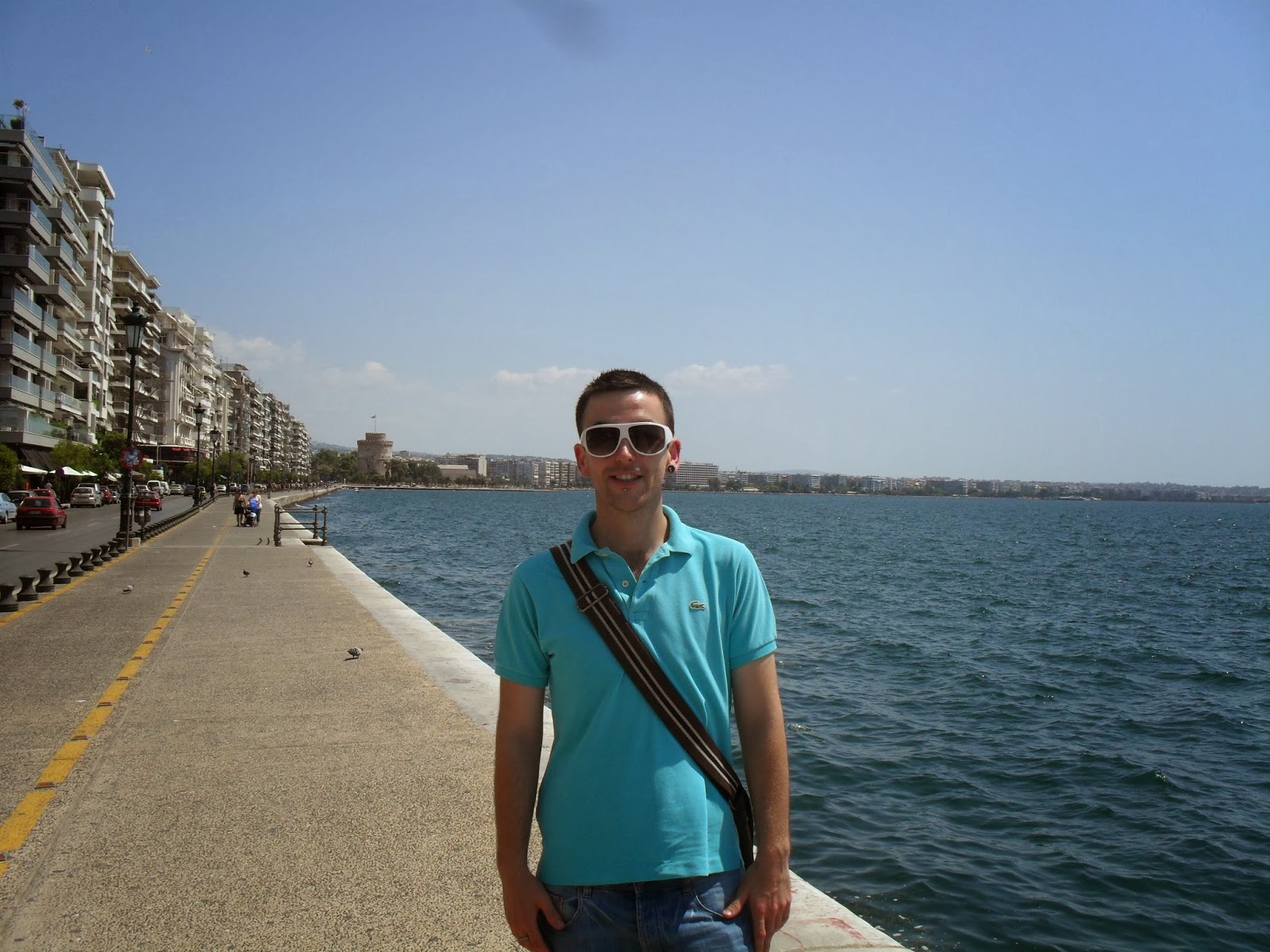
We walked eastward along the front to the White Tower. A beautiful sand-like coloured tower, some 40-50 meters tall and the same distance from the sea. We walked around and tried to get in, but as it was 14:55 we were denied entry as closing was 15:00. So we wandered back to a Starbucks we saw for a light, cool relief. Again, the street sellers were out in force.
We walked north-east from there for 10 minutes to the Archaeological Museum. €6 each and Liam was in his glory. Lots of pots, tools, jewelry, sculptures, sarcophagi, grave stones, and more reflecting 8 centuries of Macedonian culture from 4th century B.C. It was all very educational – especially the technological side to the experience.

We departed there heading north-west to Egnatia, where we came across the Arch, and further up the hill, the Rotunda. The Arch is not that impressive size wise, but its carvings were excellent. A little tired, we walked back to the hotel for a short rest.

Friday, 10 January 2014

The ‘nationalism’ question in Communist states

Given the vast number of states that had Communist regimes during the 20th century, this post will aim to compare the approaches to dealing with nationalism in the former Soviet Union and former Yugoslavia, during the early life of those regimes. In doing so, I will initially define terms such as ‘nationalism’, ‘nationality’ and the ‘nation’, using views expressed by leading scholars, and those held by leading Communists. This will enable me to link communism to nationalism as an ideology, and show how Communists understood the concepts of nation, nationalism and nationalities. I can then consider why Communists needed such definitions to enable them to establish their respective regimes, and to claim their legitimacy.

I will begin by comparing the various ways that the two regimes structured their societies and the functions that operated within it. I will look at the concept of self-determination, and judge whether these regimes followed the various components of what constitutes a nation, and to reflect on whether these considerations were met. I avoid commenting on whether the demise of these two states in the 1980’s and 1990’s stemmed from these policies, as it would be unfair not to include the other numerous factors that were involved in these processes that this post will not cover. I will finish by evaluating whether communism did indeed ‘deal’ with nationalism.

In order to understand nationalism, one must first look at the related notion of the nation. Both the nation and nationalism are modern phenomena, which both ethno-symbolist and modernist scholars on nationalism agree on (Smith, Gellner, Hobsbawm). Anthony Smith (The Ethnic Origins of Nations, 1988) begrudgingly accepts that nations can be modern, however he believes that there were ethnies prior to modernity, which had 6 characteristics, and contributed to the formation of modern nations and established lines of continuity. However his overall view implies that ethnies are somewhat rigid and bounded in structure and have not merged or split over time, which ties in to Ernest Gellner’s criticism (Nations and Nationalism, 2006). In the reverse of Smith’s argument, Gellner acknowledges that groups and cultures have always existed, but that over time they have had either firm and/or fluid boundaries. Modern nations however grew out of the radically altered social conditions that existed in the latter 18th and early 19th centuries that homogenized certain elements of pre-existing high cultures, aided by education, leading to the only unit that humans could identify with. These nations were therefore inventions, or social constructs, in the era of modernity. Albeit two conflicting arguments, there is common ground in both. Therefore I will employ Smith’s definition of an ethnie (An ethnie needs a name, common myth of descent, a shared history, a distinct shared culture, an association with a territory and a sense of solidarity) as a basis for a ‘nation’, and relate to Gellner’s idea that modern nations were created only because a certain set of conditions were reached, when analyzing the two states that are the focus of this post.

To define nationalism, I return to Gellner whose view it is that ‘Nationalism is primarily a political principle, which holds that the political and national unit should be congruent.’ Smith also agrees with this aspirational tone as the aim of nationalism, and concedes that today’s nation-states rarely have congruent lines. Eric Hobsbawm (Nations and nationalism since 1780: Programme, myth, reality. 1991) also agrees with Gellner on his interpretation of nationalism, and adds that this principle is the bond between the people and the polity, and overrides all other obligations. I will return to this theme of legitimacy later on. But both agree that nationalism came before the nation, or as Hobsbawm puts it ‘Nations do not make states and nationalisms but the other way around.’ It is this view that I align myself with, and hope to highlight during this post, in that states used nationalism as a vehicle for political legitimacy, and created nations. However, the boundaries of such terms as the ‘nation’ or ‘state’ will be picked up later.

Finally nationality, or national identity, can be described as identification with the nation-state or nation.  This can be how individuals describe themselves, or have it bestowed on to them as an individual. The different applications of this term will be evident in the rest of this post.

Having now defined the terms that I will use in this essay, I can now look to how communism viewed nationalism. Given that all attempts at creating Communist states have all tried to apply the theories of Karl Marx and Frederick Engels, I will look to the Communist Manifesto for reference. In the founding document of communism, it states:

            ‘The working men have no country. We cannot take from them what they have not got. Since the proletariat must first of all acquire political supremacy, must rise to be the leading class of the nation, must constitute itself as the nation, it is, so far, itself national, though not in the bourgeois sense of the word.’ (The Communist Manifesto 1848)

In essence, although the prime aim of communism was the abolition of countries, Mark and Engels believed that the working class must achieve political power within countries, thus to constitute the ‘nation’ itself. They go on to argue that although capitalism is already dissolving national differences, communism would achieve it faster. Imperialism of one nation over another would disappear, as exploitation of one man over another does.

The fundamental difference here is that communism sees nations only as vehicles on the route to communism, because embodied in the state is political power to achieve its ends; and ultimately it is internationalist as there would be no class differences or antagonisms. Nationalism on the contrary defines itself within borders, sets out to create differences from other groups so that it can ultimately wield political power over a nation within a state – thus create a nation-state. But my main focus is not on the ends but the means to reaching communism. The use of the nation and boundaries, for the proletariat to ascend to power, features heavily in the practice of communism.

One of the leading figures on nationalism in the USSR was Joseph Stalin, who in the early years of the Soviet Union was the Commissar for the Nationalities. In 1913 he developed his own definition of the nation. He explained that a ‘nation is a historically evolved, stable community of language, territory, economic life, and psychological make-up manifested in a community of culture.’ (Marxism and the National and Colonial Question, 1935). His argument reflected the later views of Gellner when he wrote that nations belong ‘to a definite epoch, the epoch of rising capitalism.’ Thus Stalin laid the foundations for two similar future scholars. He preceeded Smith by defining characteristics of a nation, though not correlating exactly with the categorizations he used, but also accepted that the nation only arose out of industrialization.  

As for Yugoslavia, Josip Tito in 1941 co-wrote a resolution of the fifth conference of the Communist Party of Yugoslavia, (The Party of the Revolution, 1980) which contained a section on ‘the struggle of national equality and freedom’. Instead of theoretical points he makes practical ones, focusing on the need for self-determination for the Macedonians, Albanians and other minorities from enemies both outside and inside Yugoslavia. Stalin also wrote on this point of self-determination, by allowing a nation to determine its own future. This can be seen in the state systems in the former USSR and former Yugoslavia.

The USSR was the first Communist country in the world therefore it did not have a country to look to for establishing its system, but it did have a legacy to deal with from the Russian Empire. Self-determination was the key to ensuring that the former empire, and all its nations, stayed within the new Soviet Union. Albeit it in opposition to the internationalist stance of communism, this approach was seen as necessary for it would promote further revolution. Walker Connor (The National Question in Marxist-Leninist Theory and Strategy, 1984) takes a less theoretical and a more political stance on the context within which this policy developed. He believes that this policy was necessary because of several factors, mostly relating to internal political consolidation, and to ward off external threats. However, Connor points out that a change of heart soon came about and that socialism, or the unification of the working class, was re-established as the ultimate goal, so a proviso was added to statements regarding secession. However, the ‘working men of the world now had a country’.

Socialist Yugoslavia, on the other hand, formed after World War Two, when it had the experience of being united under a monarch, even if dismembered by the Axis powers. Prior to the war, the political discourse revolved around the structure of the state, and the balance of power between a strong centralized centre, and a loose confederal system, typified by the Serbs arguing for the former, and the Croats the latter. This power issue was linked to the desire for political control over territorial boundaries that existed within the state. It also had the legacy of being split by two former dominant empires, the Habsburg and Ottoman, along with all their cultural, social, political and economic baggage. The paradox here though was that at the time, the notion of one Yugoslav nation was preeminent. The idea of self-determination was a recruiting tool Tito used for his Partisan forces, attracting, notably, the Serbs domiciled within the Croatian republic borders, but also those residing in Bosnia-Herzegovina. The use of ‘Yugoslav’ as a tool for mobilization, however, was omitted, and the national name of the audience being addressed was used.

From the start of Tito’s rule then, we can see that there were many obstacles to overcome when navigating the troubled waters of nationality and the nations. Tito opted for a federal state structure with which to deliver his socialist utopia. Silvo Devetak (The Equality of Nations and Nationalities in Yugoslavia, 1988) details five spheres of social relations that were regulated in Yugoslavia between the nations and nationalities. The legal, constitutional and institutional apparatus was the first of these. It followed strict rules in ensuring that the nations and nationalities were represented fairly and equally. They were allowed to express their cultural and linguistic differences, but also to interact with the state in their own tongue. Socio-economic considerations were met with targeted funds to those areas deemed ‘backwards’, for fear of dissent from the local nation that may raise national sentiments. The educational system was used to foster friendship and mutual understanding, but this was applied, and could only be effective, in the more diverse areas. Socio-political organizations were set up to get gather different groups together, and tried to be as broad as possible, such as the Socialist Youth League. Finally, the penal system outlawed the practice of national inequality and hatred. It was the exercise of the last point that was visible when Tito purged the Croatian party in the 1970’s.

Parallel to this was the structural issue of territorial boundaries. The ambiguity in the constitution arose around who had the right to self-determination. If one decided that the republics were the boundaries, then it would justify a claim by a nation to a ‘state’. However, if you invested in the nation the power for self-determination, then the lines are less clear. Therefore the system that operated in Yugoslavia institutionalized the differences between the nations, but also tried to blur the boundaries between the nation and republic. Through the use of nationalities within the republics and the guarantee of equality, they aimed to eliminate the desire for nations to seek assurances from a ‘mother’ nation, or in Bosnia-Herzegovina’s case, to be split by there being no majority nation.

In the USSR, although workingmen now had a country, to govern it, the Communists had to wear some of the nationalist’s clothes. Self-determination was still the language of the Communists, but the application of it was somewhat different and varied. Martin McCauley (The Soviet Union 1917-1991, 1993) points to the strategy of korenizatsiya that allowed for the establishment of local institutions to be run by indigenous people. This would give the air of legitimacy to the regime, so that it wouldn’t be seen to be imperialist; yet carry out the diktats of the Party arriving from Moscow. A federal system of national and regional autonomous areas was therefore established. The original intent of Lenin and Stalin was that nations could determine their own future, on the assumption that if they chose to leave, then their bourgeois revolution would then lead to a socialist one and a return to the Soviet fold.

However, as McCauley points out, there were many obstacles here too. Firstly, there was only a limited proletariat in the Soviet Union, and it was its geographical fringes that lacked the education and skills to develop one. This led to increased Russian labour migration to these areas assigned for industrialization. An example of the rise in nationalism came via collectivization when the Ukrainians opposed this move in the 1930s. Secondly, the Communist Party itself was significantly made up of Russian members. A drive was initiated to increase non-Russian numbers, but subsequent purges led to their numbers dropping again. Thirdly, the use of local languages was enshrined in law, however there were disparities between those local speakers of languages, and those elites who were readers and writers of those indigenous or other languages. However, the Communist Party had its impact on this too, and in certain areas one language was favoured more than others, or the authorities would change between Latin, Cyrillic or Arabic scripts, dependent on its objectives in that nation; an example being the imposition of the Cyrillic alphabet onto an original Latin text Moldavian language. Thus ‘Great Russian chauvinism’ quietly crept back into fashion, and at the same time standardized ‘national’ languages were codified.

These points by McCauley illustrate that ‘Leninist nationality policy deliberately promoted the formation of nations and the development of national languages and cultures. It was believed that these new nations would be socialist-orientated and would therefore support the building of socialism in the Soviet Union.’ Therefore Stalin’s characteristics of the nation, reflective of Smith’s, were used to bestow onto people a national identity and with that, a polity of Communists to govern the newly demarcated autonomous republics. These boundaries were sometimes arbitrary and some often created for political reasons, but given legitimacy because of state backing.

To conclude, the Communist states had a theoretical base upon which to assume that with the transition to socialism, nationalism would cease to exist. However, as realities hit those Communist leaders in the first decades when establishing their power, they had to go some way towards the goal of nationalism by providing for territorial borders for nations, and also creating new nations within borders they established. Smith’s ethnie is evident here in that Communist states couldn’t start from a blank page, but had recent historical/cultural baggage to deal with, so even the creation of a new ‘Soviet’ or ‘Yugoslav’ identity was a big task. Gellner’s view of nations being created in the context of certain circumstances is reflected by the fact that Communists sought to speed up industrialization and thus negatively gave a hand to developing nationalism.

Self-determination is a key idea that the two states shared. Through their employment of it they ensured that local leaders were loyal to the Party as opposed to their nation, allowing for the effective governing of those states. In Yugoslavia this was ambiguous as there were boundaries of the nation and similarly boundaries to the republics, and nationality was often fluid. In the USSR, boundaries were fixed and often drawn up to ensure it contained sizeable non-national groups, and nationality was determined at birth. Both of these methods sought to establish political control, as reflected on by Hobsbawm previously, and therefore needed nations and nationalities to rationally organize their societies; but in doing so they became exposed to nationalism. In short, communism couldn’t ‘deal’ with nationalism but instead it had to embrace it.