Friday, 2 June 2017

Around the Balkans in 20 Days – Part 3

We decided to have breakfast in the apartment this morning, no doubt because of the effect our vodka and wine induced evening had on our reluctance to venture outside so early and in such searing heat. So coffee and (non fresh) chocolate croissants it was, before showering and packing for the day. Today the sky was pristine – not a cloud. Hence we packed sun cream, factor 50 naturally, and lots of water. We also packed ham and bread so that we could have a picnic later in the day. But first we had a task to complete.


We left the apartment, on to the main square, and then turned right aiming for the naff Arc de Triomphe replica. The only saving grace in my eyes were the remnants of the colourful revolution, etched on to the monument as a reminder of another triumph the citizens were seeking to achieve. Onwards from this the 11th October Street merged with a road from the right, its name a symbol of the start of the Partisan resistance in 1941 commemorated by the Communists. And as we walked on, symbolism from the current era was evident everywhere. To our left was a park, adjacent to the brutalist mall, which contained almost a graveyard of religious, cultural, and event-marking structures. The first to appear involved Greco-Roman men linked arm in arm, with the world being held behind them. The dates and list of names pointed towards this being a memorial to the Macedonian security services that were killed during a low level insurrection in 2001. Initially a localized skirmish, involving a transfer of land between Macedonia and what was then Serbia, escalated into an ethnic conflict. No Albanian names could be seen.

A peppering of statues that had no explicit symbolic reference led us to the end of the park. Here, a latterly installed statue heralded the first meeting of the Macedonian ASNOM in 1944 – the Anti-fascist council that was led by Tito prior to the war’s end. Kiro Gligorov, the first post independence President of Macedonia, sits prominently at the table whilst a comrade speaks from the lectern. The Government seemingly had to mix it up a bit with a statue from the Communist past. It was noticeable that there was still no Albanian statue this side of the Vardar. Opposite the park stood the Macedonian unicameral Parliament. Even it didn’t escape the ‘make-over’ of the city, with tacky domes forced onto its wings and cream paneling covering its original terracotta marble effect facade. For fear of under doing it, another man on a horse was placed outside.


After our little tour of ‘Disneyland’ we walked on. Even after only leaving the apartment 10 minutes earlier, the heat was overpowering.  We took a left at the junction and walked back towards the river, turning right at another small modern shopping mall. We picked up a fellow traveler on the way – a stray dog. What was a cute addition for a few minutes soon turned into an annoyance we couldn’t shift. The dog became aggressive towards certain passersby and fellow stray dogs. I felt both lucky to have the dog ‘on our side’ but impatient for it to lose interest in us and wonder off. However it was with us all the way to the dilapidated rail and bus station. Built following the earthquake, there was a hubbub of activity at its entrance, consisting mainly of taxi drivers and food vendors chatting amicably whilst eyeing up potential custom. We walked straight in, past the row of bus company desks to our left and a waiting area to our right, through to the other side of the station. We could not find the train station area. Outside now, we turned left towards the road, then under the bridge that supported the rail platforms. We found a secretive side entrance into the dark and unwelcoming train station hall. No one was about, and only one desk was staffed. In English, I asked if there was a day train to Belgrade. We were informed that there was not, only a night train. I was really disappointed, as I wanted to see the countryside slowly pass by as we took our first train journey. We left the desk and considered our options. We decided to ask at the bus desk for times of departures and cost. They had a couple of ‘express’ buses that only departed at nighttime and took 6 hours, and other buses departing during the day that took around 8 hours. We decided against night travel so opted for one of the day buses. It cost the same amount we budgeted for the train, so we weren’t dipping into reserves. We paid for our tickets, and I left reassured that our transport to Belgrade was now confirmed.

With our task complete, we walked back to the Ramstore, our canine friend nowhere to be seen. Whilst walking over we agreed that our next visit should be the cross on top of Mount Vodno. I was eager to go following my aborted attempt the last time I visited. So at the Ramstore, we jumped into a taxi and made our way up the windy road to the cable car. Our taxi driver was a woman in her mid-50s. She spoke good but broken English and was very chatty during our drive. She explained to us, somewhat nostalgically, that when she was in school, they had a choice of languages to learn and she chose English as it was one of the most common ones. She was interested to hear that we planned on visiting Matkasee, so much so that she gave us her number so that she could take us there tomorrow. We took her business card as we departed and waved her off.

We walked along a path with a shop in a wooden hut and picnic benches dotted within the ascending forest to our left. John was very impressed with the free wifi available in such a remote place. Very ‘back to nature’ I thought. We walked on to a ticket booth and the lower station of the cable car. We paid our £4 fee and boarded our private pod. We slowly slid up the side of the mountain, and as the trees departed we could see the city below us. At first, it was the entirety of our view, but as we climbed the whole valley came into range. Villages that emerged on the horizon soon came to be viewed from a Birdseye perspective.  As we neared the top you could see the crescent shaped valley from east to west, with the mountains to the north our only obstacle to peering into Kosovo. We arrived at the summit and departed our pod. The Millennium Cross stood stoically ahead of us, and to its right a run down restaurant that seemed closed for refurbishment. We visited the small kiosk in its base to buy snacks, and then decamped on to a table to eat our picnic whilst soaking up the views.


The 360-degree panoramic view was truly awesome. The clear day meant you could even see Serbia over to the east, towards the end of the mountain range. To the west emerged a motorway out of the city, partly taking form as a lengthy viaduct heading towards Tetovo, the predominantly Albanian town. After our picnic, we had a wonder along the mountain ridge. There were open circular wooden huts dotted across the mountaintop, only about 5 or 6. One was occupied with an amorous young straight couple. We walked along to the furthest hut, then back again, and on to a run down building that had a plaque marking a German Command Bunker – prime spot if any. We saw a workman in his 70’s emerge from a nearby building site and walk down the hill and into the thick forest just below. We took a few more pictures and then decided to make our way back down, waiting to avoid another group so we had a pod to ourselves again.


We reached the lower station, and walked over to the car park. There were no waiting taxis so we decided to use our phones (without 3G) to descend the mountain via the forest. We saw a large map on a billboard next to a large hotel-like building just off the roadside as we left the car park, but the colour coding was undecipherable. We could see from Google Maps a track through the forest, so decided to go for it. As we got off to a false start, we noticed the workman from earlier. He was obviously heading home on foot. We saw him dip into a slender gap in the forest on the side of the road, so we decided to follow him. He could have been anyone, but we decided to trust the stranger rather than our own technology and sense. Though as we descended, we saw coloured markings on trees every so often. It finally twigged, about half way down, that three different colors direct you in three different ways. I believe we took the easy route. After 45 minutes of walking on a dry dirt track, we came across man made works embedded in the forest – some form of water drainage system for the mountain – then re-entered civilization with a farm or two, then houses with grand gardens.


We passed a shop as we walked down hill in the up-market, hillside neighbourhood and grabbed a couple of iced teas and extra water, before heading to a café I researched before arriving. The downside of Macedonia is that it has a terrible record on LGBT rights. There is one LGBT resource centre that in the past has been attacked on a number of occasions; and the Dutch Embassy has done a lot to support civil society to make the LGBT community more visible, acting as a symbol of hope. However, I managed to research somewhere that was LGBT ‘friendly’. It was west of the main square 10 minutes on foot, tucked in a cul-de-sac just off one of the main boulevards. It had a bohemian pop-up vibe about it. There was an entrance gap between high walls either side, and in the middle of the courtyard stood a large tree, in a rather parched pond, with wooden seating constructed over and around it. We were the only patrons. Our thirst not even quenched by the iced tea and water, such a hot day that it was, we asked the waitress for a drink and was suggested a local specialty. I accepted and was offered basically an iced tea. Oh well. We sat in the shade for about half an hour whilst we regained energy and hydrated. The café leant against a 4 story high residential block, where we got our free wifi from, and was sheltered under the tree and a tarpaulin canopy. Upon leaving, we noticed a military truck parked nearby and a few officers. My suspicions were roused – was this place being watched? Was it really an LGBT friendly place or a trap to lure us in? More realistically, it was probably parked at the back of a barracks. We crept back out on the boulevard, lest we became associated with the ‘friendly’ venue.

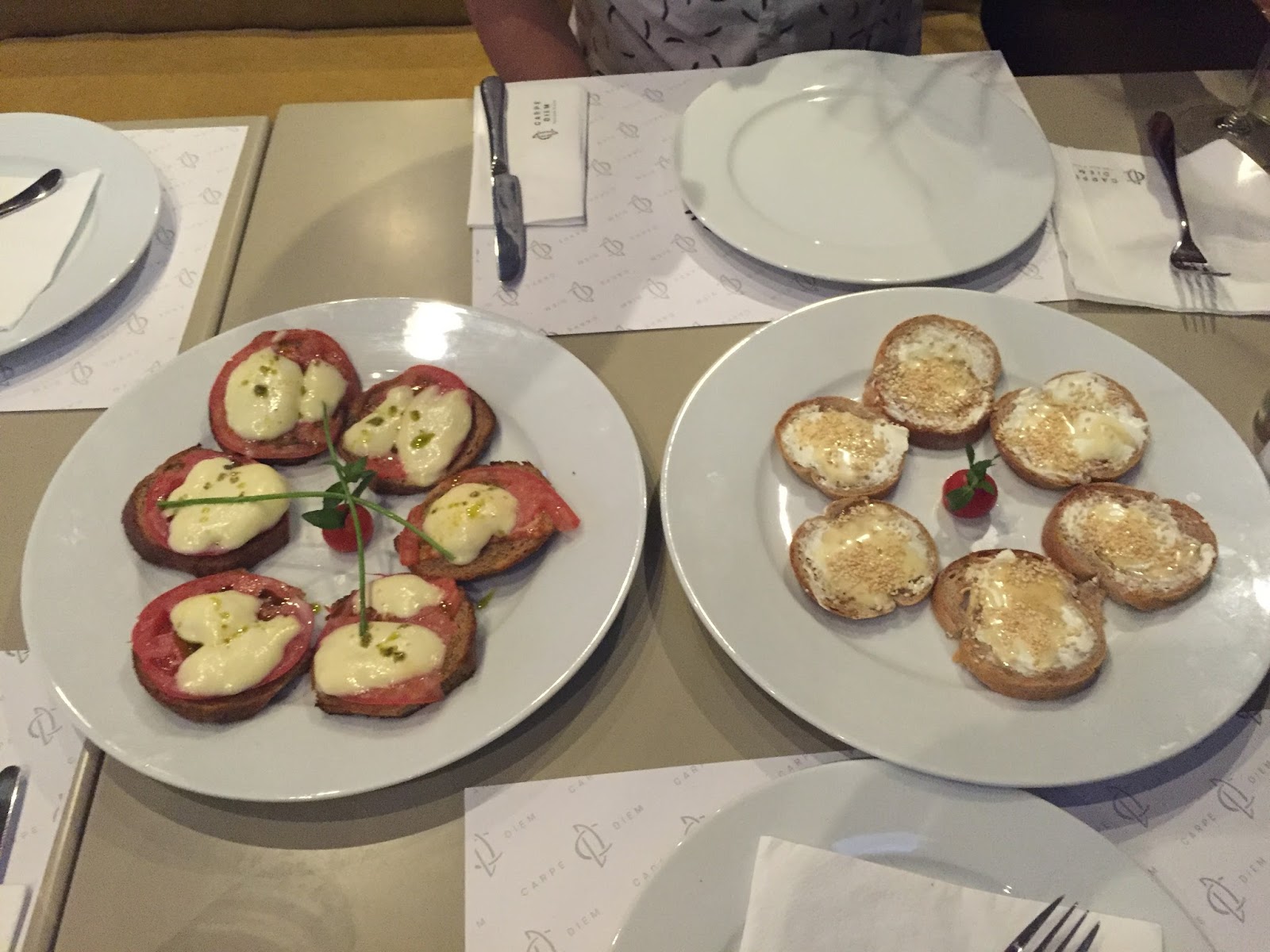
The sun was starting to lower in the sky, so that the larger buildings were providing much appreciated shade from the heat every so often. After a long and busy day, we returned to the apartment for a snooze and refresh. By around 9pm, we woke up, got showered and changed again, then sat on the balcony drinking some red wine, recanting our day thus far and plans for tomorrow, whilst simultaneously observing the hubbub below. The screaming lady returned once more. After draining much of the bottle, we had to remind ourselves that we were intending to go out, so we locked up and went down to the Square. Tonight we decided to go to one of the restaurants along the riverside. The bridge looked amazing lit up in the night, with the byzantine museum and theatre looming grandiosely behind. Again, the square was busy with families and couples. We walked by the restaurants, checking out their menus, until we decided on a place that looked quite classy called ‘Carpe Diem’. We sat in the canopied section outside, eager again to observe Skopjians going about their evening. We had a full, three-course meal (John may have skipped the dessert), and two bottles of Tikves Alexandria white wine. The total bill, with tip, came to around £20. Half of that was the wine! We finished off the second bottle slowly, before setting off for the café we visited earlier in the day.


The cul-de-sac looked a lot more sinister in the darkness, but as we ventured in our eyes adjusted to the darkness that was only lightly dusted with moonlight from up above. We crept in to the courtyard, half expecting the atmosphere to be a bit livelier for an evening, so were disappointed to see only a handful of patrons. We sat towards the main building at the back - in a corner and opposite another couple 10 feet away. Our order for beer spoken in English piqued the curiosity of the other patrons, but that soon abated. Over the course of two beers, we either discussed plans for the rest of the holiday or fell into a relaxed silence, observing others in the vicinity. By 1am we grew tired again, so paid our bill and departed back to the apartment.


Tuesday, 11 April 2017

Around the Balkans in 20 Days - Part 2

We awoke in a daze, not only because of our previous days in Berlin catching up with us, but to the new surroundings in Skopje. Air con whirring in the corner of the room and sunlight peering through the curtains, signified a new day in new accommodation. A refreshing shower preceded our flight down stairs on to the main square in search of breakfast.

We traversed the square to a series of cafes and selected one at random. Our hunger was satisfied with a light continental breakfast and coffee. Although it may seem that we were eager to return to homely comforts, we were in the perfect location from which to observe passersby and wake up more agreeably.  Spritzers emitted a cooling mist from the canopy intending to cool us patrons, however a slow breeze turned it away from John and I, leaving a tumbler of water the only option to cool down in the mid-morning heat.

We had an appointment with our hostess’ father to take us to the police station at eleven o’clock. So we strolled back to our apartment, all 90 seconds away, and paid him a visit.

The one thing to know about Skopje is that it is basically a massive village – everyone knows everyone. Our hostess’s father (let’s call him Mr Airbnb) took us on the “ten minute” walk up to the police station. We arrived twenty minutes later, his popularity evident by the peppering of greetings to passersby along our route. Despite his self-admitted poor English, Mr Airbnb succeeded in pointing out prominent buildings and monuments along our walk.

I have never been fond of the grotesque mutilation of the modernist buildings in Skopje’s city centre. On my first visit here, in 2009, the main square was a stoic blank plaza, with either the Kale Fortress or Millennium Cross as its only backdrop. Over the years as I have revisited, additions such as statues, new government buildings, and even galleons on the Vardar, have all increased the sense that Skopje has become what many have called ‘Disneyland’. Its main square littered with poor representations of selected historic figures, the disappointment being that Macedonia has a much more varied and diverse history than that which the Government wants to present to its people and the world. Yet the resistance to these buildings and monuments, and by extension to the Government pursuing the vanity project, was all the more evident in daylight as we walked on. An ironic symbol of the vast waste of money being spent appeared as we turned a corner, the revamped Ministry of Finance, itself now the victim of the ‘Colourful Revolution’.

We entered the local police station, and John’s nerves piqued as he saw the ‘No Guns’ sign on the glass entrance door.  Several burly Macedonian officers were speaking in raised voices to and over one another, between an office to our left and a reception cubicle to our right. Being in a police station is usually an uncomfortable experience, a sense that you have done something wrong sweeping over you.  Our only comfort was Mr Airbnb being our bridge between sightseer and illegal alien. He picked up two documents, and explained that we had to complete them. After a couple of minutes, we completed our papers and returned to the reception desk to hand them and our passports over to the officer at the desk. He inspected our passports, to check that our details on the documents were identical, and then recorded our stay in a logbook. Evidently, government money had not been spent on IT equipment to register visitors.  Once we received our passports and a small docket that we had to keep on us, we departed. And so, after our first experience registering our stay in a country, we thanked Mr Airbnb and ventured off back to the main square.

As noon approached, I decided that we should do a little exploring. As the day was slightly overcast, we could spend a little longer outdoors than what we could if we had the sun and heat bearing down on us. We aimed for the Old Bazaar, having first to pass through a vanguard of kitsch neo-classical buildings on the rivers left bank, there seemingly to thwart curious visitors from proceeding any further.  The insinuation being that Macedonia was Macedonian, and its history had to reflect that. We carried on regardless, to discover another present and past that hid behind them.


The architecture of the Old Bazaar could not be more different to the modernist buildings occupying the right side of the river.  Faint yellow, single and double tier buildings, lined stone slab streets. Their terracotta roofs hinting towards their near Mediterranean location, yet the overall feel of the neighbourhood was primarily echoing its Ottoman lineage. Weaving narrow streets branched out uphill to our left, or onwards towards the main market space. Shopkeepers were making the most of the dry weather, sitting outside their cosy shops, almost as advertisements for the shops themselves rather than the wares contained within. After rambling along the main thoroughfare, we were met by the bustling general market. Located on a narrow strip of land, between the main road heading north into the Skopje suburbs, and the old town, the market was a hive of activity.


This was the heart of the predominantly Albanian part of town. Many of the stalls sold trinkets with the Albanian national flag, mirroring those flown on nearby buildings. The switch from Macedonian Cyrillic to Albanian Latin script in only a few hundred yards was keenly felt, though not altogether unfamiliar for an English speaker. Groups of older men sat with Turkish coffee and played dominos, whilst mothers and children nosed at the offerings on food stalls or those selling household items. It reminded me of my childhood in Wrexham.  Not the coffee and dominos.

We turned back on ourselves, and instantly took a right turn to begin walking up the hill. I knew that ahead of us was the one experimental modernist building in the neighbourhood – the Museum of Macedonia. I was aware of how empty the exhibition was from a previous visit, but the grounds of the museum contained an Ottoman building that I was curious to see.  As we turned a corner, we entered the concrete stone plaza that gradually rose to the museum further up the hill. We veered right to investigate the rundown Ottoman structure. Kurshumli An was an old caravanserai, or what we would call an inn. Although not open for us to have a look around, we studied the architectural style - rather byzantine in look, with the use of slim terracotta bricks. A hidden gem juxtaposed next to its modernist neighbour.  A group of 5 or so children played football on the weed-strewn plaza, indifferent to us whilst we took pictures. The marvel of these two buildings, and that they were not looked after, brought home the extent to which the governments – both city and national – fail to grasp the potential for tourism with the existing historical buildings and monuments. But a part of me also felt that it was an adventure was to seek them out, and an onslaught of tourists would begin to tarnish their untouched grandeur.


And so onwards we went, scaling the hill still further. After passing yet another small group of domino players in this quieter area, we saw one of the neighbourhood’s larger mosques peaking out above buildings ahead of us.  And this was the moment we were caught off guard. A smaller mosque we were walking past sounded up its tannoy to deliver the mid afternoon call to prayer. Then the main mosque ahead of us, evidently with a greater number of tannoys producing a roaring loudness, competed with the smaller mosque for attention. Then in the distance two or three more calls to prayer erupted.  Although I had experienced the call to prayer here previously, for John this was his first ever experience. An immediate fear – had we trespassed on to someone’s land, or was some other trouble imminent - immediately turned into marvel at the spectacle around us.  


As the calls receded, we continued our climb around past the main mosque, and up towards the Museum of Modern Art. From its grounds we had spectacular views of the city below and beyond. The Philip II stadium dominated the foreground to the south west, the river snaking around it towards us, and then swerving to pass us below. Southward, over and above the city, the Millennium Cross emphasised the Orthodox Christian population residing on the right bank of the Vardar. We descended the hill via the Kale Fortress. This was the first time I had managed to explore its grounds, blocked on my previous visits by ongoing excavations. The grounds contained very few standing structures, those being a number of guard towers on the perimeter facing the city. Aside from the walls of the fortress, the only things of note were the vaults that had been uncovered that resembled mere stone trenches.  We did a return trip along the fortress wall, gauging the drop from its ledge to the ground outside and pointing out possible past entrances Ottoman soldiers may have used.


The sun was starting the break through the overcast sky as we returned back to the city via the Stone Bridge. But I, with the strange copious amounts of energy I tend to have, was eager to point out further sights from my past visits. A burning desire to ‘show off’ Skopje came over me. John knew he had to keep up regardless. We followed the river towards the City Park to gaze upon the monument marking the Partisan take over of Skopje in 1944, in the grounds of the government building. Unhappy bedfellows I am sure. We toured the block that would lead us back in to the city, passing dated air con-pocked residential tower blocks resting next to the byzantine looking Cathedral of St Clement of Ohrid. Avoiding a return to the square, we turned south towards the City of Skopje Museum. This is housed in the former Skopje Railway Station. Only a third of the modernist 1920s building remains, but the simplistic clock still points to the time the devastating 1963 earthquake struck. The reason for a lot of the brutalist 1960s architecture rose out of the ashes of this disaster, mostly as gifts from an array foreign capital cities and countries. A nod to Yugoslavia’s then widely regarded non-aligned status.


A natural finish to the busy day led us next door to Ramstore Mall. I knew of a cheap supermarket in the basement where we could grab basics for breakfast and lunch. We did a shop to last us our stay, and strolled back to our apartment. Needless to say, by 5pm we had knackered ourselves into an afternoon nap. Air con naturally on.

Around mid evening time we woke up, just as the sun was beginning to set on the city. Our apartment came with a narrow balcony that overlooked the square, so we sat on the two campstools that were there to take in the transition to twilight. At the supermarket I was keen to get my hands on some wine from the Tikves region. M&S had only recently begun to stock it at £8 a bottle back home. Here, it was £3.50 for the priciest. I bought one to take back home with me, and another to enjoy now, as we soaked up the views from up on high. In the summer heat of Skopje, a glass or two of red from the region eased me into the relaxing evening that lay ahead.


Once refreshed and dressed, we went down to the busy square and were seated on an outside table at Pelister. An easy first choice for us to eat at, for it has an eclectic mix of local and pan European food to satisfy our tastes at reasonable prices. We could also people watch – our favourite pastime – as couples and families strolled around Alexander the Great and his horses. After devouring my risotto, washed down with a local crisp white, we departed the restaurant and walked along the riverside embankment strewn with cafes and bars where we earlier had breakfast. You had two sections to each bar; the main bar that protruded from the brutalist shopping mall, and across a pathway from it an outdoor part with seating, fans and TV screens. Beyond that, another pathway and then the river. We chose a particularly rowdy bar, unsure whether the night may develop into a club or party. Two strong vodka cokes, on par with Spanish resort levels, arrived at our table, so that we finished our busy first full day in Skopje sat outside taking in the mildly chaotic nightlife that Wednesday offered us.


Wednesday, 4 January 2017

Around the Balkans in 20 Days - Part 1


Berlin Schönefeld had just recently opened one of the newest Wizz Air routes, connecting the German capital with the capital of the Republic of Macedonia – Skopje. We departed the few remaining friends, gathered for a short weekend of renowned Berlin nightlife, to depart on our own trip to the states that once made up the central and eastern republics of the Socialist Federal Republic of Yugoslavia.

A short two-hour trip, on our budget yet comfy flight, saw me return to the city on the Vardar for my fourth time. For John, stepping out of arrivals at Alexander the Great Airport was his first visit to any territory once under the rule of Josip Broz Tito. I can only imagine that my feelings of familiarity were equally matched by John’s feelings of intrigue and wonder for the twenty days ahead.

Yet, as we met the hostess and her father for our Airbnb apartment, we soon changed tack as to whether we would arrive in the city centre at all. A well intended instruction of not needing to use our seat belts as we got into the car, feeling obliged to indulge in local practice, soon turned into stomach tightening regret. We awkwardly gripped on to the handrail as we zigzagged between lanes of the motorway whilst hurtling towards the city centre at 100km per hour.

Thankfully, reduced speed limit signs as we entered the city limits seemed to have an effect, slowing down the driving and making it seem less erratic. As we approached the city from the east, the Millennium Cross began to emerge, and turn towards us as we arched around the mountain upon which it was perched. The orange glow of the city soon came into competition with it, distracting us from our friendly chat with our hostess. We covered the usual – what we did for work (us, politics and charity; her, actuary), what brought us here (visiting the region, I mentioned my multiple visits that took us on a tangent), how she learned such good English (TV and school), and where was good to visit. The latter was more to confirm that the research I undertook could be confirmed as fair to explore by a local. A winery, Matkasee, the Millennium Cross, and the Kale Fortress were all met with our hostess’s approval, including directions on how best to get to them.

Once the Kale Fortress appeared to our right, a hundred or so meters above us lit up like a 1920’s cabaret stage, I knew exactly where we were and began to calculate the route that our hosts would take us to the apartment. Although approaching almost midnight, evidence of the summer’s demonstrations against the VMRO-DPMNE Government could be seen. The ‘Colourful Revolution’ saw protesters attack the newly constructed facades of state and other prominent buildings and monuments with a palette of paint worthy of Kandinsky. While I was explaining these events to John, our hostess proudly informed us that her building was one of the few in the centre not to have its façade so appallingly done up to the ‘Neo-Classical’ style now de rigueur thanks to ‘Skopje 2014’. No doubt my ‘tour guide’ act was already becoming tiresome to John. It was past midnight. John must have been thinking “Only 19 days to go!”

We pulled into a triangular courtyard off one of the side streets that leads to Macedonia Square. We collected our stuff, headed out on to the main Macedonia Street, and were met with rows of waited tables bursting in to the street from the abundance of cafes, all pumping out pop music. The cooking of corn on a makeshift barbecue along with the smell of cigarette smoke lingering in the still of the night, both lent themselves to my first noticing the enveloping heat that the evening still possessed. Romance was lost however, when a lone pensioner began wailing on a nearby bench. Over the course of our stay, we would hear her a couple of times, even at this hour, howling without interruption from residents or passersby.

We made our way up to the 6th and top floor of the apartment block, the entrance to which was opposite the wailing lady, and entered through the door to the left. Our studio apartment was ideal for the two of us, but the balcony that overlooked Macedonia Square was its USP. Once our hostess made arrangements for our morning visit to the police station to record our visit, we unpacked essentials for the morning, turned on the air con, and called it a night.


Wednesday, 21 December 2016

LGBTI Rights, Social Democracy and South East Europe


The coming together of three of my passions – The Labour Party, LGBTI rights, and the countries of South East Europe. This conference/workshop was a follow up from one held in Belgrade last year. Initiated by the European Forum for Democracy and Solidarity, and hosted by the Labour Party through the Westminster Foundation for Democracy; this session sought to provide practical aims and objectives for delegates, from the social democratic sister parties of the region, to pursue further LGBTI rights.

To put LGBTI rights in context of the countries of South East Europe, one only needs to look at ILGA Europe’s ‘Rainbow Europe Map’. The range amongst all the countries of the former Yugoslavia sees Croatia place 10th and Macedonia 39th out of the 49 countries of Europe. And this is solely on legislative terms. The attitude of society towards LGBTI people is overwhelmingly negative, and is hardening.

So the objectives for the conference delegates – representing Bosnia & Hercegovina, Croatia, Macedonia, Montenegro, Serbia, Slovenia and Vojvodina; as well as leads on LGBTI groups from Sweden and the Netherlands – were threefold.

First, the delegates had to contextualize the struggle for LGBTI rights. This came from speaking about their experience of furthering LGBTI rights both in society and within the party, the uneven passing of LGBTI legislation across the countries in the region and its relation to EU accession, and learning from the experiences of LGBTI social democratic groups in Sweden, the Netherlands and the UK.

Second, the delegates had to analyse and evaluate the successes and failures of integrating LGBTI rights into their social democratic parties. Here, breaking into three groups helped each group focus on one or two countries at a time, but allowing the entire delegation to pick out differences and similarities during the roundup at the end.

Third, the delegates had to then draw together an action plan for them to take practical steps to further LGBTI rights.

Throughout the conference, many shared observations were made. One of the agents of change in advancing LGBTI rights that was mentioned was the EU. Delegates commented that the EU guided the hand of Governments into passing legislation, even if only as a ‘box ticking’ exercise. Governments could easily ‘blame’ the EU on the need to pass these changes in order to achieve the overarching objective to join the EU. However, these changes have not yet acted as an agent of change in society.

Another observation was that the party leadership’s seemed to be positive towards the LGBTI community in most countries, but it was the middling and lower ranking membership of those parties that had a problem of accepting LGBTI rights. However, it was pointed out that future leaders and representatives of the parties were where delegates could exert pressure to further LGBTI rights, both in the culture of the party and future party policy. The youth sections were agreed as a starting point to entrench political education on LGBTI rights and increase activism.

And so it followed that many delegates agreed there seemed to be no comprehension amongst party members or some leaders as to how or why LGBTI rights were central to the values of social democracy. This turned into a debate on the meaning of social democracy, which the delegates would take back to their parties.

The lack of leaders, local and national, to either come out as LGBTI or be pro-LGBTI was a constant weakness most delegates raised, especially from Macedonia. Lack of visibility meant there was a lack of seriousness to accept the LGBTI agenda, as it is seen as an electoral negative rather than a potential electoral positive. Those contributors not from the region emphasised the parallel processes of greater visibility meaning greater social acceptance – and hence less electoral disadvantage.

The conference ended after delegates from each country agreed to small, achievable steps to take. These included arranging a meeting with the leader of their party, asking for a safe space in Headquarters for LGBTI members to meet, asking for an email to go out to all party members to make them aware of the existence of an LGBTI party group, setting up a Facebook group, and looking towards future local government elections to develop cost-free pro-LGBTI policies.


The success of this conference will be seen in the actions that these individual delegates take. As I said in my remarks at the start of one of the sessions, they are the founders of the LGBTI rights movements in their parties, and through those they will change laws and societies, and continue the march towards LGBTI equality. A heavy burden for them to shoulder, but one this conference motivated them to lead.

Wednesday, 12 October 2016

Independence, the ‘Transition’ and the Road to Ohrid (2/5)

The communist period had no bearing on the wider discussion on social democracy in its development or present state, other than on the impact of communist legacies from this period, which is highly relevant and will be pursued. Avoiding to address the causes of the collapse of communism, as this event was in no way influenced by social democracy, allows us to look at this as an historical fact in its influence upon social democracy, in that the League of Communists transformed into the later named Social Democratic Union of Macedonia and so social democracy could have parliamentary expression. 


Kiro Gligorov - First President of the Republic of Macedonia

Enter Democracy

Karen Dawisha and Bruce Parrott see that ‘democracy is a political system in which the formal and actual leaders of the government are chosen within regular intervals through elections based on a comprehensive adult franchise with equally weighted voting, multiple candidacies, secret balloting, and other procedures, such as freedom of the press and assembly, that ensure real opportunities for electoral competition.’ However, from this come many variables as to the practice of democracy, not just in Macedonia, but the world over. Further to this, these practices will, and often do, change over time. Hence there is a need to avoid applying non-communist democratization processes to post-communist states, as their experiences are starkly different. Dawisha and Parrott note these variables include the international discourse relating to democratization at the time, whether a state exists or needs to be created, the homogeneity of the population, the extent of political participation, the nature of the party and electoral systems, the legacies of communist elites in the new era, the functioning of political society and culture, and economic liberalization. However, for democracy to function an awareness of, and adherence to, the rules of the game is needed; a major component of this is the ability to accept defeat (Ghia Nodia). Yet, independence is linked to democracy via nationalism according to Ghia Nodia: ‘Whether we like it or not, nationalism is the historical force that has provided the political units for democratic government.’ Thus independence, even if only covering part of the Macedonian nation, fulfilled the political goal of nationalism, and thus provided a space for democracy to function. Nationalism has been said to be able to either unite or divide a country, but a state that has to cater for a sizeable ‘other’ nation within its borders creates problems in the configuring of that state.

A State for the Nation?

During the transition to multi-party elections a debate on how to define the constitution of the new independent Republic of Macedonia emerged. The choice was simple; either an ethnic state for the Macedonian nation, which nationalists wanted and even sought to extend its boundaries to their brethren in Greece and Bulgaria, or a push for a civic state of individual citizens. The balance was between group rights and individual rights, but fundamentally it was about inclusion and exclusion. President Gligorov had to balance the demands of nationalists on both sides of the ethnic divide who thought in group terms. However, the result didn’t appease either side and highlights the downside to democracy. Donald Horowitz states that ‘The problems of inclusion and exclusion do not disappear when new institutions are being adopted and put into operation. At these points, conceptions of the scope of the political community will limit the participation of some groups in the institutions of the new regime.’ Therefore the ethnic divide that derived from nation building prior to independence, acted as the cleavage with which to include and exclude people using citizenship, when debating the relationship between the state and the nation(s) in the constitution during democratization. 

However, ethnic conflict was avoided, unlike elsewhere in the former Yugoslavia. A model for explaining this from Gojko Vuckovic involves two dichotomies, the first are ethnic violence and ethnic accommodation, and the second are whether integration or disintegration results. The alignment of certain variables place states, at different times, within this matrix. Macedonia during the transition managed to resist ethnic violence and disintegration by functioning within a multiethnic state system through bargaining between the groups. Given that democracy is in essence competition, the management of these divisions expressed during competition is necessary in an ethnically divided society.

Development of the Electoral and Party Systems

The role of the electoral and party systems, which are interlinked, initially helped eased tensions because this is where groups or individuals engage in the democratic process. Yet set in an ethnic frame, these became institutionalized and thus hard to change in the future. The electoral system after independence elected officials via a two round system, it then moved to a mixed one with elements of proportional representation, to one of full proportional representation for the 2000 elections (Peter Emerson and Jakub Sedo). Although democratic in theory, the definition of democracy, as previously illustrated, was open to interpretation. The setting of constituency boundaries is one mechanism by which ethnic divisions and exclusion can be fostered, either by grouping ethnicities separately or by demographically engineering a mono-ethnic victory in a mixed area (Horowitz). Given the minority status of the Albanians, numbering 25.1% of the population in 2001, they could never achieve power at the national level alone. So it became an unspoken rule, then codified in 2001, that the winning ethnic Macedonian party would include Albanians in the coalition. However, this is assuming that ethnic groups vote for ethnic parties, which sadly was the case in the 1990s and beyond. There remains an element of ideological difference between the two dominant ethnic Macedonian parties, yet all parties were more or less led by identifiable leaders of an ethnic type. In summary, Lenard Cohen and John Lampe state ‘Questions of party ideology or socioeconomic cleavages between the two largest ethnic Macedonian parties have been less important. There has been considerable partisan identification by adherents within the two parties, and a low rate of voter movement between the two organizations.’

So what we have are two mutually supportive processes whereby an ethnically divided party system is supported by a proportionally representative electoral system that reifies ethnic difference and exclusion, which gradually come to institutionalize ethnic politics in the state. This consociational form of government, as detailed by Arend Lijphart, may not provide majority rule but it ultimately provides stability, and that is its purpose. This stability rests on the attitudes of the political elites along with the type of political culture and extant subsystem autonomy in action. Pessimistically, this insinuates that a move to an ideologically based party politics will be difficult because of this institutionalization. This I will approach further on. However, debates on minorities in the party systems have failed to address minorities within dominant parties in multi-ethnic societies.

The Conflict over Macedonia™ 

Since independence, disputes over the unique identity of ethnic Macedonians have fed both internal ethnic divisions and external foreign relations, leading to a test of the country’s stability. The perceived threats were to the cultural, historical and ethnic nature of Macedonian identity and thus seen as a threat to the security of the state itself.

Ulf Brunnbauer’s polemic on historiography in Macedonia argues that during socialism, the task of creating the Macedonian nation was ongoing, yet after socialism’s collapse it actually intensified. He believes that this is because there was a need to provide continuity, in the economy and administration, which included the sciences. The creation of myths aided by historians could not go against this continual nation building, so it progressed. But its foundations were in the very period mentioned earlier, immediately after the Second World War. So Brunnbauer argues that in the 1990s ‘Any Macedonian national narrative that wanted to present the events on the territory of “Macedonia” as Macedonian national history was bound to come into conflict with these older historiographies.’ Greece was the main threat to Macedonian nationhood. The disputes ranged from what the independent state should be called and the design of the flag, to the more recent claim to Alexander the Great in order to trace the history of present day Macedonians to ‘ancient Macedon’. From the Greek perspective, this highlighted Macedonian expansionist intent for northern Greece. According to Loring Danforth, underlying impacts such the suspension of economic relations by Greece in 1994, international recognition of the republic, and the situation of Macedonians outside its borders all added to Macedonia’s problems stemming from its identity crisis. Ultimately ‘the Macedonian Question is a symbolic conflict that centers on the construction (or production) of conflicting ethnocentric national narratives.’ (Roudometof). This links to Hobsbawm and Ranger’s thesis on the invention of traditions, and is built upon the definition of where Macedonia is and the historical origins of the nation, which I tackled in the previous chapter. 

An important point to note is that by the time of independence, everyone under forty five years of age had been born within this Macedonian national culture. So, irrespective of claims to the ‘creation’ of Macedonians, this is what people were socialized into, how they understood their history, and went about ‘existing’ as a nation with a state in the 1990s and beyond.

Ethnic Division and the Pull of Nationalism

As the 1990’s came to a close, along with the symbolic contest with Greece, ethnic tensions within Macedonia began to increase. During this period, UNPROFOR then UNPREDEP was in the country providing stability and peace at the request of the President. However, their departure in 1999 along with the humanitarian crisis in Kosovo led to a renewed politicization of the ethnic Albanians domestically. The binary of inclusion and exclusion were in evidence during this period and reflective in the processes and discourses previously outlined. Strikingly leaders didn’t want independence or incorporation into Albania. Instead they grew tired of the political system that had not answered their calls for Albanian rights. These issues included language and education rights, one important example being the request for a university in Tetovo taught in the Albanian language. The failure of the system, the political parties as actors within this system, and of events outlined, altered the variables that kept the peace, which led to a challenge to the state’s stability. ‘Feelings of insecurity and lingering threat perceptions also contributed to the Macedonian majority’s reluctance to respond favorably to Albanian demands for expanded rights in the areas of education, language and state employment.’ (Jenny Engström). The incompatibility of Albanian nationalist demands with that of Macedonian nationalism present in the state, as well as the feeling of inclusion and exclusion from the state and access to power, led to a security dilemma and conflict (Thomas Hylland Eriksen). The unrest was situated in the Albanian areas, and the guerilla forces were clashing with Macedonian state forces. A political solution was fashioned and agreed by the two ethnic Macedonian parties and two ethnic Albanian parties at the time in 2001. The deal fulfilled the demands sought by Albanians the previous decade involved in the parliamentary process, but had now been accepted after violent conflict, and resulted in the National Liberation Army leader, Ali Ahmeti, entering the formal political system. But of importance was the fact that the state remained intact and the decentralization of power was agreed as a solution to end perceived ethnic oppression. However, ‘the decentralization model in Macedonia did little to de-ethnicize political loyalties or transcend intergroup conflicts…’ (Cohen and Lampe)

During this period a political culture developed, but one that may not have been suited to the changing situations in the country. A delicate balance of factors and pressures meant that although nationalist sentiments could be observed in the politics of the country, ethnic conflict was avoided for a considerable period. It was when the equilibrium between these factors altered that led to conflict.

Tuesday, 12 July 2016

Thoughts on The Death Of Yugoslavia by Laura Silber and Allan Little


My reading of this text, in a way, ‘bookends’ my knowledge and study of South East Europe. It was my original viewing of the series The Death of Yugoslavia that drew my attention to the region two decades ago. So in this book I was seeking to find a deeper portrayal of events by the authors.

This text does not seek a theoretical understanding of the conflict, and it only fleetingly calls upon historical or anthropological perspectives on why events may have unfolded as they did. This is rather different to the TV show, whose audience included those not familiar in the history of the region, so could have led one to believe that their analysis of events was the classic ‘ancient hatreds’ paradigm. The start of the book clearly indicates this as not being so. Instead, the book walks the reader through a series of key events that the authors see as being essential to fueling the subsequent wars and ethnic cleansing.

Echoing the same timeline as the TV show, you get further insight to some of the events and key players in the drama that was taking place in the 1980s and 1990s. It cleverly portrays the balance between the agency of individuals and those of institutions, which led to the Yugoslav state’s collapse. 

Symbolic individuals are familiar; Milosevic, Tudjman, Izetbegovic, Kucan – all heads of the republics/states they sought, and eventually came, to control. However, the spotlight also moves onto other individuals who were aggressors, and even those trying to calm the rising ethnic tensions. Borisav Jovic was Milosevic’s right hand man. Holding various functions at the Serbian and Federal level, Jovic was one of the key disciples of Milosevic’s attempts initially to centralize power in the Yugoslav state, then into the goal of uniting all Serbs. Milan Babic and Milan Martic are two individuals in Knin who took on the Serb Nationalist mantle once independence was sought by Croatia. What began as the Croatian states’ attempts to impose law and order, soon escalated to Serbian defense of their villages and towns, drawing battle lines in the process.  The Croat Josip Reihl-Kir, regional police chief in eastern Croatia, continuously tried to halt small skirmishes between Serb militia and Croat police from developing into a civil war, all the while facing pressure from above in the form of the hawkish HDZ officials.

Aside from individuals, the portrayal of institutions and forces as agents in the descent to state collapse and war are superbly woven into the story. As mentioned, the contest between centrifugal and centripetal forces for power in the Yugoslav state began in earnest once Tito died; although under him they had precedent. The multi-member presidency effectively reified the implication that republics were now the keepers of their resident nations, with a couple of notable and dangerous exceptions to that logic. Economic decline and social strife fuelled this polarized debate – symbolized by the western republics of one side, and the eastern on the other, or richer versus the poorer states. However two institutions kept them together, the League of Communists and the Yugoslav Peoples Army (JNA). ‘Brotherhood and Unity’ was still the central plank to their worldview. Any violation to the sovereignty and territoriality of Yugoslavia was verboten. It was the former that was to go first.

At the seminal, and what was to be the final, conference of the League of Communists in January 1990 (I have covered this in a past blog piece), it was Kucan as head of the Slovene delegation that led the walkout that saw the end of the League of Communists.  The centripetal forces had won. The JNA on the other hand clung on, even after the loss of Slovenia and Croatia. However, by that time, its Serb contingent moved from working under the JNA banner in Croatia then Bosnia to local Serb units. The detail of the movements on the ground are vividly portrayed, with lines of communication – either between Croatian Police forces and the leadership in Zagreb, or the Serb militias and the ‘Yugoslav’ leadership in Belgrade – explained concisely.

Further on, the details of the war and sieges on the ground, and the pathetic response by world community, is despairing. Hindsight only makes you question why the EC and UN did not do more. Initially wanting to keep Yugoslavia intact, splits developed in the international community that led to different directions and approaches on how to stop conflict emerging. Within Yugoslavia, the tussle of whether 'self-determination' should be exclusive to the republics or the nations fed into the splits in the international community. The price paid was ethnic cleansing.


What gives this book its power is the knowledge garnered from the active participants. Although written in 1996, and with the participants possibly not giving a full and frank account, the authors weaved a compelling account from numerous actors and actions of institutions, to describe the events and processes that took hold of the former Yugoslavia from the early 1980s. How it slowly describes the ethnic untangling of peoples is a daunting prospect for us in communities that are ever becoming more multi cultural. However, the book doesn’t give, nor does it need to, an account of how to stop this. Instead this book is more a warning, a warning to those who seek political power by manipulating institutions, individuals and the masses, through tools of fear and hatred, in order to put into practice a narrow nationalist agenda.